
RolloutIQ™ vs Procore
The Retail Rollout Alternative to Procore
Procore is built for general construction, and it is powerful at it. It now sells portfolio tools to owners as well. A retail rollout is a different program, though: 50 to 500 stores opening on their dates, each one a location with its brand, region, and remodel history. RolloutIQ™ is built around that program, from the first planned store to its opening.
The Challenge
Where Procore Fits a Retail Program Less Well
Procore is a deep construction platform with a public API, a large partner ecosystem, and a growing set of owner tools. For a retail rollout team, the gaps sit in the store model and in the shape of the license.
Owner Portfolio Tools, Without a Store Model
Procore now gives owners a company-level project map and, since mid-2026, Owners Hub and Portfolio Monitoring. Those roll up construction projects. We found no retail location register with a lifecycle status, and no store record that carries from a planned site through remodels and relocations.
Volume-Based Pricing Built for Contractors
Procore prices on Annual Construction Volume, the dollar value of the work running through the platform, with unlimited users. A retail owner running hundreds of small projects pays on a model designed around contractor volume.
No Retail Solution to Start From
Procore publishes no retail solution page. A retail team sets up its own store milestones on top of a general construction product.
Depth Built for Construction Professionals
A retail store development team uses a fraction of the depth Procore builds for construction professionals.
Comparison
Feature Comparison: RolloutIQ™ vs Procore
See how RolloutIQ™ compares to Procore across the features that matter most to multisite retail operators.
Purpose-built for retail rollouts
RolloutIQ™
Procore
Multi-site portfolio dashboard
RolloutIQ™
Procore
Canonical location register with lifecycle status
RolloutIQ™
Procore
Real estate kept separate from the construction project
RolloutIQ™
Procore
Store development lifecycle tracking
RolloutIQ™
Procore
Brand as a portfolio field with brand-scoped approvals
RolloutIQ™
Procore
MCP server for your own AI assistant
RolloutIQ™
Procore
Native mobile field apps
RolloutIQ™
Procore
Tenant-isolated database architecture
RolloutIQ™
Procore
What this page says about Procore was last checked against its public materials in September 2026. Products change, so check with Procore for its current capabilities.
See sourcesHide sources
- Procore, Pricing (2026)
- Procore, Portfolio Management and Capital Planning for owners (June 2026)
- Procore Support, Company-level Portfolio tool
- Procore, Owners (2026)
- Procore Developers, API introduction
- Procore Developers, Agentic APIs (2026)
See It in Action
What RolloutIQ™ Brings to the Table
Real screens from RolloutIQ™, not a feature list. The capabilities that set it apart from Procore for multi-site retail rollouts.
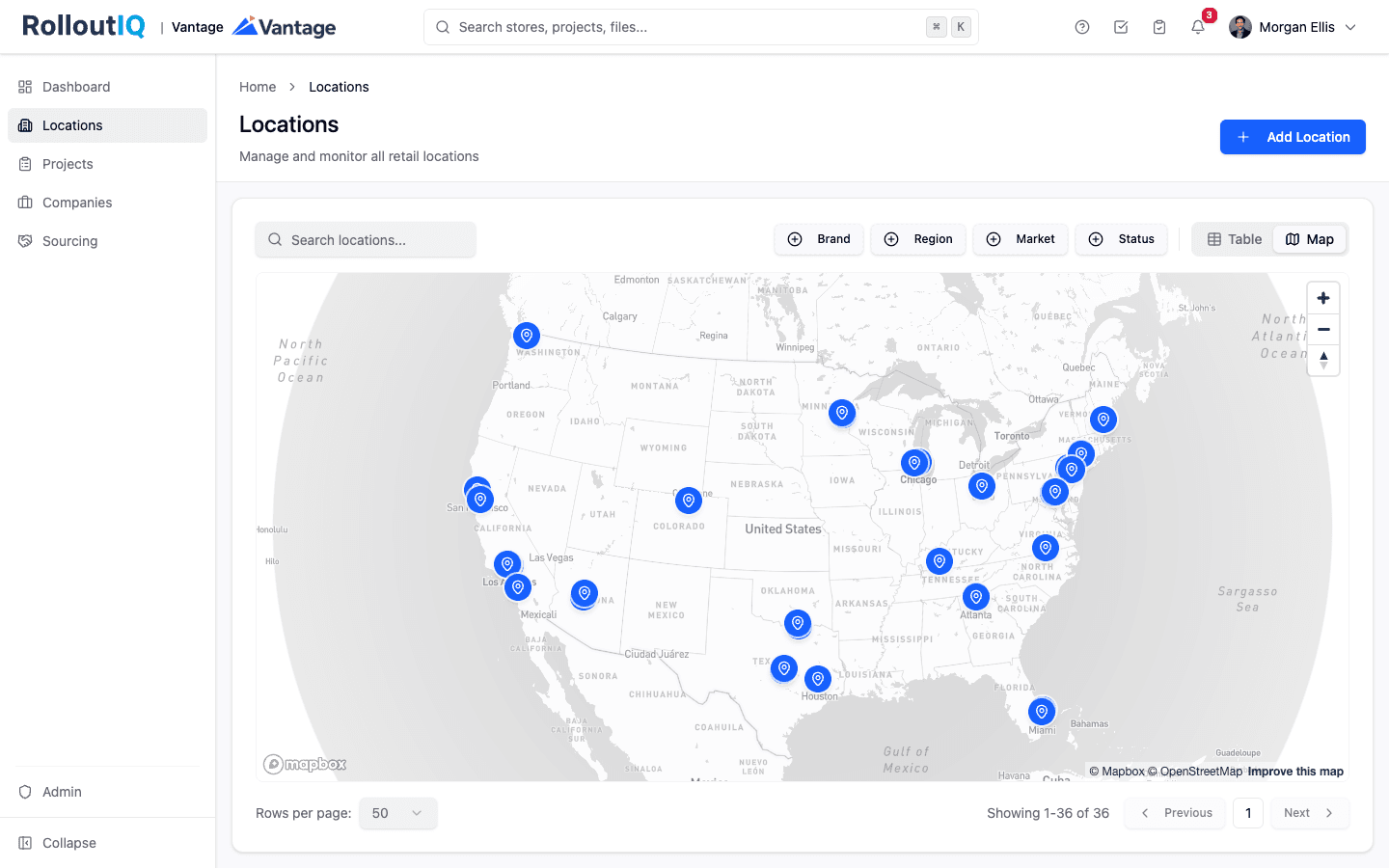
See Every Store in One Place
Every location and its projects on one portfolio view instead of 30 browser tabs: which stores are still in planning and which are slipping against a Q3 open.
- Portfolio map and list across every location
- Schedule health rolled up by brand, region, and market
- Drill from the portfolio into any single store
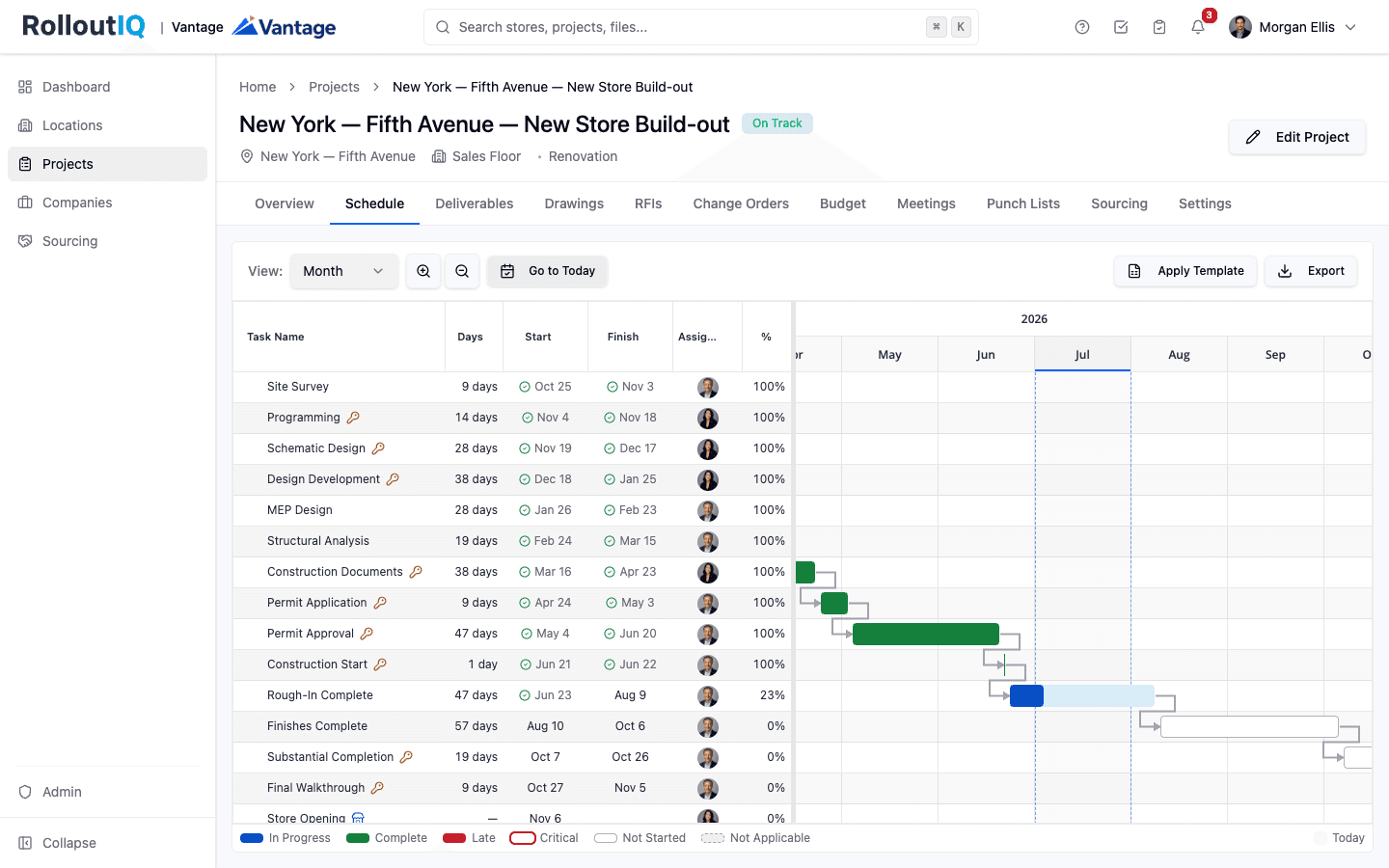
A Schedule That Recalculates When Reality Changes
A real critical-path schedule with dependency math. Move one deliverable and RolloutIQ™ ripples the change through the timeline, so the new opening date shows up the moment you save.
- Critical-path dependencies with lag
- Ripple recalculation, with a preview of critical dates that move
- Phase and deliverable milestones per project
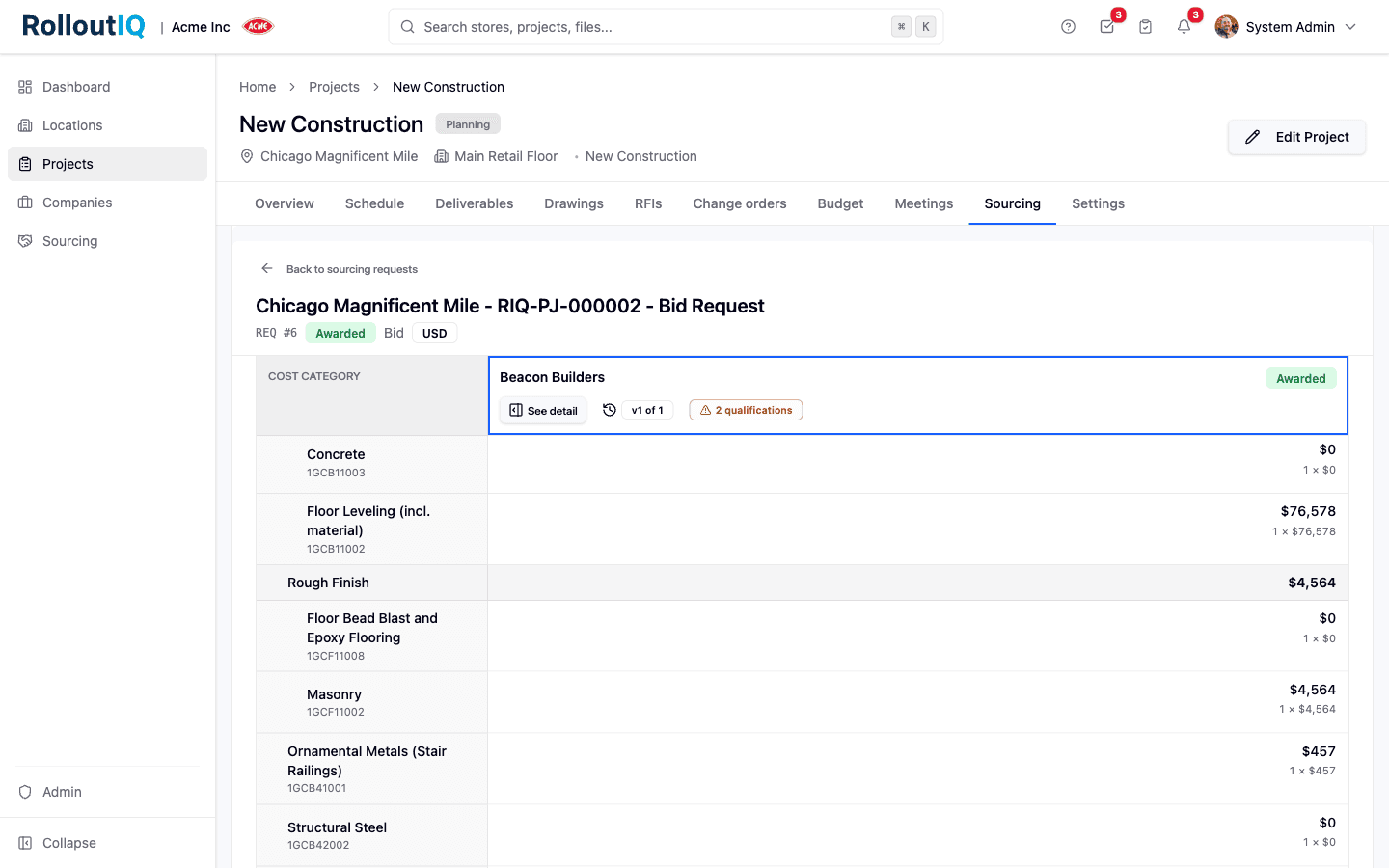
Compare Every Bid Side by Side
Send one pricing form to every bidder, then line their numbers up in a leveling matrix against the same cost categories. Award with a governed decision that flows straight into the budget.
- Sealed competitive bidding
- Side-by-side leveling matrix
- Awards feed the project budget
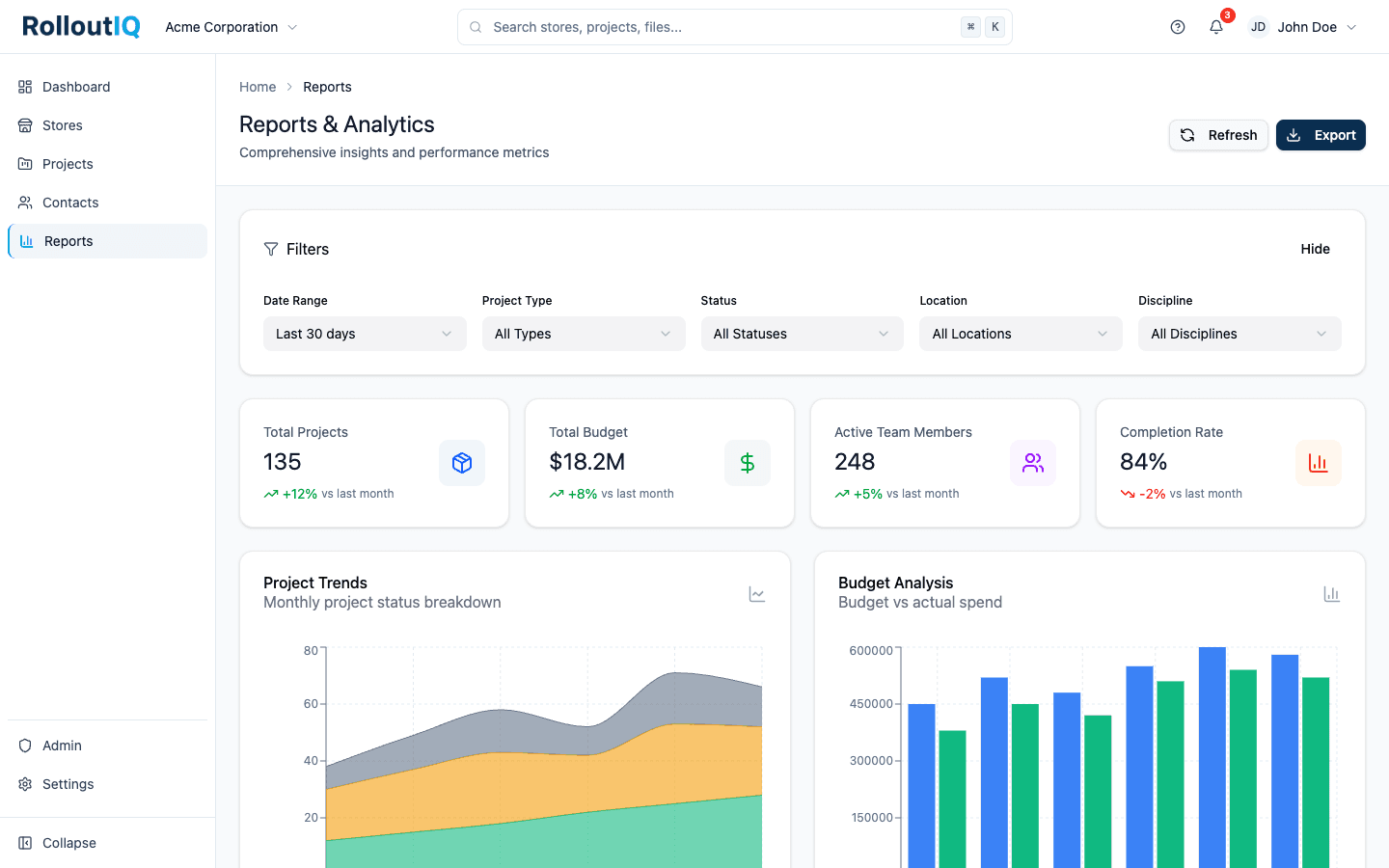
Portfolio Reporting Built for Leadership
Four tabs of portfolio reports show which projects are on track, which need attention, and which are at risk, with a CSV of any section or a board-ready PDF of any tab.
- Portfolio reports with CSV and PDF export
- On track, needs attention, and at risk at a glance
- Daily trend capture across every store
Use Cases
Built for How Retail Teams Work
Multi-Unit Rollout Programs
Manage your whole store pipeline in one view. Track every location from a planned site through grand opening, with the phases and milestones you define in your own templates.
Governed Budgets at Portfolio Scale
Lock each project's budget with an approval and change it only through routed, fully versioned revisions, with contingency drawn tracked across every store.
Brand Standards on Every Walk
Punch walk templates carry pass or fail criteria for fixtures, signage, and finishes, so every location is checked against the same standard before handoff.
A Retail Data Model From Day One
Locations, spaces, and projects arrive as the data model, with brand, region, and market on every store. Your playbook becomes reusable schedule templates your admins build once.
FAQ
RolloutIQ™ vs Procore: common questions
Procore publishes a public REST API and developer portal, so project data can be extracted during a switch. RolloutIQ's team loads your store portfolio as part of onboarding, since there is no self-serve importer for a whole portfolio.
Procore ships its own agents, including Agent Builder and Agent Studio. Its Agentic APIs, built on Datagrid, are open only to approved design partners in a pilot, and Procore had published no MCP server for customers as of September 2026. With RolloutIQ, the assistant your team already uses reads project data through a read-only MCP server, under each person's permissions.
Brand is a field on every location, and approval matrices for budgets and change orders can be scoped to a brand and region. The store and project lists, Reports, and Portfolio Explorer can each show one brand, and portfolio health groups by brand.
Ready to Switch from Procore?
See how RolloutIQ™ runs a retail rollout program from the first planned store to opening day.