
RolloutIQ™ vs Tango
The Rollout-First Alternative to Tango's Store Lifecycle Suite
Tango covers lease, construction, facilities, energy, and workplace in one suite, and says it serves 650+ enterprises. RolloutIQ™ goes deep on the slice that decides whether your stores open on time, with critical-path schedules, change orders across every vendor stream, and a read-only MCP server for your own AI assistant.
The Challenge
Where Tango and a Rollout Team Pull Apart
Tango owns the upstream lifecycle deeply, from predictive site selection to lease administration and ASC 842 accounting. For a retail rollout team the tradeoffs show up in construction execution depth and in how AI reaches your data.
A Suite Built for a Wider Buyer
Workplace, energy, and occupancy products came into Tango through its acquisitions of AgilQuest, WatchWire, and Locatee. A retail development team pays for a suite built for a wider buyer, and Tango publishes no implementation timeline.
No Documented Submittals or Sheet Versioning
Tango Projects covers schedules, capital planning, bidding and RFIs, FF&E procurement, and field enablement. Tango's blog also describes PO and change order management across construction and FF&E costs. Its product page does not document submittals or per-sheet drawing versioning.
Tango's Agents Are Still in Early Access
Tango's AI agents were listed as coming soon for early-access customers as of September 2026, and we found no MCP server. RolloutIQ™ ships a read-only MCP server today, so your team can point its own assistant at live project data.
Comparison
Feature Comparison: RolloutIQ™ vs Tango
See how RolloutIQ™ compares to Tango on the workflows that matter most for multisite retail rollouts.
Purpose-built for retail rollouts
RolloutIQ™
Tango
Lease administration and ASC 842 accounting
RolloutIQ™
Tango
Reusable project schedule templates
RolloutIQ™
Tango
Change orders across every vendor stream
RolloutIQ™
Tango
Per-sheet drawing identity & versioning
RolloutIQ™
Tango
Brand as a portfolio field with brand-scoped approvals
RolloutIQ™
Tango
MCP server for your own AI assistant
RolloutIQ™
Tango
Read-only audit log
RolloutIQ™
Tango
Tenant-isolated database architecture
RolloutIQ™
Tango
What this page says about Tango was last checked against its public materials in September 2026. Products change, so check with Tango for its current capabilities.
See sourcesHide sources
- Tango, Home (2026)
- Tango, Tango Projects (2026)
- Tango, Artificial intelligence (2026)
- Tango, Tango acquires Locatee (2024)
- Tango, Program and project management data (blog)
- Tango, The problem with an API-only approach to integration (blog)
See It in Action
What RolloutIQ™ Brings to the Table
Real screens from RolloutIQ™, not a feature list. The capabilities that set it apart from Tango for multi-site retail rollouts.
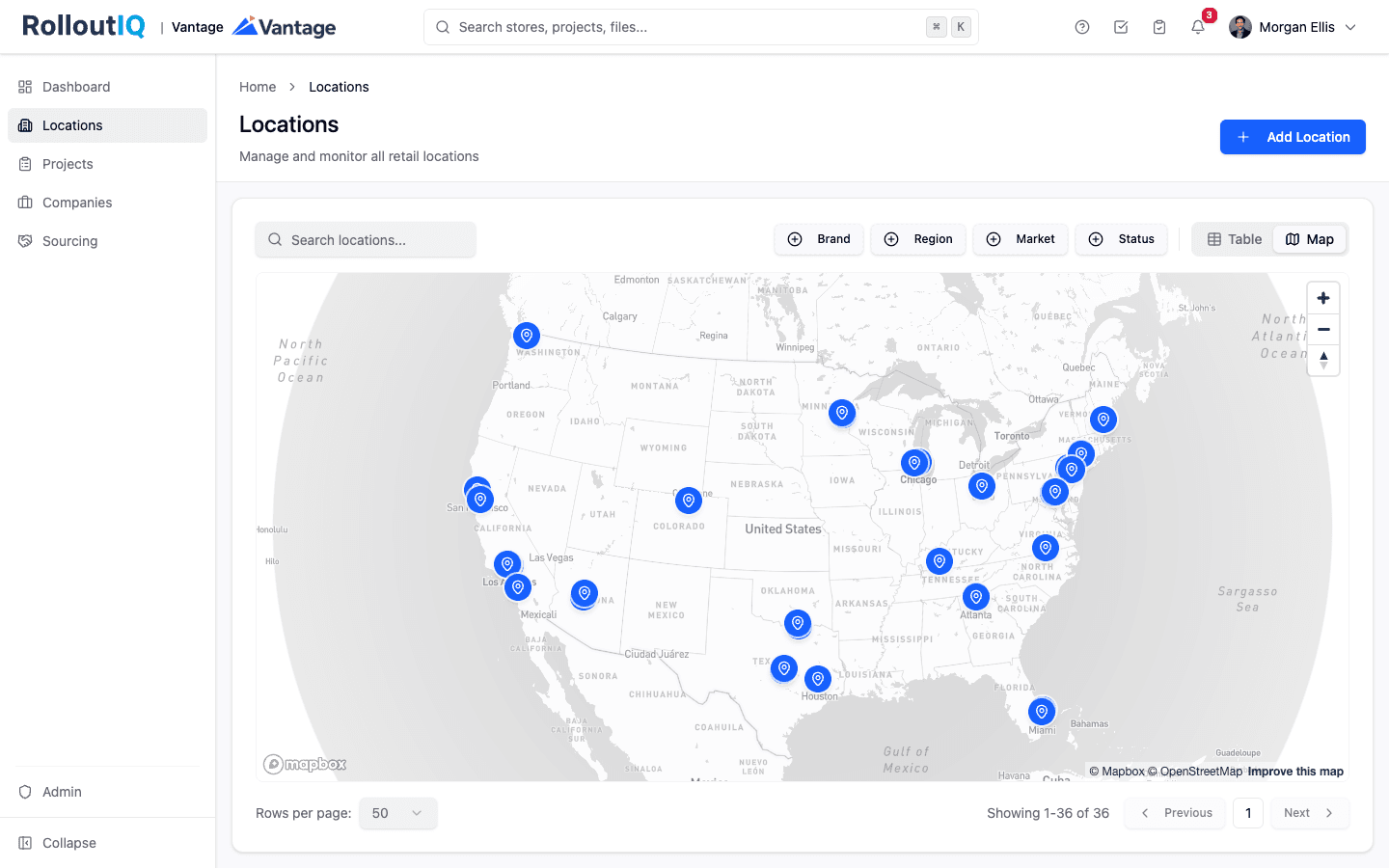
See Every Store in One Place
Every location and its projects on one portfolio view instead of 30 browser tabs: which stores are still in planning and which are slipping against a Q3 open.
- Portfolio map and list across every location
- Schedule health rolled up by brand, region, and market
- Drill from the portfolio into any single store
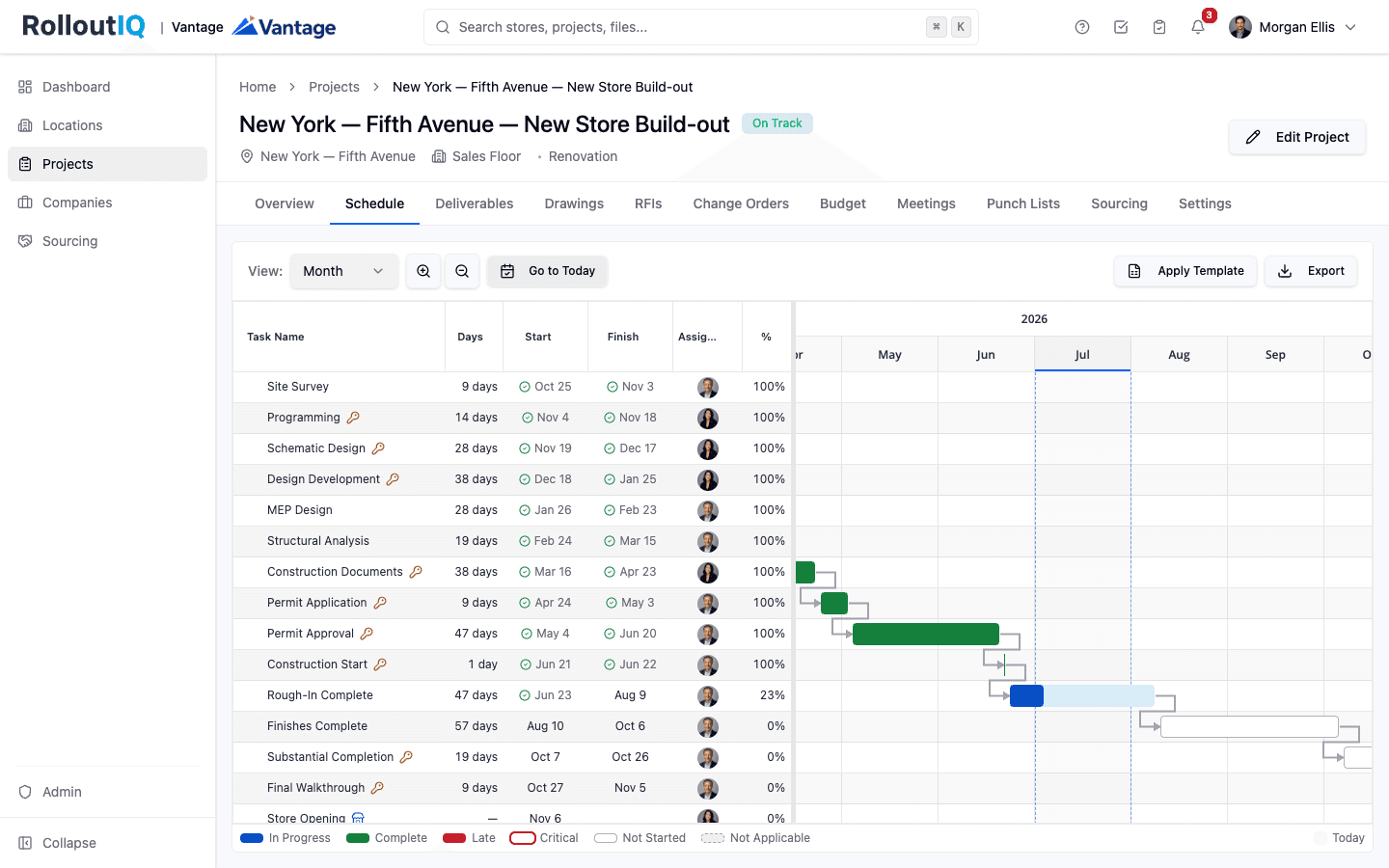
A Schedule That Recalculates When Reality Changes
A real critical-path schedule with dependency math. Move one deliverable and RolloutIQ™ ripples the change through the timeline, so the new opening date shows up the moment you save.
- Critical-path dependencies with lag
- Ripple recalculation, with a preview of critical dates that move
- Phase and deliverable milestones per project
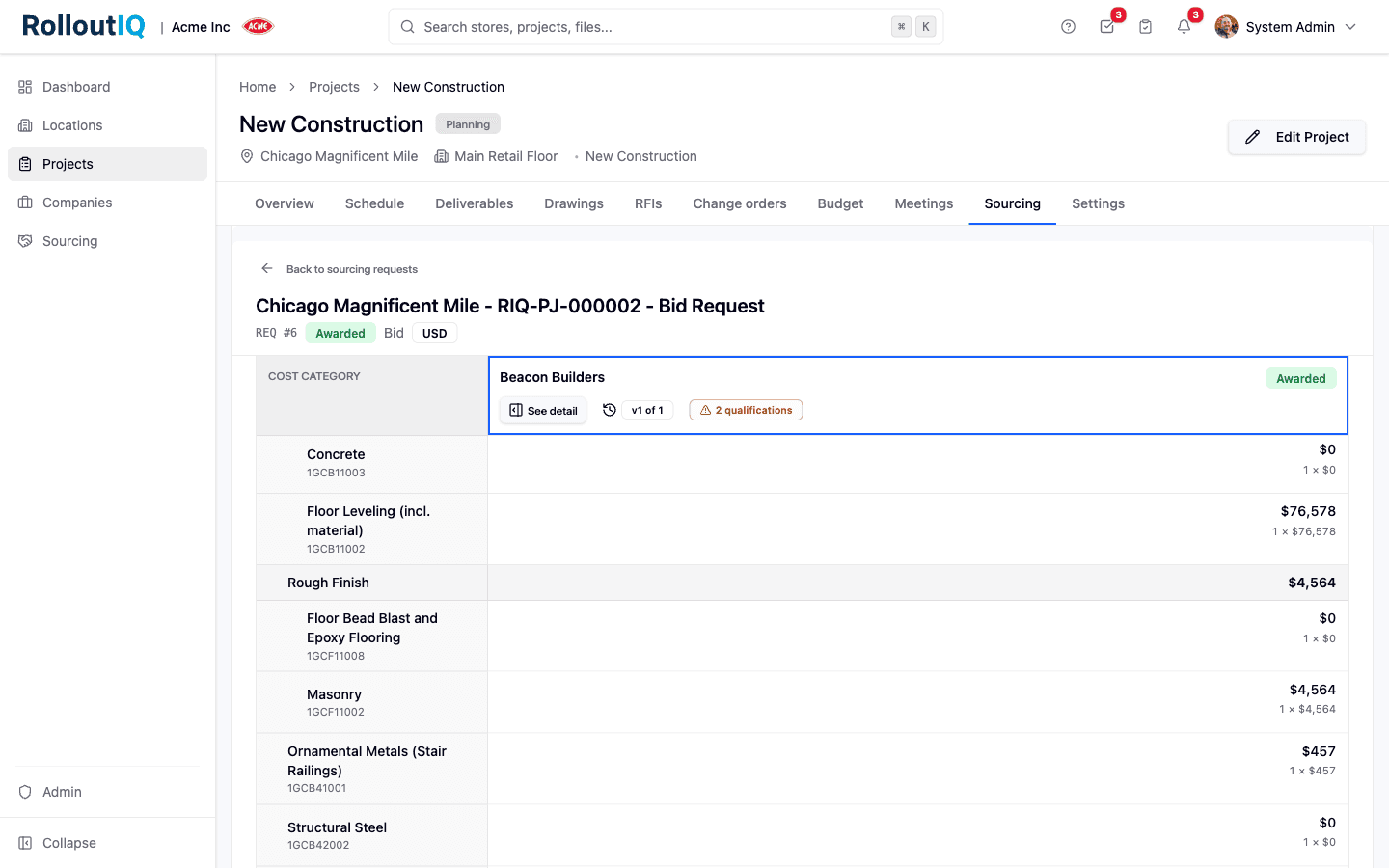
Compare Every Bid Side by Side
Send one pricing form to every bidder, then line their numbers up in a leveling matrix against the same cost categories. Award with a governed decision that flows straight into the budget.
- Sealed competitive bidding
- Side-by-side leveling matrix
- Awards feed the project budget
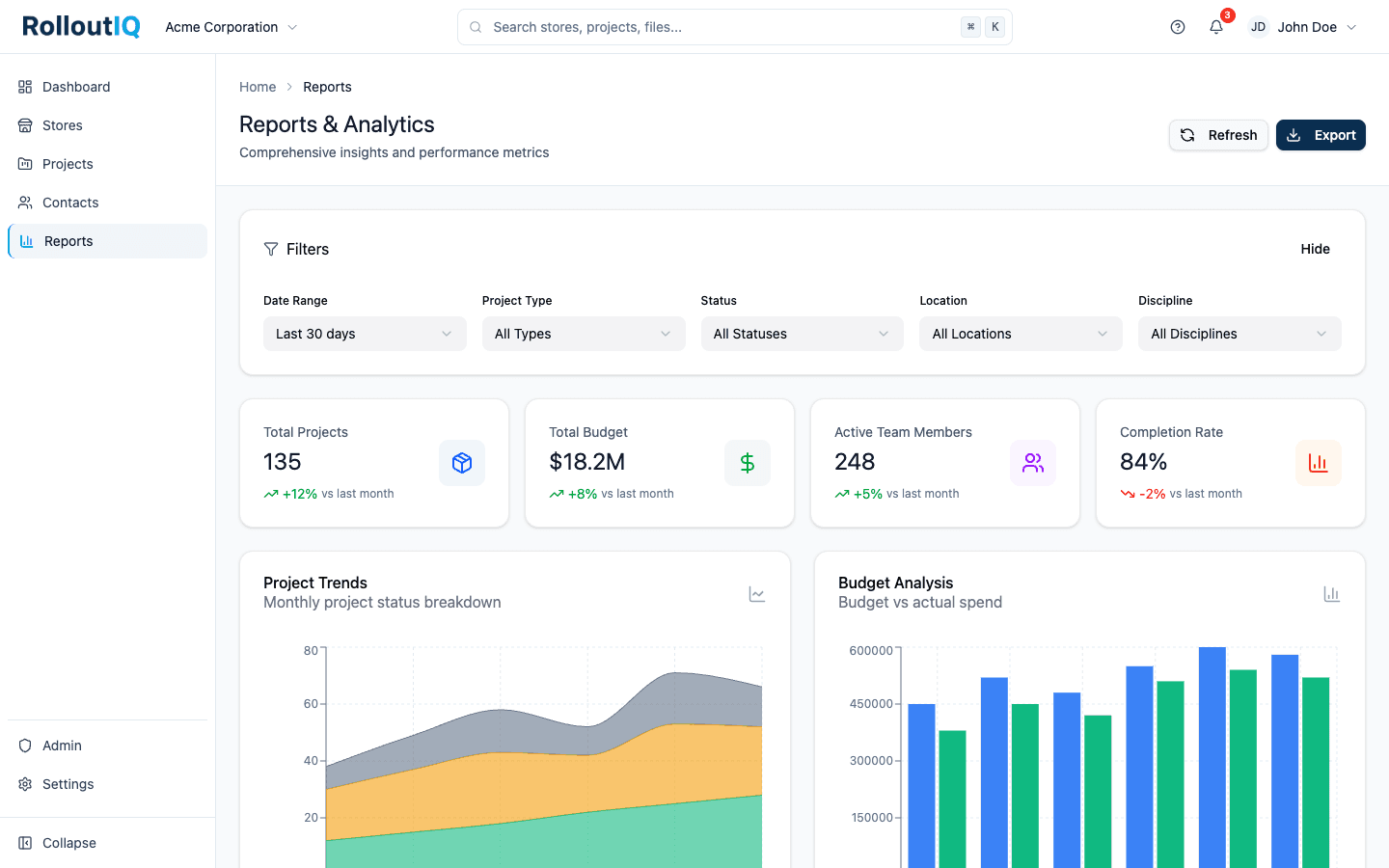
Portfolio Reporting Built for Leadership
Four tabs of portfolio reports show which projects are on track, which need attention, and which are at risk, with a CSV of any section or a board-ready PDF of any tab.
- Portfolio reports with CSV and PDF export
- On track, needs attention, and at risk at a glance
- Daily trend capture across every store
Use Cases
Why Retail Operators Move from Tango to RolloutIQ™
Construction Depth for the Rollout
Schedule templates, change orders across every vendor stream, submittals with parallel review, and per-sheet drawings cover the construction slice in depth.
Agentic Enablement via MCP
Tango's agents are still in early access. RolloutIQ™ ships a read-only MCP server with tools for locations, projects, schedules, and templates, so your team can build on its own LLM stack now.
Portfolio Schedule Health at a Glance
Each store's on-track status, finished key deliverables, and days to opening roll up to one dashboard, so a slipping date shows while there is time to act.
FAQ
RolloutIQ™ vs Tango: common questions
Yes. Tango supports API integrations and also maintains standard nightly integrations on its customers' behalf, so RolloutIQ can run the construction program downstream of Tango's lease and site data. RolloutIQ has no Tango connector today, so the link runs through your data team or an onboarding load.
Tango's AI page listed its agents as coming soon for early-access customers as of September 2026. We found no Tango MCP server. RolloutIQ's read-only MCP server lets your own assistant read project data.
RolloutIQ has no lease module and no ASC 842 accounting, and Tango is the stronger tool for both. RolloutIQ is built for the construction side of the program.
Want Construction Depth for the Rollout?
See how RolloutIQ™ covers the construction side of the program with rollout depth and a read-only MCP server.