
RolloutIQ™ vs Autodesk Forma
The Owner's Portfolio Layer Above Autodesk Forma
Autodesk Forma (the construction cloud formerly called Autodesk Construction Cloud) is a deep, capable platform that general contractors and design teams run on a given build. RolloutIQ™ is the retail owner's portfolio record above it, holding every store and every project across many contractors, from the first planned site to opening.
The Challenge
Why Autodesk Forma Leaves Gaps for Retail Owners
Autodesk Forma is strong construction management for the project team, with a large bid network and BIM coordination. For a retail operator, the gaps sit in the owner-portfolio layer: a store model, retail references, and control of the account.
Built Around the Project
Forma organizes work project by project, with owner analytics layered across them. There is no Location, Space, Project hierarchy for a store portfolio, and nothing that follows a store from planning through its remodels and relocations.
Owner References Sit Outside Retail
Autodesk's published owner stories are universities, transit systems, ports, utilities, and data centers. None is a retail chain running a store rollout, and the platform's owner story centers on capital programs.
The Contractor Often Owns the Account
On many builds the general contractor controls the Forma hub, and the project data lives in that account. Autodesk markets data ownership to owners, but in practice the hub usually belongs to whoever bought the license. RolloutIQ™ is the owner's record by design, across every contractor the owner hires.
Quote-Only, With No Published Timeline
Autodesk publishes no single onboarding timeline, and pricing is quote-only across user, project, and account options.
Comparison
Feature Comparison: RolloutIQ™ vs Autodesk Forma
See how RolloutIQ™ stacks up against Autodesk Forma for retail store development and multisite construction.
Retail portfolio hierarchy (Location, Space, Project)
RolloutIQ™
Autodesk Forma
Owner-controlled system of record
RolloutIQ™
Autodesk Forma
Store development lifecycle tracking
RolloutIQ™
Autodesk Forma
Brand as a portfolio field with brand-scoped approvals
RolloutIQ™
Autodesk Forma
MCP server for your own AI assistant
RolloutIQ™
Autodesk Forma
Subcontractor prequalification & bid network
RolloutIQ™
Autodesk Forma
Native CPM scheduling
RolloutIQ™
Autodesk Forma
3D modeling / BIM coordination
RolloutIQ™
Autodesk Forma
Native mobile and offline field tools
RolloutIQ™
Autodesk Forma
What this page says about Autodesk Forma was last checked against its public materials in September 2026. Products change, so check with Autodesk Forma for its current capabilities.
See sourcesHide sources
- Autodesk, Autodesk Forma construction (2026)
- Autodesk, Solutions for owners (2026)
- Autodesk, Pricing (2026)
- Autodesk, BuildingConnected (2026)
- Autodesk Platform Services, MCP server samples on GitHub
- Autodesk, Autodesk MCP Servers (2026)
- Autodesk, Forma Schedule tool (2026)
See It in Action
What RolloutIQ™ Brings to the Table
Real screens from RolloutIQ™, not a feature list. The capabilities that set it apart from Autodesk Forma for multi-site retail rollouts.
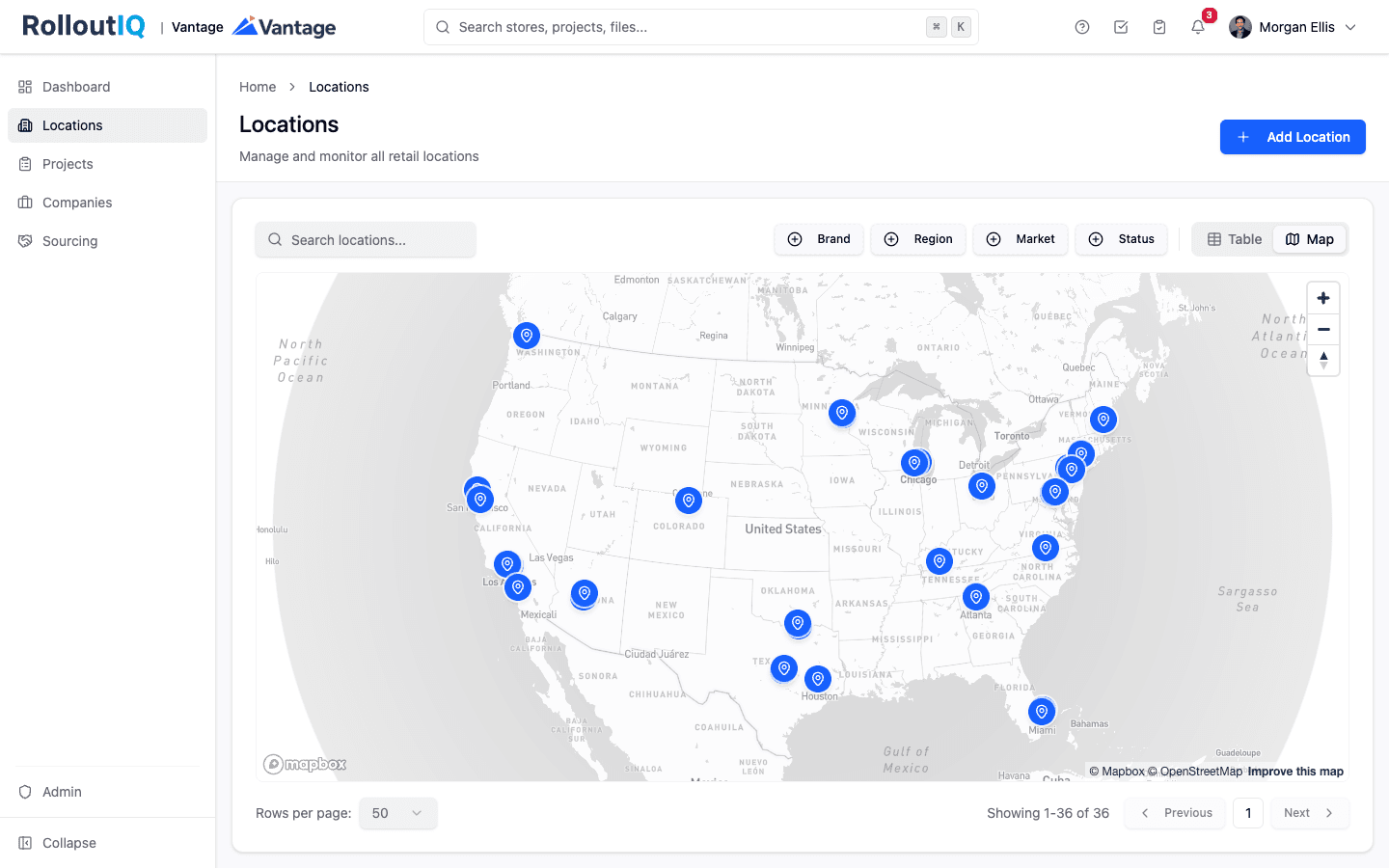
See Every Store in One Place
Every location and its projects on one portfolio view instead of 30 browser tabs: which stores are still in planning and which are slipping against a Q3 open.
- Portfolio map and list across every location
- Schedule health rolled up by brand, region, and market
- Drill from the portfolio into any single store
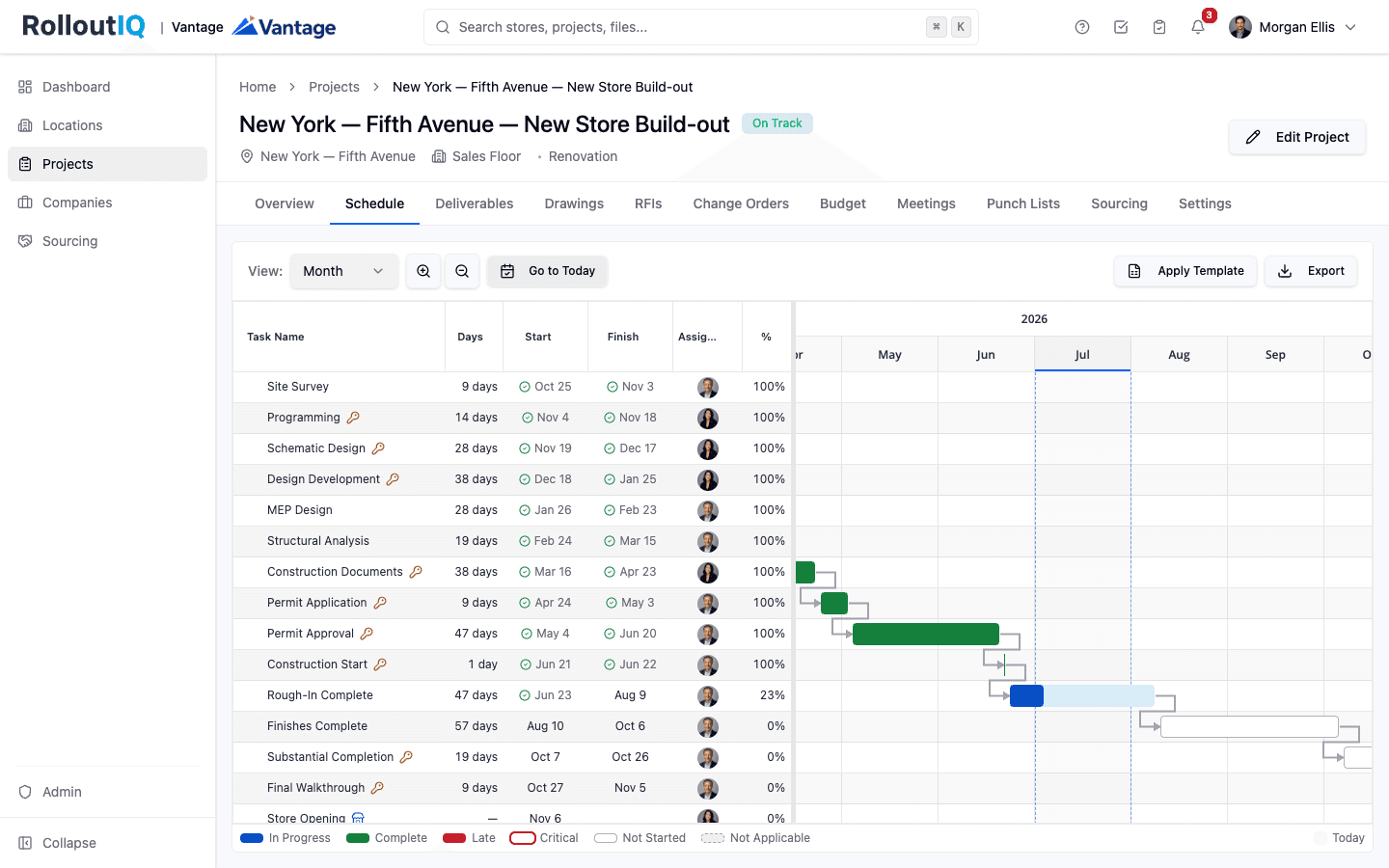
A Schedule That Recalculates When Reality Changes
A real critical-path schedule with dependency math. Move one deliverable and RolloutIQ™ ripples the change through the timeline, so the new opening date shows up the moment you save.
- Critical-path dependencies with lag
- Ripple recalculation, with a preview of critical dates that move
- Phase and deliverable milestones per project
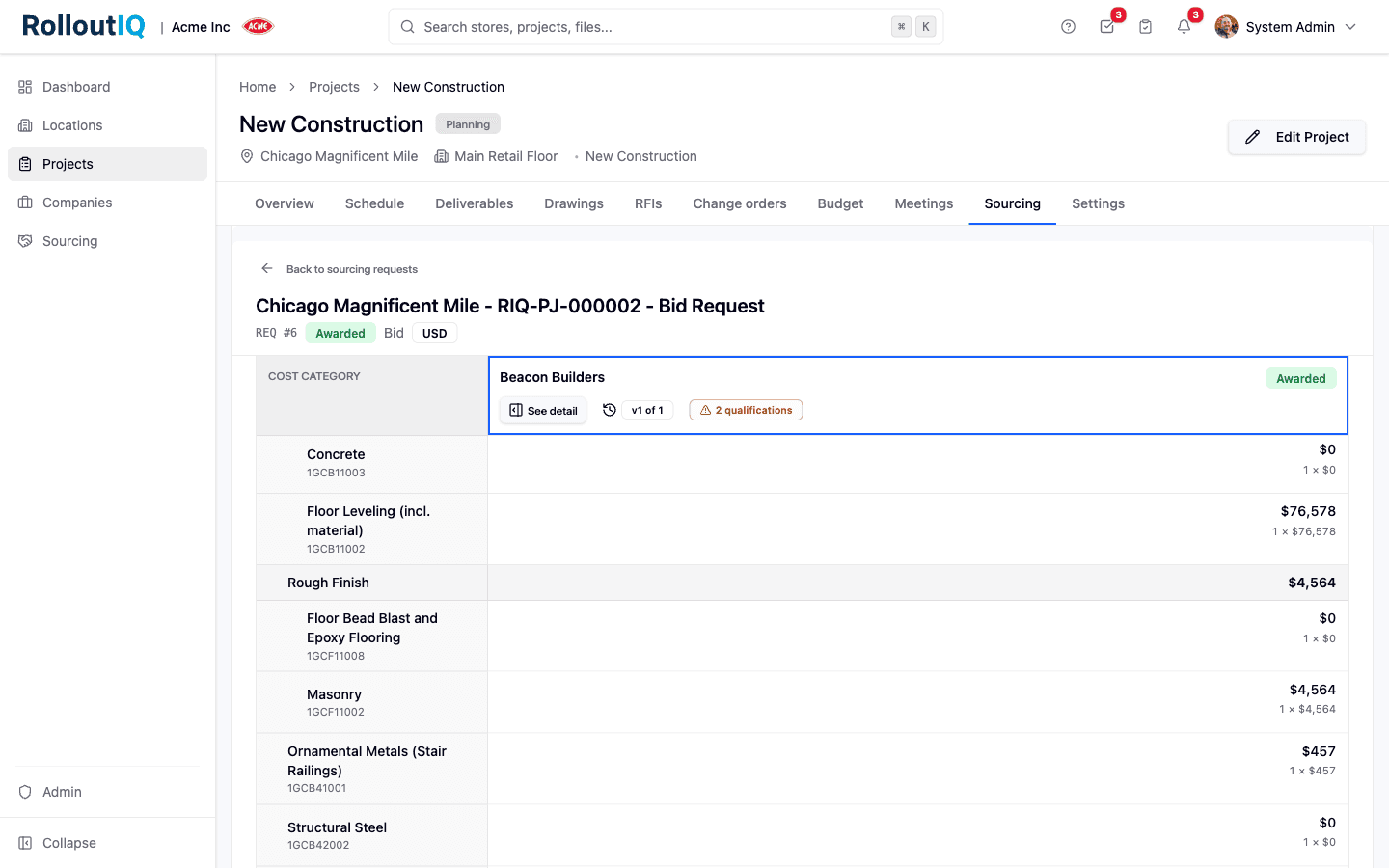
Compare Every Bid Side by Side
Send one pricing form to every bidder, then line their numbers up in a leveling matrix against the same cost categories. Award with a governed decision that flows straight into the budget.
- Sealed competitive bidding
- Side-by-side leveling matrix
- Awards feed the project budget
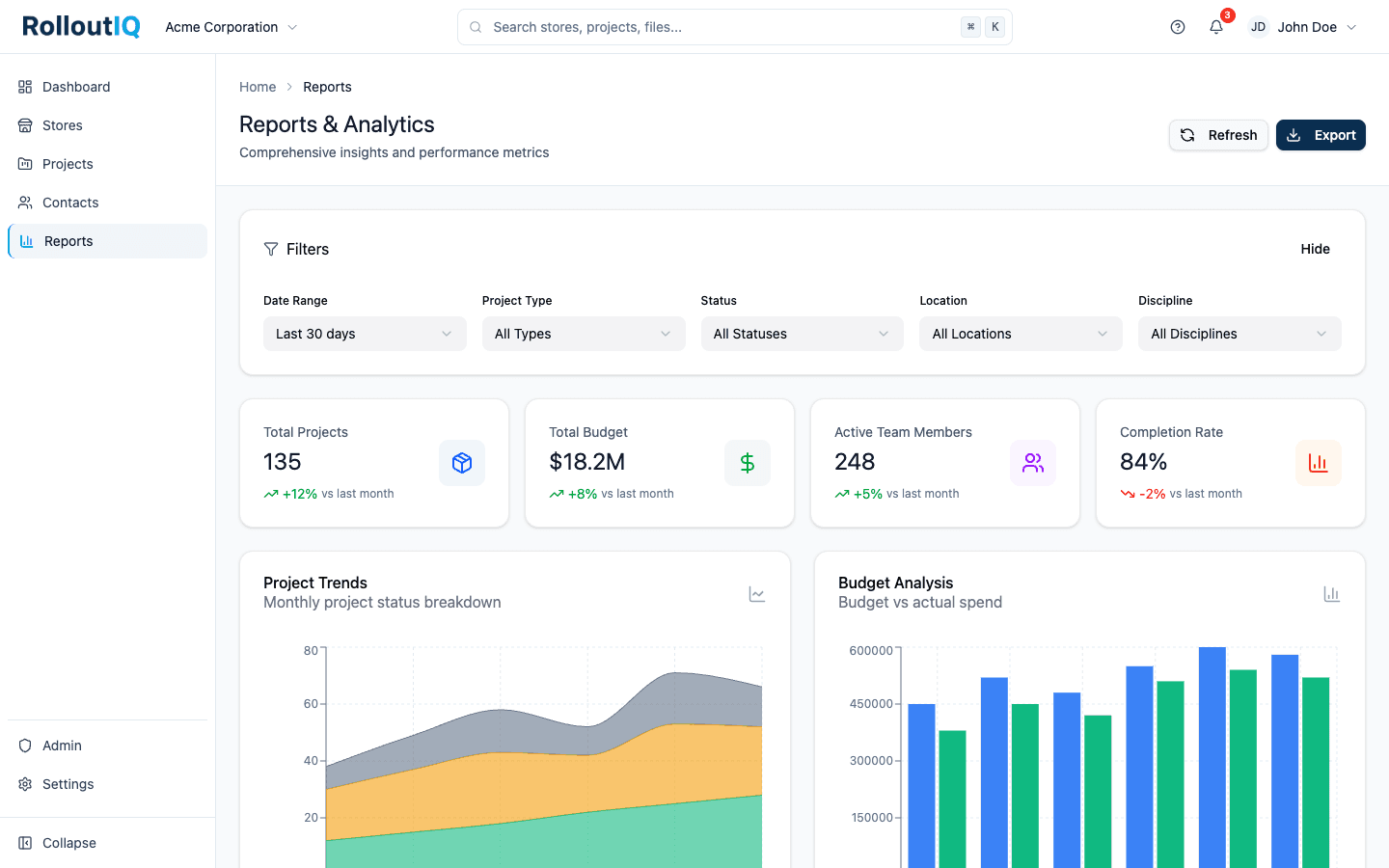
Portfolio Reporting Built for Leadership
Four tabs of portfolio reports show which projects are on track, which need attention, and which are at risk, with a CSV of any section or a board-ready PDF of any tab.
- Portfolio reports with CSV and PDF export
- On track, needs attention, and at risk at a glance
- Daily trend capture across every store
Use Cases
Why Retail Owners Choose RolloutIQ™
Owner Portfolio System of Record
RolloutIQ™ holds every store and project, across all its contractors, in one owner-side record, above the individual project accounts a contractor administers.
Portfolio Schedule-Health Visibility
One portfolio dashboard tracks every store in your pipeline by on-track percentage, key deliverables completed, and the countdown to opening.
Repeatable Rollout Programs
Template your store development process once and apply it to every new location. Update the template and every new project starts from it.
Permits and Inspections on the Schedule
Permit and inspection milestones come from reusable templates as deliverables with an owner, dates, and the stamped permit or signed inspection attached as a file, so every market moves through the same steps.
FAQ
RolloutIQ™ vs Autodesk Forma: common questions
Yes. Forma can stay with the general contractor on each build while RolloutIQ holds the owner's portfolio across every contractor. RolloutIQ has no Forma connector today, so project data moves between them by export, or through Autodesk's APIs and a RolloutIQ API token scoped to a user's permissions.
Autodesk folded Autodesk Construction Cloud into Autodesk Forma in 2026, and the product names changed, so Autodesk Build is now Forma Build. Older ACC links redirect to Forma.
Model coordination and design collaboration are Forma strengths that RolloutIQ does not match. RolloutIQ handles drawings as per-sheet records with version history, which is what a store rollout team builds from.
Yes. Autodesk runs managed MCP servers for Product Help, Fusion, and Revit, and it publishes sample MCP servers for its platform APIs on GitHub. Its MCP page listed none for Forma construction project data as of September 2026.
Need the Owner's View Above Autodesk Forma?
RolloutIQ™ gives retail owners a portfolio system of record that spans every contractor and every store, alongside the construction platforms the project teams already run.