
Solutions for Luxury Retail
Luxury Boutique and Flagship Construction Management
A luxury house writes one global design standard, then hands each boutique to a local architect and a local contractor who bill in their own currency. RolloutIQ™ gives the store planning team at headquarters one record of every boutique, flagship, shop-in-shop, and pop-up, in whatever city it is going up.
The Challenge
Where luxury boutique and flagship buildouts get hard
A Concept Book Redrawn City by City
Headquarters owns the concept book, and a local architect turns it into a permit set that meets the city's code. Any substitution of a stone or a metal finish has to come back for the brand's approval, or the boutique opens off-standard.
Finishes Made Overseas
Custom millwork and stone for a boutique are often fabricated abroad and shipped to site, so the order goes out months before construction starts. A late container or a tariff change can move the opening date and the budget at once.
Landlords and Historic Districts
A shop-in-shop answers to the department store's design and construction rules, and a street boutique on a landmark block may need a preservation permit. In New York City, any change to the exterior of a storefront on a designated building requires a Landmarks Preservation Commission permit before work begins.
Openings Kept Quiet
Brands often keep a new boutique confidential until they announce it. The store planning team needs the architect and the contractor working from the same plan without that plan traveling any further.
Platform Features
Built for luxury boutique and flagship rollouts across markets
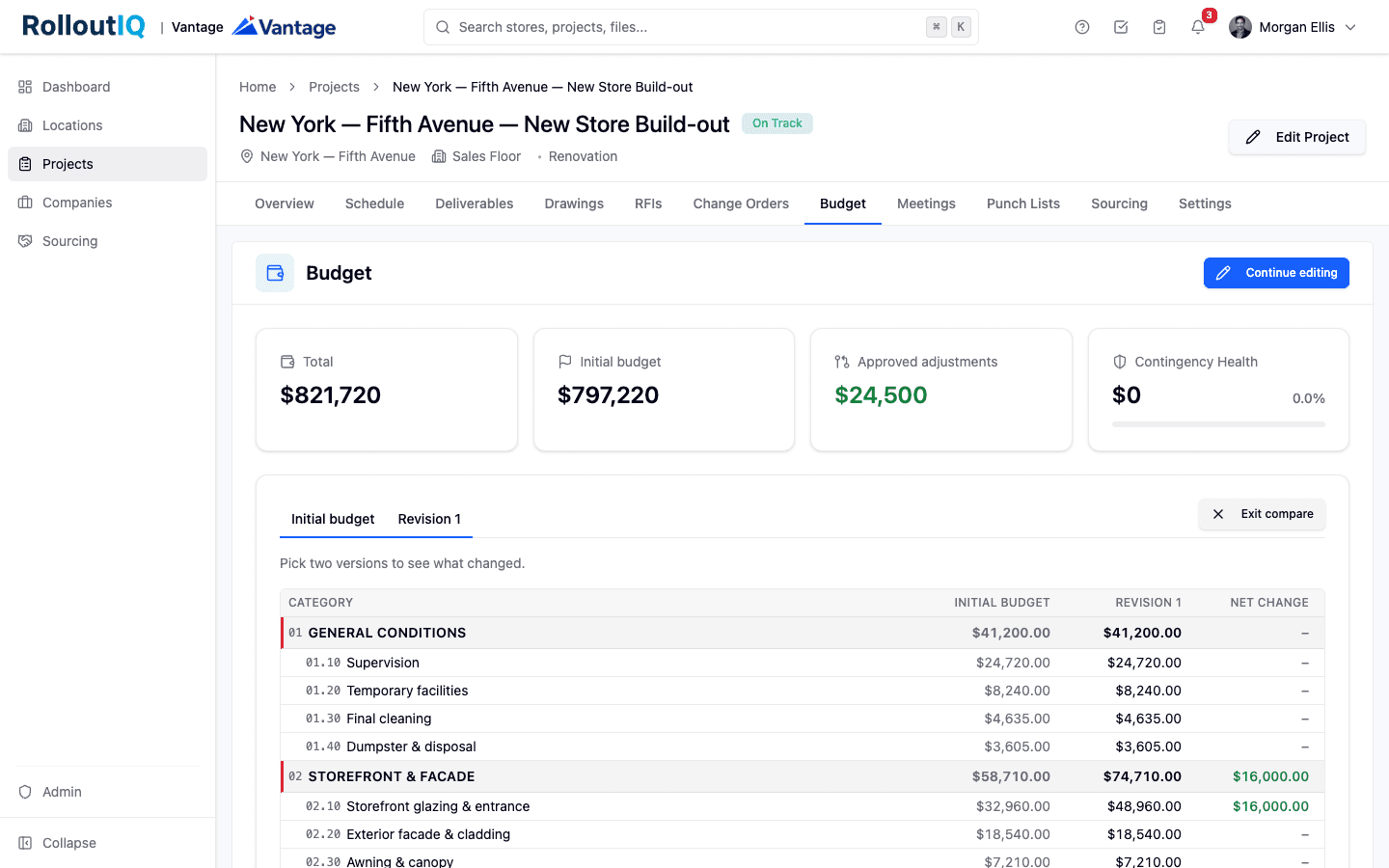
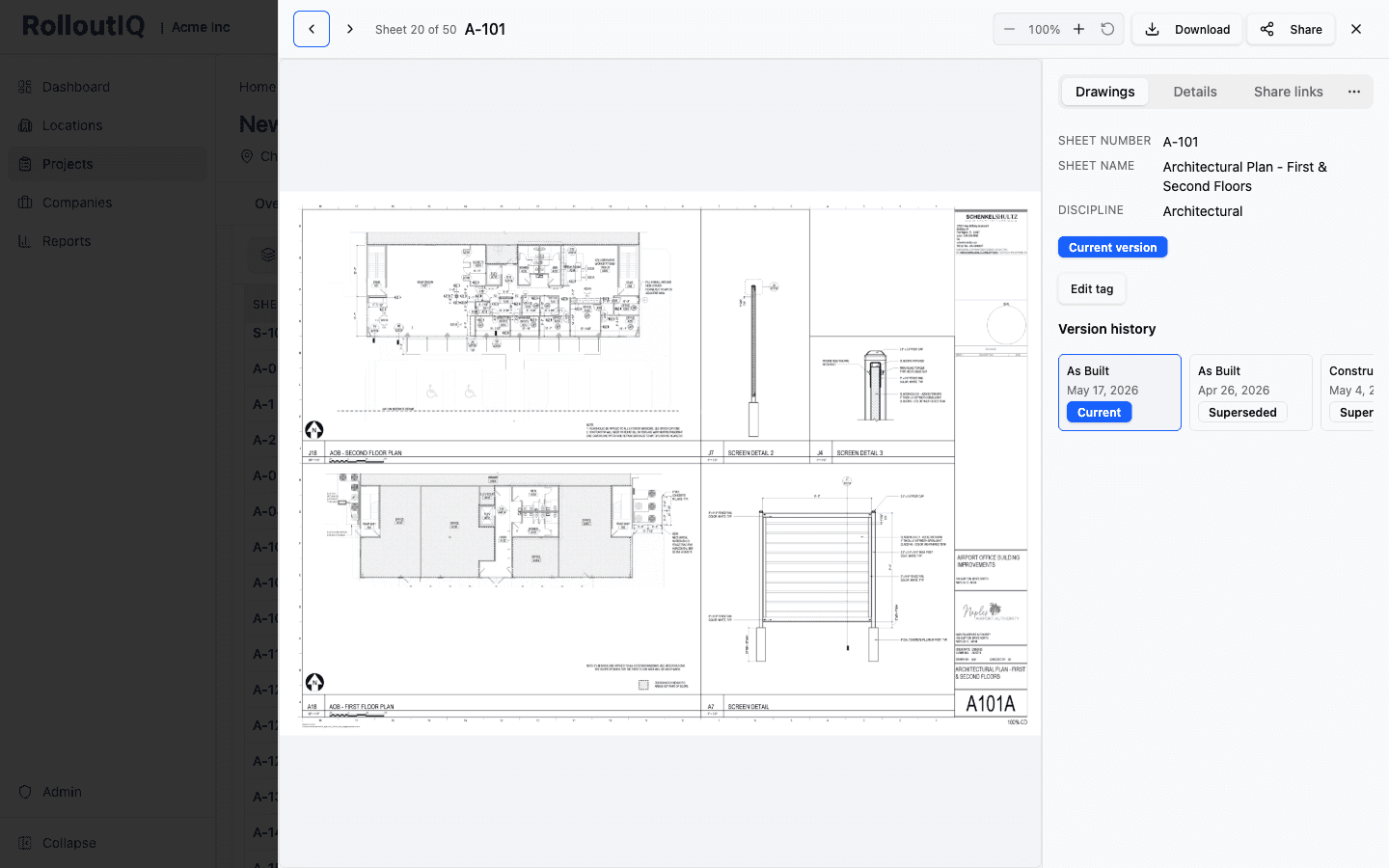
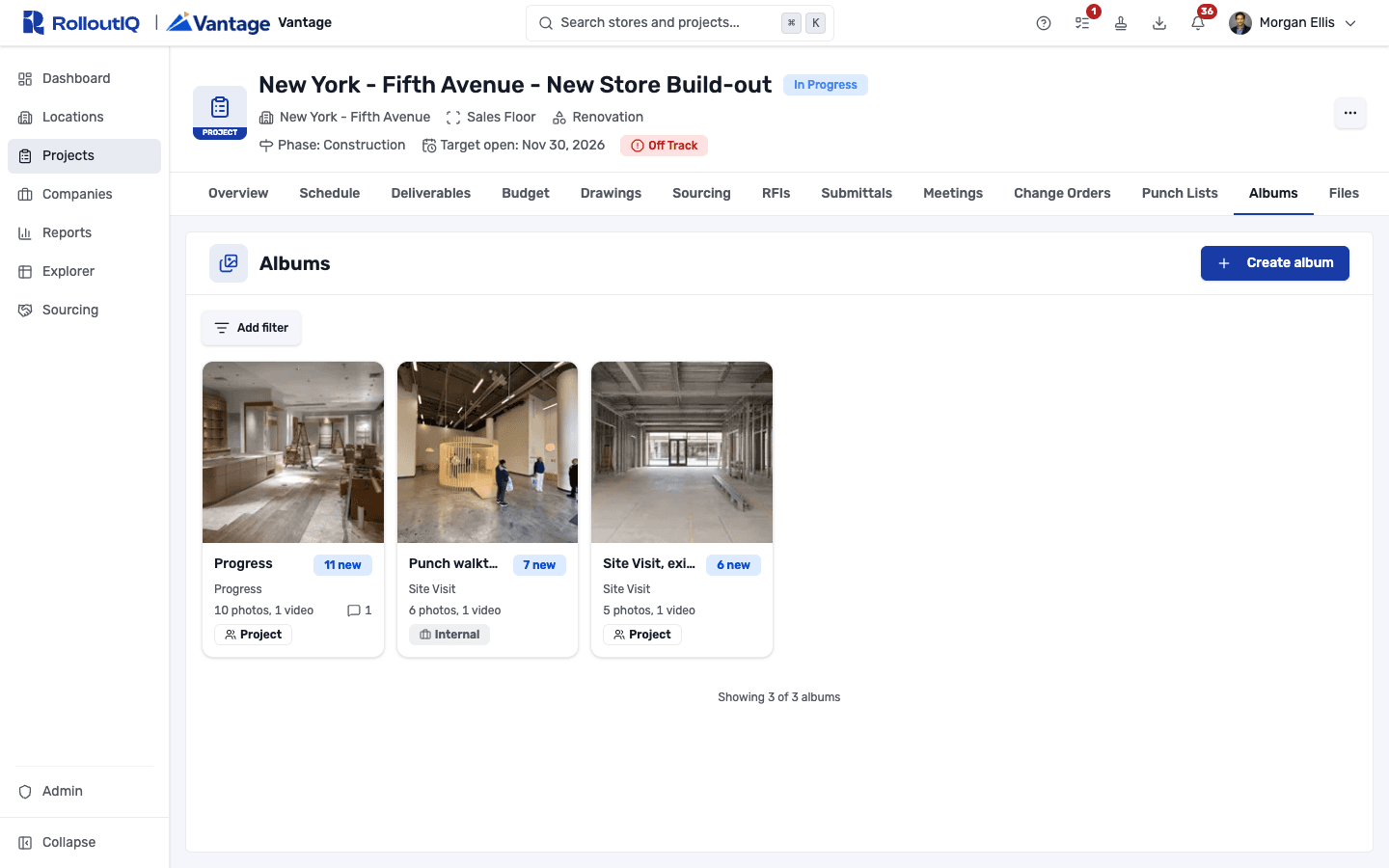
RolloutIQ™ holds each boutique, flagship, shop-in-shop, and pop-up as a project, with the schedule, budget, approvals, and drawing set for it in one place.
Outside Firms See Only Their Projects
Give a local architect or contractor a role on the boutiques they work on, and that firm's people can open those boutiques and nothing else in your portfolio. A drawing set can sit in draft, visible to your project admins, until you publish it to the team.
Boutiques, Flagships, and Shop-in-Shops Together
Each boutique, flagship, department-store shop-in-shop, and pop-up is a project on its location. Filter the portfolio by brand, region, or market to see one maison's openings for the year.
Budgets in Local Currency
A project carries its own currency, and its exchange rate to your base currency freezes when the first budget is approved. Reports roll change order figures up to the base currency and name how many projects were left out for lack of a rate.
Approvals by Brand and Region
Approval matrices for budgets, change orders, and sourcing awards can be scoped to a brand, a region, or both, each in a fixed currency. A change order on a Tokyo boutique routes to the Japan approvers in yen, with no conversion at decision time.
Finish Samples on the Record
Send millwork shop drawings and stone samples through submittal review with the brand's design team as reviewers. Every round keeps who decided and why, so a substitution approved in Milan is easy to find when Dallas asks for the same one.
Long-Lead Orders on the Critical Path
The millwork release and the stone shipment go on the schedule as deliverables linked to the opening. A slip recalculates everything downstream of it and shows the new opening date right away.
Single Source of Truth
One source of truth for your Luxury Retail portfolio
As your Luxury Retail footprint grows across sites, the same store ends up spread across separate spreadsheets and point tools, and the numbers drift apart. RolloutIQ™ keeps one durable record per store from the first deal through opening day, so your Luxury Retail rollout runs on one set of numbers every team can trust across the whole multi-site portfolio.
See how RolloutIQ™ is the single source of truthInside the Platform
See Your Rollout in One Place
The same RolloutIQ™ system of record that runs the whole program, from deal to grand opening across every store.
By the numbers
Public figures from company filings, trade associations, research firms and federal data on how this industry is building, and none of them are RolloutIQ™ results.
LVMH stores worldwide at the end of 2025, across its 75 maisons
LVMH, 2026
of those LVMH stores located in the United States
LVMH, 2026
Richemont capital spending in fiscal 2026, over half of it on its retail network
Richemont, 2026
forecast global sales of personal luxury goods in 2025
Bain & Company and Altagamma, 2025
Keep reading
Go deeper on the work
FAQ
Common questions
Luxury brands building boutiques in several countries use RolloutIQ™ so headquarters and the local teams work from one record of every project. Each boutique, flagship, shop-in-shop, and pop-up gets a critical-path schedule, an approved budget in its own currency, submittal review, and a versioned drawing set. Design stays with the brand's own architects.
Yes. In RolloutIQ™, each project carries its own currency, and its exchange rate to your base currency freezes when its first budget is approved, so reported cost does not drift with the market. Two limits matter: an admin enters the rates, since there is no live market feed yet, and conversion runs only between a project's currency and the base currency.
RolloutIQ™ grants access project by project, so an outside architect or contractor on a luxury boutique sees only the projects its firm is assigned to. Drawing sets can stay in draft until a project admin publishes them, and photo albums can be limited to your own company or to their creator. When a firm's work on the boutique ends, take its role off, since access stays in place until an admin removes it.
In New York City it does. The Landmarks Preservation Commission says any change to the exterior of a storefront on a designated building requires an LPC permit, applied for before work begins. Other cities run their own preservation reviews. RolloutIQ™ leaves the filing to you and puts the preservation approval on the boutique's schedule as a deliverable, with the storefront work sitting behind it on the critical path.
In RolloutIQ™, the department store can be the location and the luxury brand's shop-in-shop a space inside it, carrying its own projects. The build, any later refresh, and an eventual exit each sit as a separate project on that space, with the department store's design review added to the schedule. The lease and the department store's work letter can be attached as files on the location or the project.
Ready to Run Every Boutique Opening From One Record?
See how RolloutIQ™ handles local currencies, landlord reviews, and imported finishes for a luxury brand's store planning team. Book a demo with our team.