
RolloutIQ™ vs Mastt
The Retail-Native Take on Owner-Side Project Controls
Mastt is the closest philosophical competitor to RolloutIQ™: modern, owner-side capital project controls with transparent per-project pricing and live client-facing dashboards. It has added a retail page for store rollouts and fitouts. RolloutIQ™ is built entirely around stores, with locations, spaces, and projects as the data model.
The Challenge
Where Mastt's Capital-Program Model Shows for Retail
Mastt's owner's-rep dashboards and transparent pricing are real strengths. For a retail operator, the gap sits in the data model.
Projects and Programs, Without a Store Record
Mastt rolls projects up into programs. It does not model the store, its lifecycle, or its brand as objects. RolloutIQ™ keeps each location as a durable record with its spaces and projects, so remodels and relocations stay attached to the same store.
A Capital-Program Heritage
Mastt's flagship references are defence, water, and airport programs. It has added a retail page for store rollouts and fitouts, built on the same project-and-program model.
Controls Start at the Project
Mastt's owner-side controls start with the project's cost and schedule. RolloutIQ™ opens a location record while a site is still in planning, so the same store carries from planning through opening.
Agent Inside Mastt, No MCP Server
Mastt Agent works inside Mastt and is sold as a separate product, and Mastt exposes no MCP server for customer-built agents. RolloutIQ™ ships a read-only MCP server and a REST API under the same permissions as the app.
Comparison
Feature Comparison: RolloutIQ™ vs Mastt
See how a retail-native platform compares to a modern, owner-side capital project controls tool.
Retail-native Location, Space, Project model
RolloutIQ™
Mastt
Store lifecycle from planning to open
RolloutIQ™
Mastt
Transparent published pricing
RolloutIQ™
Mastt
Construction schedule with CPM dependencies
RolloutIQ™
Mastt
Per-sheet drawing identity & versioning
RolloutIQ™
Mastt
RFI workflow depth
RolloutIQ™
Mastt
Brand as a portfolio field with brand-scoped approvals
RolloutIQ™
Mastt
MCP server for your own AI assistant
RolloutIQ™
Mastt
REST API
RolloutIQ™
Mastt
Native iOS and Android apps
RolloutIQ™
Mastt
Tenant-isolated database architecture
RolloutIQ™
Mastt
What this page says about Mastt was last checked against its public materials in September 2026. Products change, so check with Mastt for its current capabilities.
See sourcesHide sources
- Mastt, Pricing (2026)
- Mastt, Retail industry (2026)
- Mastt, Mastt Agent (2026)
- Mastt, Home (2026)
- Mastt, Schedule (2026)
See It in Action
What RolloutIQ™ Brings to the Table
Real screens from RolloutIQ™, not a feature list. The capabilities that set it apart from Mastt for multi-site retail rollouts.
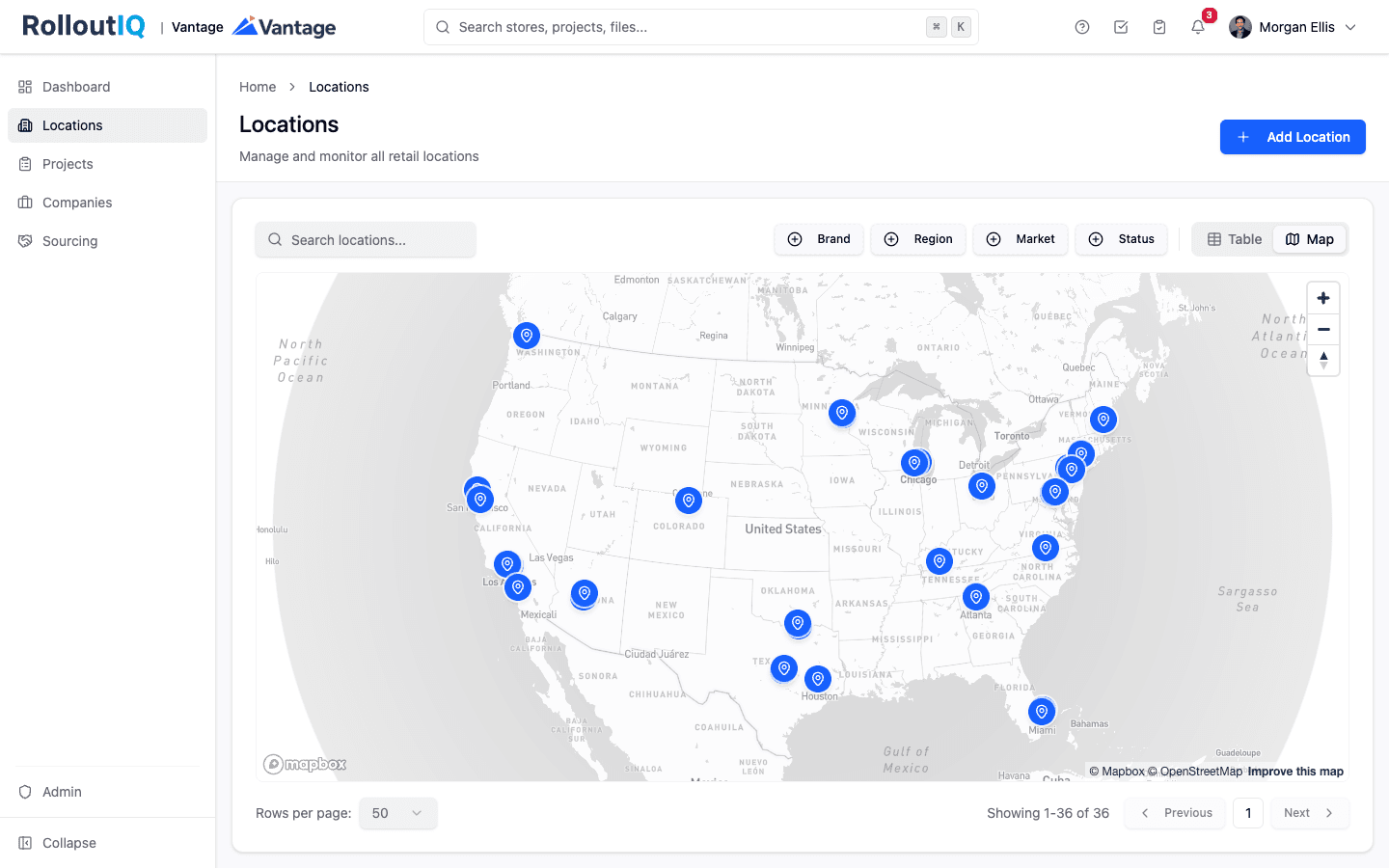
See Every Store in One Place
Every location and its projects on one portfolio view instead of 30 browser tabs: which stores are still in planning and which are slipping against a Q3 open.
- Portfolio map and list across every location
- Portfolio list filtered by brand, region, or market
- Drill from the portfolio into any single store
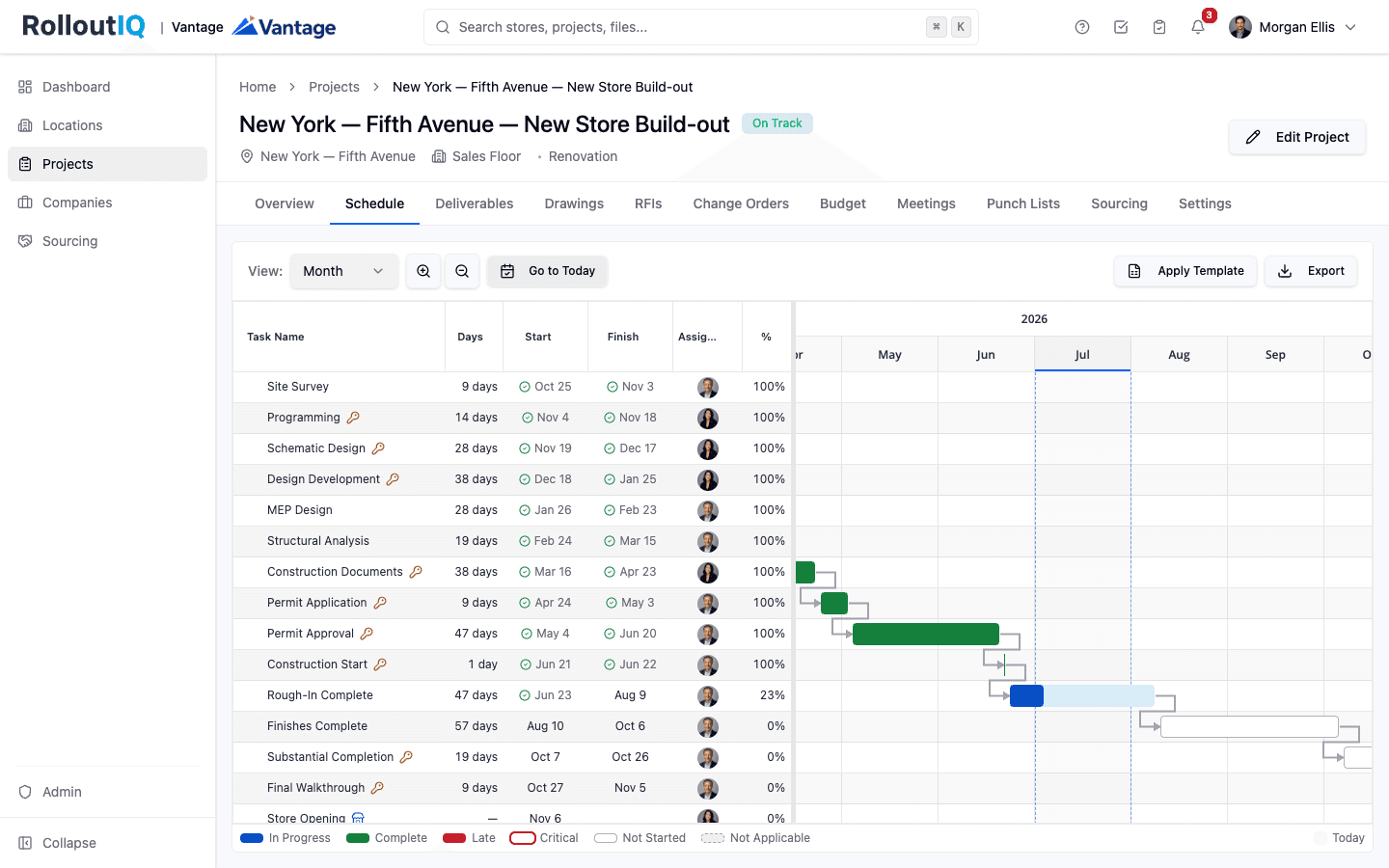
A Schedule That Recalculates When Reality Changes
A real critical-path schedule with dependency math. Move one deliverable and RolloutIQ™ ripples the change through the timeline, so the new opening date shows up the moment you save.
- Critical-path dependencies with lag
- Ripple recalculation, with a preview of critical dates that move
- Phase and deliverable milestones per project
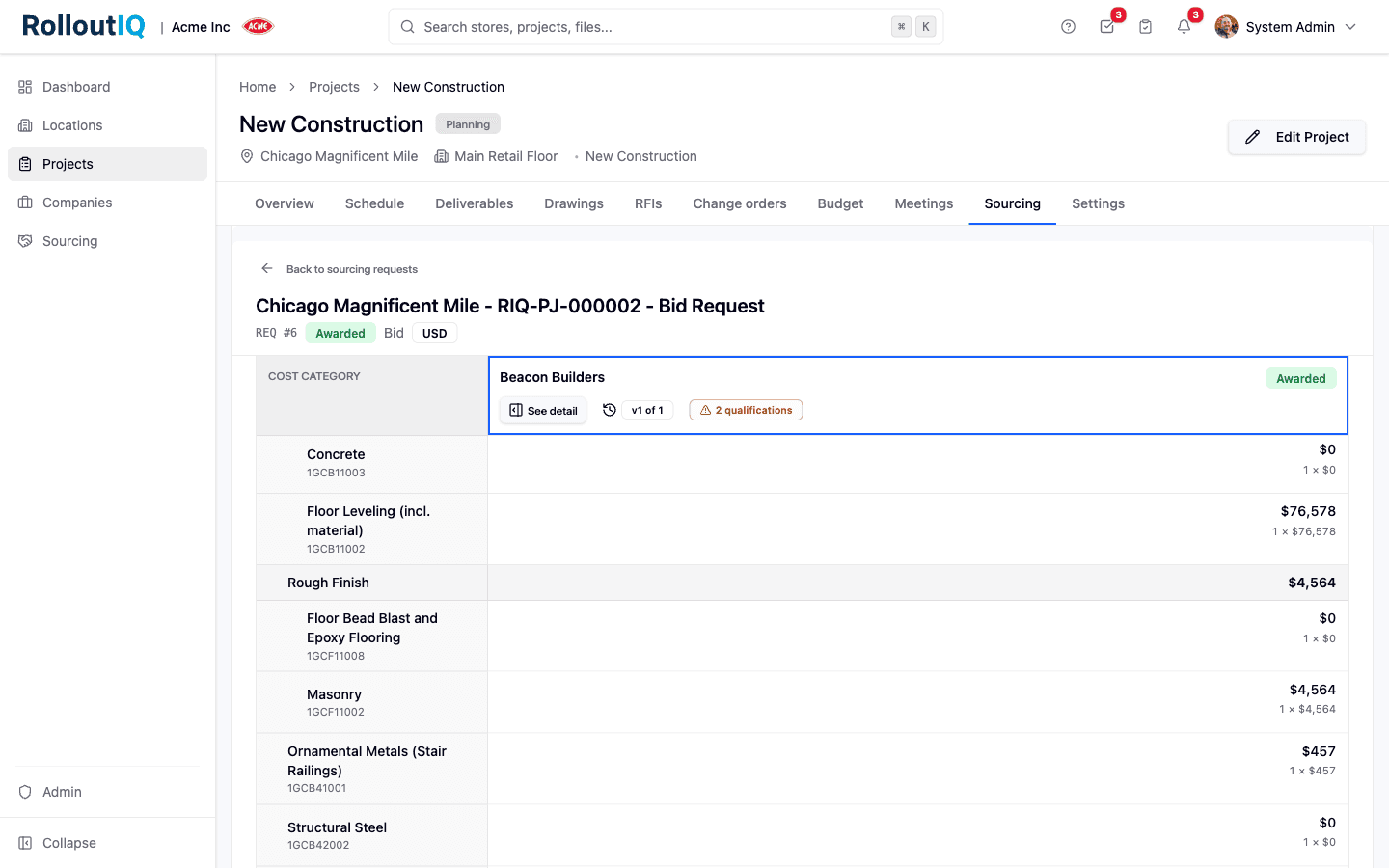
Compare Every Bid Side by Side
Send one pricing form to every bidder, then line their numbers up in a leveling matrix against the same cost categories. Award with a governed decision that flows straight into the budget.
- Sealed competitive bidding
- Side-by-side leveling matrix
- Awards feed the project budget
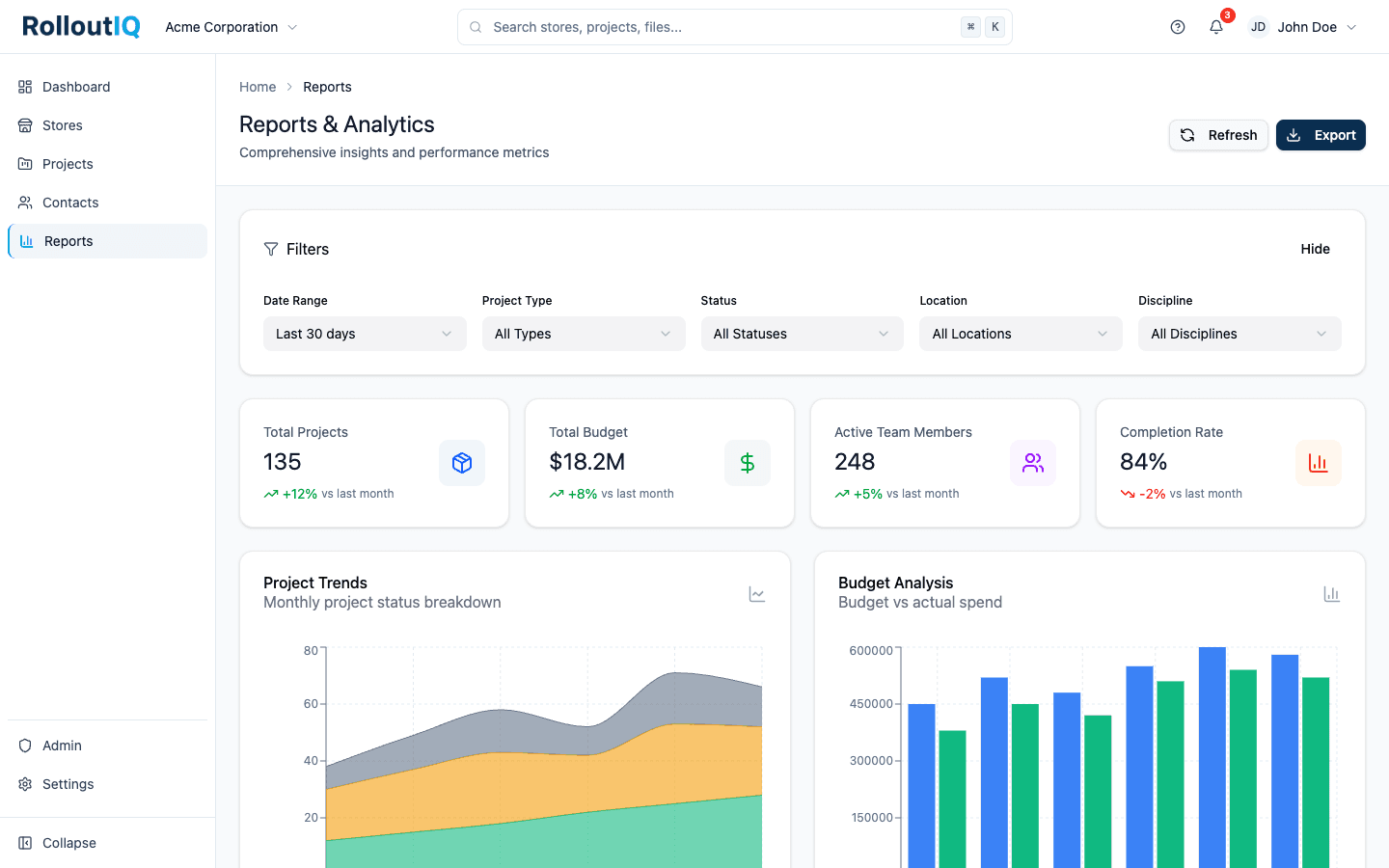
Portfolio Reporting Built for Leadership
Four tabs of portfolio reports, led by a hotlist that ranks the At Risk and Off Track projects with the reason for each. Any section exports to Excel and any tab to a board-ready PDF.
- Re-targeted openings and the reasons behind them
- A schedule risk hotlist of the stores in trouble
- Daily trend capture across every store
Use Cases
A Store Model Instead of a Program Model
Stores as First-Class Records
Locations and the spaces they occupy are native records, with brand, region, and market on every store, so operators model the portfolio the way they run it.
One Record From Planning to Opening
Open a location while the site is still in planning, then carry it through construction and opening, with every later remodel on the same record.
Your Assistant, Your Stack
Point Claude or your own agent at a read-only MCP server, and build portfolio reporting and document search on the LLM stack you already pay for.
FAQ
RolloutIQ™ vs Mastt: common questions
Mastt publishes per-project pricing: the first project is free on Starter, and Professional averages about $165 per project per month with unlimited users. API access and ERP integrations sit on the Enterprise tier. RolloutIQ does not publish pricing, so ask us for a quote.
Mastt Agent handles delegated work, questions, and workflows inside Mastt and is sold as a separate product. Mastt exposes no MCP server for connecting your own agents.
Mastt markets store rollouts on its retail page, with Super Retail Group and Airport Retail Group as named retail customers. Its model is projects and programs, and RolloutIQ's is stores with their spaces and projects.
Need Owner Controls Built for Retail?
See how RolloutIQ™ pairs owner-side controls with a store model that follows each location from planning to opening.