
Solutions for Home Goods & Big Box Retail
Big Box Store Construction and Rollout Management
A big box chain can pour slab for a new warehouse store and fit out an anchor somebody else walked away from in the same year, and its discount banner may be pushing a few hundred remodels through on a standard scope the whole time. RolloutIQ™ puts all of it, along with the racking and fixture vendors behind each store, on one schedule your team can see.
The Challenge
Where big box construction and remodel programs get complicated
Backfilling a Box Someone Else Built
Second-generation anchor space comes with the last tenant's storefront and sprinkler layout. Until the existing-conditions survey is back, nobody can price the scope, and the landlord's delivery date keeps moving either way.
High-Piled Storage Goes Through the Fire Marshal
Under the International Fire Code, goods stacked higher than 12 feet on racks or shelves count as high-piled storage, and fire departments that enforce it generally require a permit once that area passes 500 square feet, aisles included. Their reviewers want the rack layout and aisle widths on the plans, so racking drawings have to settle early.
Racking, Fixtures, and One Set of Docks
Racking goes up before fixtures go in, and the merchandise set waits on both. A single late truck at the shared loading docks can back up every crew scheduled behind it, because each package ships from its own vendor on its own lead time.
Remodel Programs Counted in the Thousands
A large discount chain can plan thousands of remodels in one fiscal year on a handful of standard scopes. To hold that pace, every store has to start from the same schedule, and someone has to spot the market that's falling behind before the season closes.
Platform Features
One system for every big box build and remodel program
RolloutIQ™ keeps each store's schedule and budget with its drawings and vendor bids from the first site visit through closeout, whether the project is a ground-up box or remodel number 300 of 400.
Every Banner and Format in One Portfolio
Warehouse stores and design showrooms sit in the same portfolio as your small-format discount banner, tagged by brand, region, and market. Each store keeps a record of the spaces it has occupied, so a move into a backfilled anchor leaves the old premises' project history intact.
Prototype and Backfill Templates
Build a schedule template for the ground-up prototype and another for backfills, plus one for each remodel scope. Applying it lays out deliverables with their dependencies and owners, so the high-piled storage permit and the racking inspection show up as dated milestones on every store that needs them.
Bids for Racking and Fixture Packages
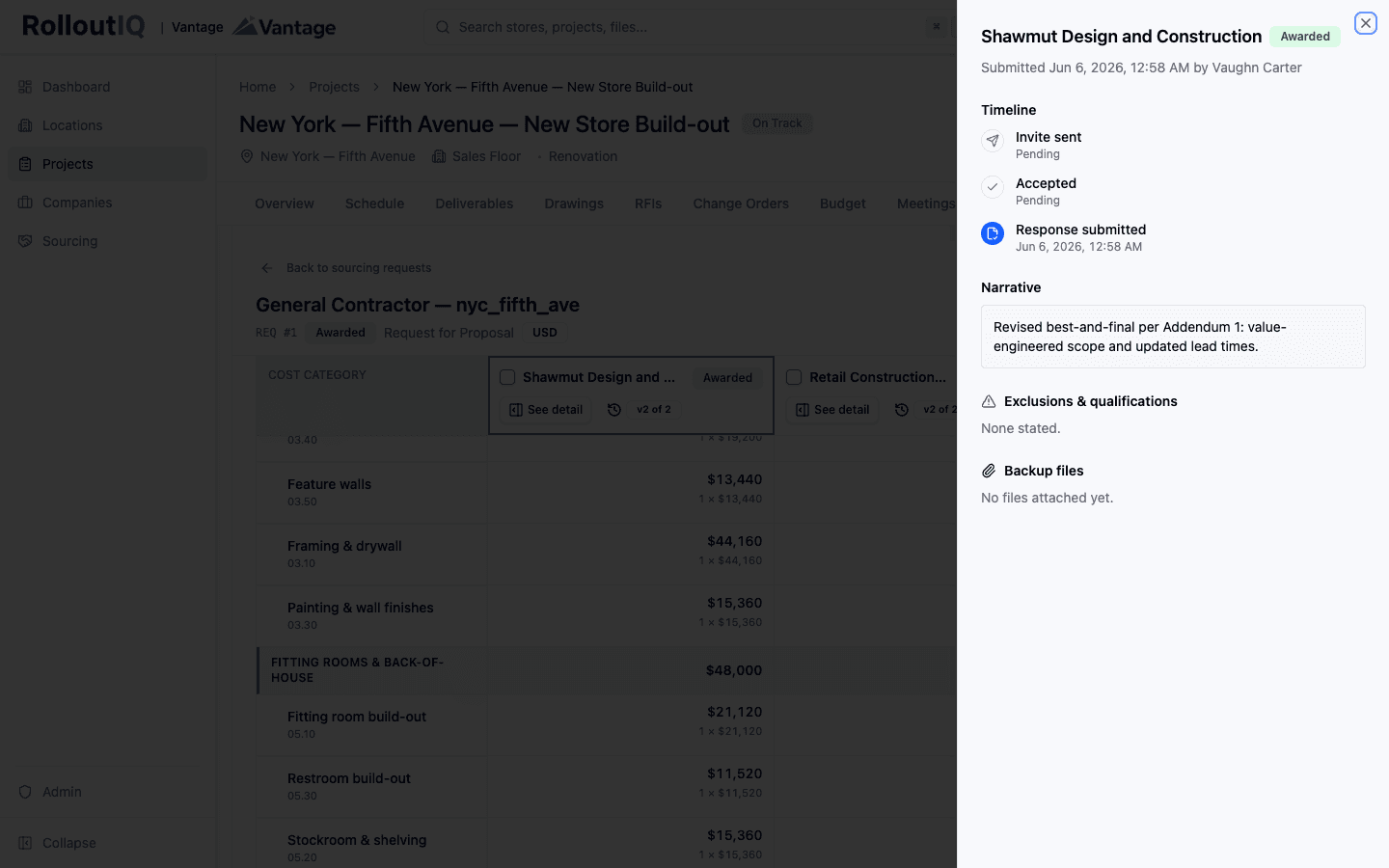
Send racking and dock equipment out through Sourcing so every vendor prices the same form, then compare the bids side by side before you award. An award that runs over the project budget can open a budget revision automatically.
Current Drawings for the Whole Box
Each project's drawing set lives as a versioned library of sheets. The installer in the field opens the same rack layout your permit set shows, with every earlier version kept behind it.
Approvals Sized to the Dollar
Budgets, change orders, and sourcing awards route through approval matrices set by amount and by brand or region. Set the thresholds once, and each change order goes only as high up the chain as its amount calls for.
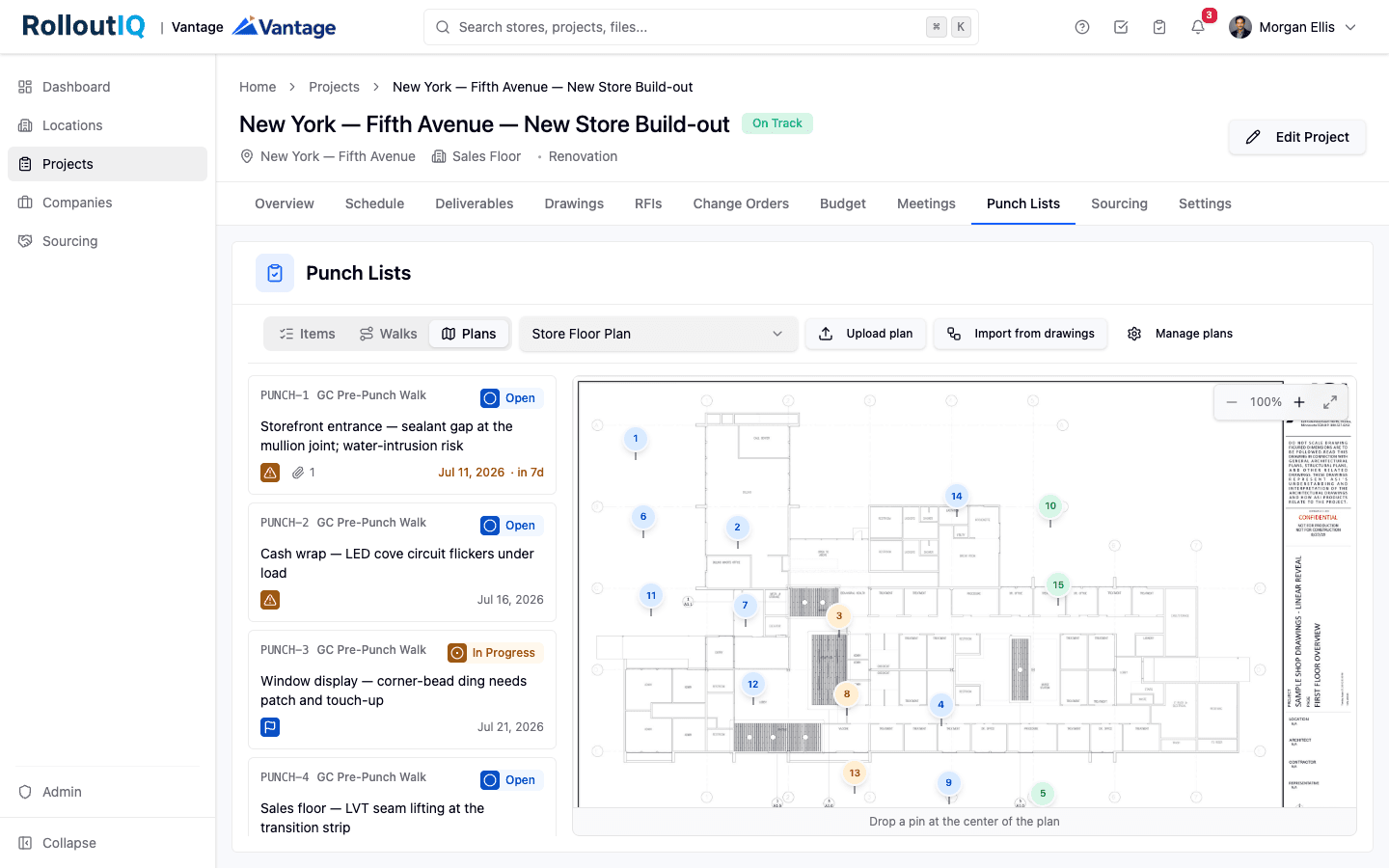
Punch Walks on the Floor Plan
Before opening, walk the box with punch items pinned to its floor plan. Each vendor sees only the items assigned to its own company.
Single Source of Truth
One source of truth for your Home Goods & Big Box portfolio
As your Home Goods & Big Box footprint grows across sites, the same store ends up spread across separate spreadsheets and point tools, and the numbers drift apart. RolloutIQ™ keeps one durable record per store from the first deal through opening day, so your Home Goods & Big Box rollout runs on one set of numbers every team can trust across the whole multi-site portfolio.
See how RolloutIQ™ is the single source of truthInside the Platform
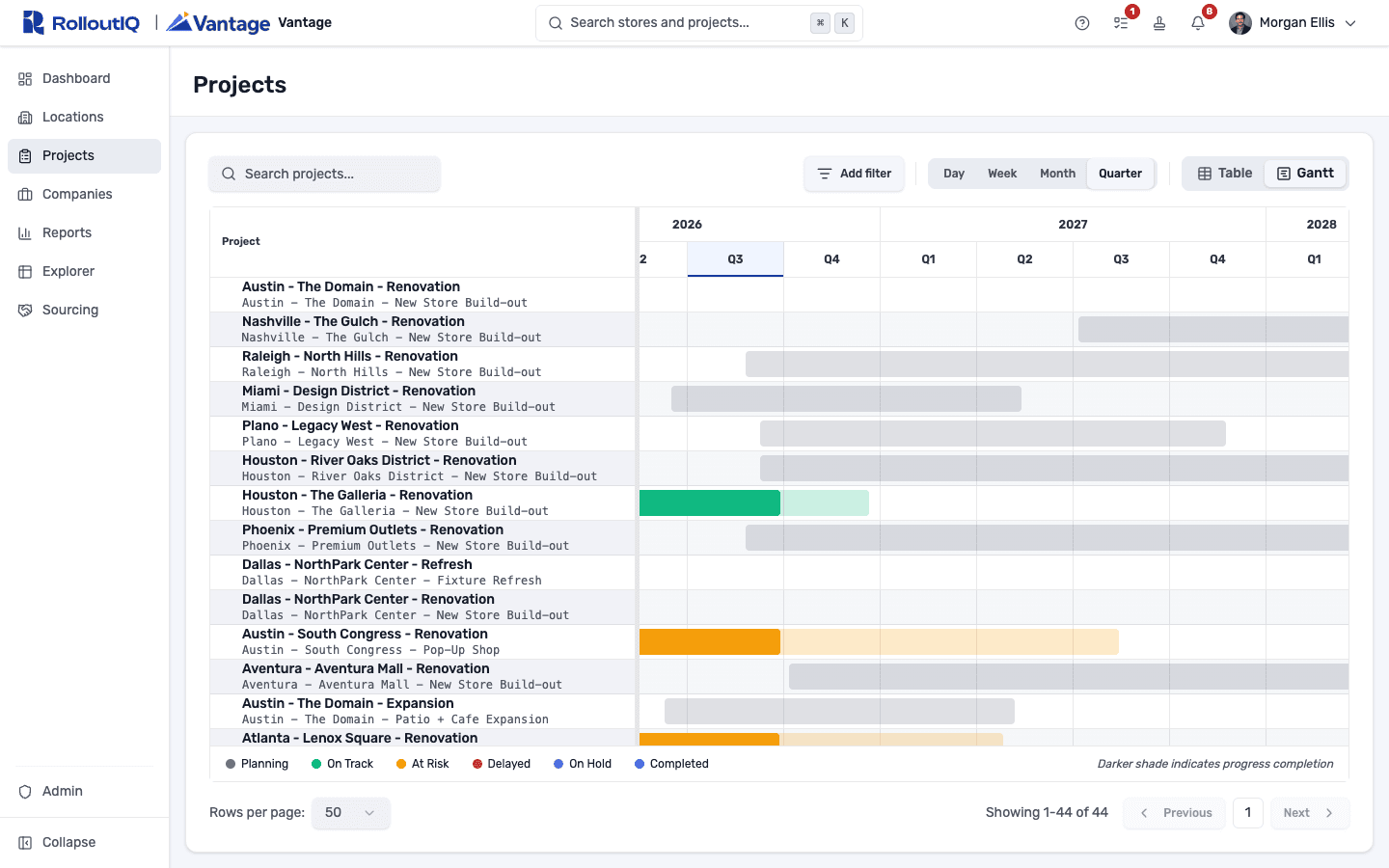
See Your Rollout in One Place
The same RolloutIQ™ system of record that runs the whole program, from deal to grand opening across every store.
By the numbers
Public figures from company filings, trade associations, research firms and federal data on how this industry is building, and none of them are RolloutIQ™ results.
new Floor & Decor warehouse stores in fiscal 2025, with 20 more planned for 2026
Floor & Decor, 2026
real estate projects in Dollar General's fiscal 2026 plan, most of them remodels
Dollar General, 2026
TJX plans to spend on store renovations in fiscal 2027, against about $222M on new stores
TJX, 2026
anchor repositionings in process at Brixmor in mid-2026, at a $79.2M net estimated cost
Brixmor, 2026
Keep reading
Go deeper on the work
FAQ
Common questions
RolloutIQ™ is store development software for retailers that open and remodel stores in volume, including big box, home furnishings, and discount chains. Each store's schedule, budget, drawings, vendor bids, and punch list sit on one record, and a portfolio view shows which stores are slipping across every banner. It's built for the owner's team, and your general contractors keep their own field tools and work with you in RolloutIQ™ on the stores you assign them.
Yes, as a milestone. Add the high-piled storage permit to your prototype's schedule template as a deliverable with an owner, attach the storage plan and the permit to it, and every store built from that template carries the date. RolloutIQ™ does not review drawings against the fire code or decide what your jurisdiction requires. Under the International Fire Code, storage above 12 feet generally counts as high-piled, and your fire marshal sets the rest.
In RolloutIQ™, each discount store remodel is a project built from a schedule template for its scope, and Portfolio Explorer lays the program out as a spreadsheet you can filter by region or schedule risk. For scale, Dollar General's fiscal 2026 plan includes about 2,000 Project Renovate and 2,250 Project Elevate remodels (Dollar General, 2026).
A backfill runs as its own project on its own space record, which carries the box's address and square footage, and a backfill template can put the existing-conditions survey and the landlord's delivery date in as deliverables with owners. If the store relocates later, the new premises gets its own space and the old one keeps its history. RolloutIQ™ is not a lease administration system, so rent and lease terms stay where you manage them today.
Racking installers and fixture vendors get in through a company role on the stores they're working, which opens those stores to everyone at the company. From there they price your Sourcing requests on a shared form and work the punch items assigned to them, and your team can give a project role the ability to answer RFIs. Remove a vendor's role when its work on a store wraps up, since access doesn't expire on its own.
Ready to See Every Box and Remodel on One Schedule?
See how RolloutIQ™ helps home goods and big box retailers manage new boxes and remodel programs across the whole fleet. Book a demo with our team.