
Construction Management
The 11-Month Warranty Walk: Managing Defects in a Store's First Year
The contractor's duty to fix defective work runs for a year after substantial completion, and that year starts just as the project team moves on to the next store, which is how a store can reach the end of it without anyone walking it.
Who owns a store's defects after it opens
The day a store opens, the general contractor demobilizes and its superintendent moves to the next job, while the retailer's construction manager is already working on stores further down the rollout calendar. They leave behind a new building that has never run through a full year of weather and customer traffic. That first year is when the defects nobody could see at the punch walk start to show up.
Nobody in particular owns those defects. Facilities owns maintenance, so the store manager calls the facilities help desk, which opens a work order and sends whichever service vendor is on contract. Construction still holds the relationship with the contractor who owes the fix, but construction has moved on and rarely sees the tickets. So a leaking condensate line that the contractor should correct at no charge gets paid for out of the store's repair budget, because the person who took the call had no idea the store was still inside its correction period.

The one-year correction period in A201
Many retail construction contracts are built on the AIA's A201 general conditions, or on a retailer's own form that borrows from them. Section 12.2.2.1 of A201-2017 sets up the correction period. If, within one year after substantial completion of the work or a designated portion of it, any of the work is found not to conform to the contract documents, the contractor has to correct it promptly once the owner gives notice. The same section also says that an owner who fails to notify the contractor during that year, and give it the chance to make the correction, waives the right to require the correction and to make a claim for breach of warranty, a point AIA Contract Documents repeats in its own guidance for owners.
Section 12.2.5 limits the period to the contractor's obligation to correct the work and puts no deadline on the contractor's other obligations. Those run on state law, under the statutes of limitation and repose. Equipment warranties sit on top of that with their own terms and start dates, often the day a rooftop unit was installed or started up, well before the store was substantially complete, while the correction period only requires the contractor to come back and fix the work at its own cost.
Walking the store in month 11
The correction period ends on a date set by the contract whether or not anyone walked the store. Walking in month 11 leaves enough time to get the defects to the contractor in writing and the corrections scheduled before that date passes. The Kentucky Finance and Administration Cabinet's facilities procedures make the same call for state buildings: a year-end warranty inspection about 30 calendar days before the 12-month warranty period ends, with the contractor, major subcontractors and the architect present. The procedure calls the inspection mandatory even when the building's occupant reports no problems.
By month 11 the building has seen a full cycle. A store that opened in spring has carried a summer of refrigeration load and a winter on its heating, and the first heavy storms have hit its roof. Door closers, after months of customer traffic, are usually the first hardware to show wear. Many of them are already sitting in the store manager's repair tickets. Most of the preparation for the walk happens at a desk, in the weeks before anyone arrives on site.
- Pull the original punch list and confirm every item marked closed is still closed, since corrections rushed in before opening are often the first things to fail
- Ask the store manager and the facilities team for every repair ticket since opening, and flag the ones caused by the construction itself
- Invite the general contractor and the key trades, mechanical and roofing at a minimum, so items get accepted or disputed on the spot
- Check whichever systems the store hasn't leaned on yet (heating if it opened in summer, cooling if it opened in winter), along with the roof and site drainage after the wet months
- Send the list to the contractor in writing the same week, with a photo and a location for each item, and get a correction date back for every one
Scheduling the walk across dozens of stores
A rollout that opened 40 stores last year has 40 walks coming due on different dates, scattered across regions, at a time when the people who might remember them are buried in this year's openings.
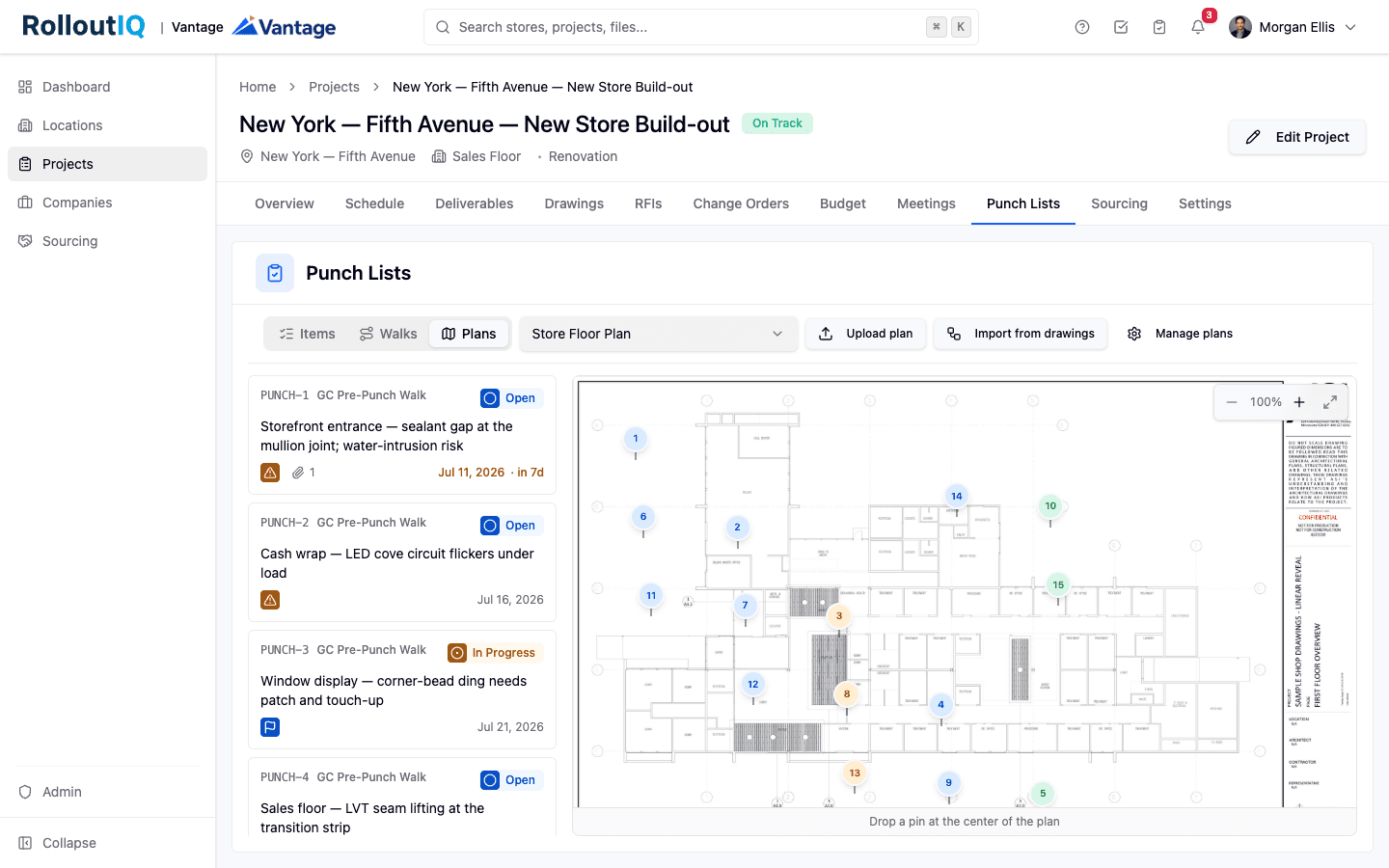
Record each store's substantial completion date on its record at closeout, and book the warranty walk from it the same day, roughly 330 days out, while the project team is still around to set it up. In RolloutIQ that walk is one more walk on the project's punch list, booked with a date and loaded from a template the same way as the pre-opening walk. Give the walk a named owner. Usually that is a regional construction manager or a facilities lead, because a walk assigned to a department tends to slide. Batch stores in one region into one trip when they come due within a few weeks of each other. And watch the stores where part of the building was turned over early, since the correction clause runs from substantial completion of each designated portion and a phased turnover can leave one store with two deadlines.
Turning repeat defects into prototype and vendor feedback
Across a whole portfolio, the 11-month lists start to repeat. The same condensate line freezes on the same rooftop unit in every cold-climate location, or the same door closer drifts out of adjustment wherever one installer worked. A defect that repeats wherever the prototype was built usually traces back to the drawings or the specification. When a defect turns up only at one contractor's stores, look at the workmanship.
That feedback rarely reaches the people who could act on it. The prototype team revises the design on its own schedule, mostly from operations and merchandising input, and rarely sees the warranty findings, which sit in a facilities system it never opens. Tag every warranty item with a trade, an area and a root cause, so a pattern shows up as a count in a report, and review the repeat categories quarterly with the prototype owner and procurement in the room. From that review, design causes feed the next prototype revision, and procurement can carry a workmanship pattern onto the responsible contractor's scorecard before next year's awards.
RolloutIQ's punch items carry a trade, an area and a severity, plus a root cause when you record one. Each goes to the contractor or trade that owes the fix, and by default it closes only after someone with permission to verify signs off on the correction.
Sources
The contract provisions and inspection practice cited in this article come from the following sources.
- Miller Nash LLP, Christine L. Taylor, Warranty vs. Correction Period: What's the Difference Between These Clauses? (2022), quoting AIA A201-2017 Sections 3.5, 12.2.2.1 and 12.2.5 - https://www.millernash.com/industry-news/warranty-vs-correction-period-whats-the-difference-between-these-clauses
- AIA Contract Documents, Avoiding Later Claims by Identifying and Correcting Defective Work Now (2022) - https://learn.aiacontracts.com/?p=14091
- Kentucky Finance and Administration Cabinet, Office of Facility Development and Efficiency, Procedures Manual Section 1103: Year-End Warranty Inspection (2013) - https://finance.ky.gov/department-for-facilities-and-support-services/office-of-facility-development-and-efficiency/ProceduresManual/00%201103%20-%20Year-End%20Warranty%20Inspection%206-22-13.pdf
The Rollout
The Rollout, in your inbox
A founder's read on retail and multi-site store development. What the latest news means for your pipeline, and what we are building, every couple of weeks.

Written by
Nariman Shariat
Founder, RolloutIQ
Nariman has spent about 20 years opening stores, in the seat between the landlord, the architect, and the general contractor, across some of the largest retail and workplace fleets in the country. Along the way he built the internal platform that ran store development across a fleet, then rebuilt the same idea company after company. He founded RolloutIQ to give multi-site development teams the single source of truth he kept having to build by hand, and writes here about the work of opening and remodeling stores at scale.
More about NarimanKeep Reading
Related Articles
Continue exploring best practices for store development and construction management.

The Closeout Package: What to Collect Before You Release Final Payment
The last stretch of a store build carries most of a store's operational knowledge along with the largest chunk of still-trapped cash. What to collect at closeout, before you release retainage, so the record does not walk away with the crew.
Punch List Management for Retail Rollouts: One Backlog for Every Walk
Retail store openings run a construction punch list and a separate pre-opening checklist in two different tools, reconciled by email. Here is how to put every walk in one backlog and verify each item before it closes.

Vendor Management Best Practices for Retail Buildouts
Your vendors make or break your rollout timeline. Learn how top retail operators manage vendor relationships, track performance, and build reliable trade networks.
Ready to Build Smarter?
See how RolloutIQ™ can streamline your retail and multi-site rollout program. Book a personalized demo with our team.