
Construction Management
One Punch Backlog for Every Store Walk
A retail store gets walked half a dozen times by half a dozen teams, in two different systems that get reconciled by email the week before opening. Here is what punch has to do to run as one backlog instead.
Retail Walks a Store Many Times, in Two Systems
A retail store is not punched once. On the way to opening it is walked half a dozen times or more. A GC pre-punch, a formal owner walk, a back-punch after corrections, a pre-opening walk, and 30, 60, and 90-day warranty walks, each with its own participants. And it is walked by more than the general contractor. The retailer's construction manager, the brand and visual-merchandising team checking prototype compliance, store operations, the store manager, the IT team provisioning point-of-sale and network, the landlord, the fire marshal, and the signage and fixture vendors all surface the items only they would notice.
Most of that walking happens in two separate systems. The construction punch, the defects against the drawings, lives in a construction tool built for the GC and the architect. The pre-opening checklist, the brand-standard, operations, and technology verification, lives in a different audit tool or a spreadsheet. Neither team can see the other's list, so reconciliation happens by email in the last week before opening, exactly when nobody has time for it.
And a single walk never catches everything. Industry practice is clear that first walks surface only sixty to eighty percent of the eventual punch, and the next walk adds another ten to twenty-five percent, from corrections done wrong, defects created by the correction work, and items nobody saw the first time. A store that opens on a single clean walk is a store that opens with an unwritten punch list.

Why One Tool Only Sees Half the Store
Generic construction punch tools model punch as discovery. Someone walks the site, finds a defect, pins it to a drawing, assigns it, and tracks it to closed. That model is correct, and it is only half of the retail job. It misses the checklist dimension entirely, the predefined brand-standard, operations, and technology items that must be verified on every store of a given type, the ones that exist before the walk even starts. The audit tools do the reverse. They are built for the checklist and blind to construction defects. Neither is one backlog, so the reconciliation stays a manual, error-prone exercise.
There is a subtler gap too. Most tools blur what was checked with what was verified. An item marked done on the same walk it was found, by the same person who found it, has not been independently verified, and in the field that is exactly the item that reopens after the store is live. Losing that distinction means a walk can read as clean while defects are still open.
The last gap is trust between parties. When the signage vendor arrives after the GC has demobilized and finds the rough-in six inches off, or a finish gets scratched during fixture install, nobody agrees whose item it is. Those disputes are unresolvable without photo evidence on a platform every party can safely see.
What Punch Should Do at Multisite Scale
The fix is not a better single list. It is one backlog that holds every walk on the project, the GC pre-punch, the pre-opening walk, and the warranty walks, with templated checklist items and ad-hoc defects living side by side. When both kinds of work share one backlog, there is nothing left to reconcile by email.
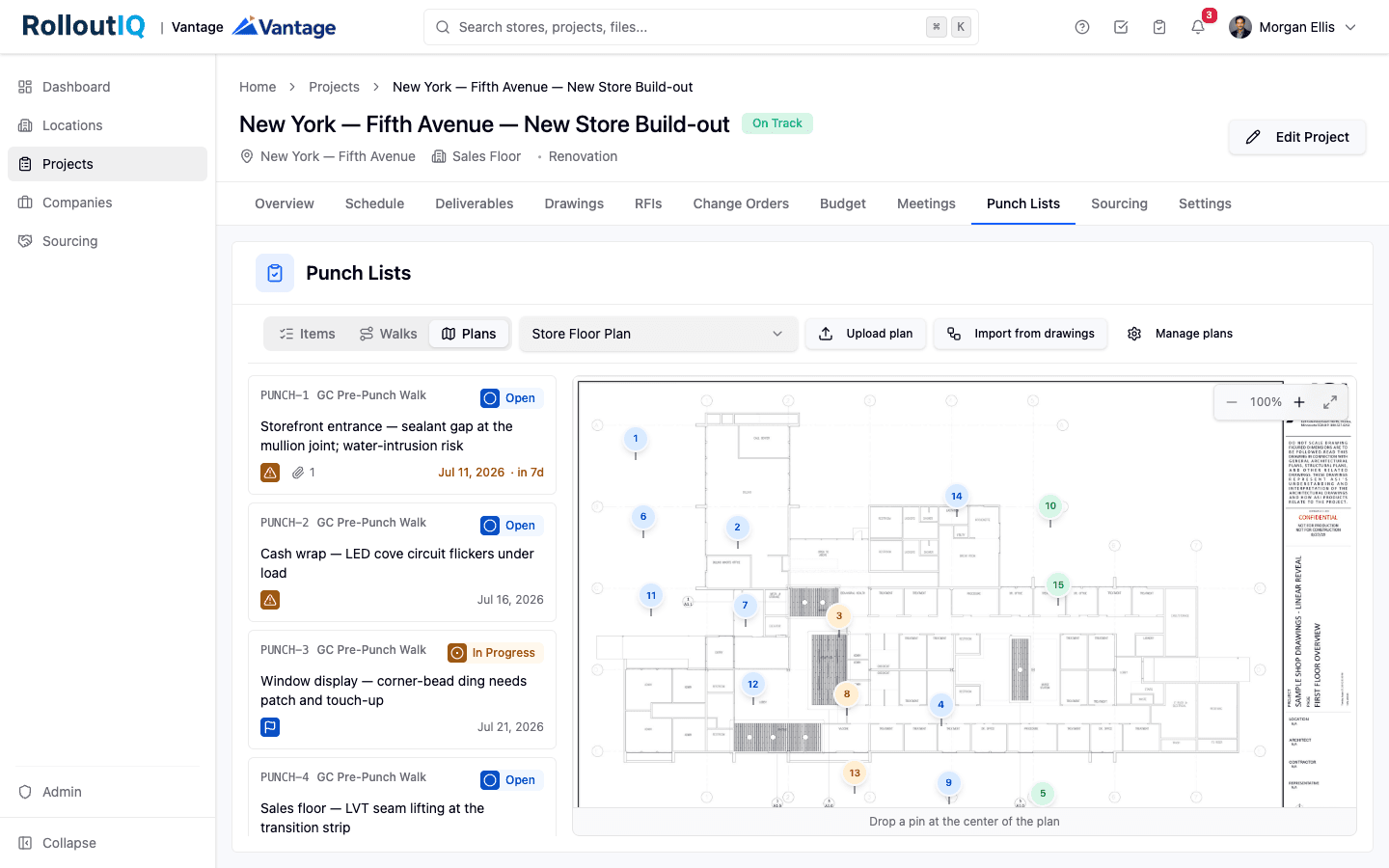
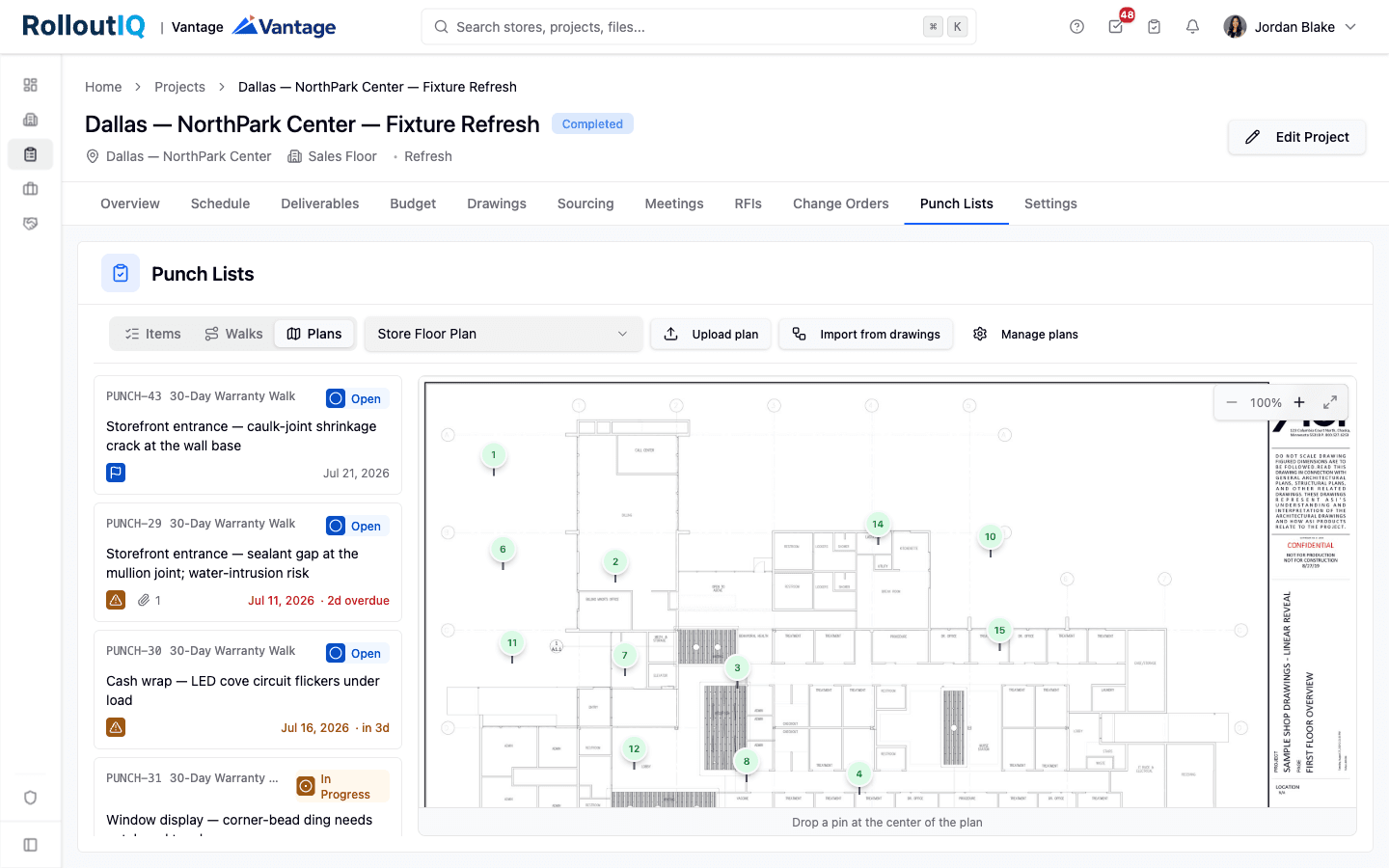
Capture has to fit the floor, not a desk. A walker on a phone taps the rear camera, picks a severity, and saves, or pins the defect to the store floor plan exactly where it lives, or works down a template item by item. Every item then sits on the plan as a pin colored by its status, so the team reviews the walk by looking at the space rather than reading a spreadsheet. Tap a pin to reopen the item, tap an empty spot to create one already pinned there.
This is the model RolloutIQ™ builds punch list management on, a walk-based backlog where checklist and ad-hoc items are captured on the plan and worked as one list.
Found Is Not the Same as Closed
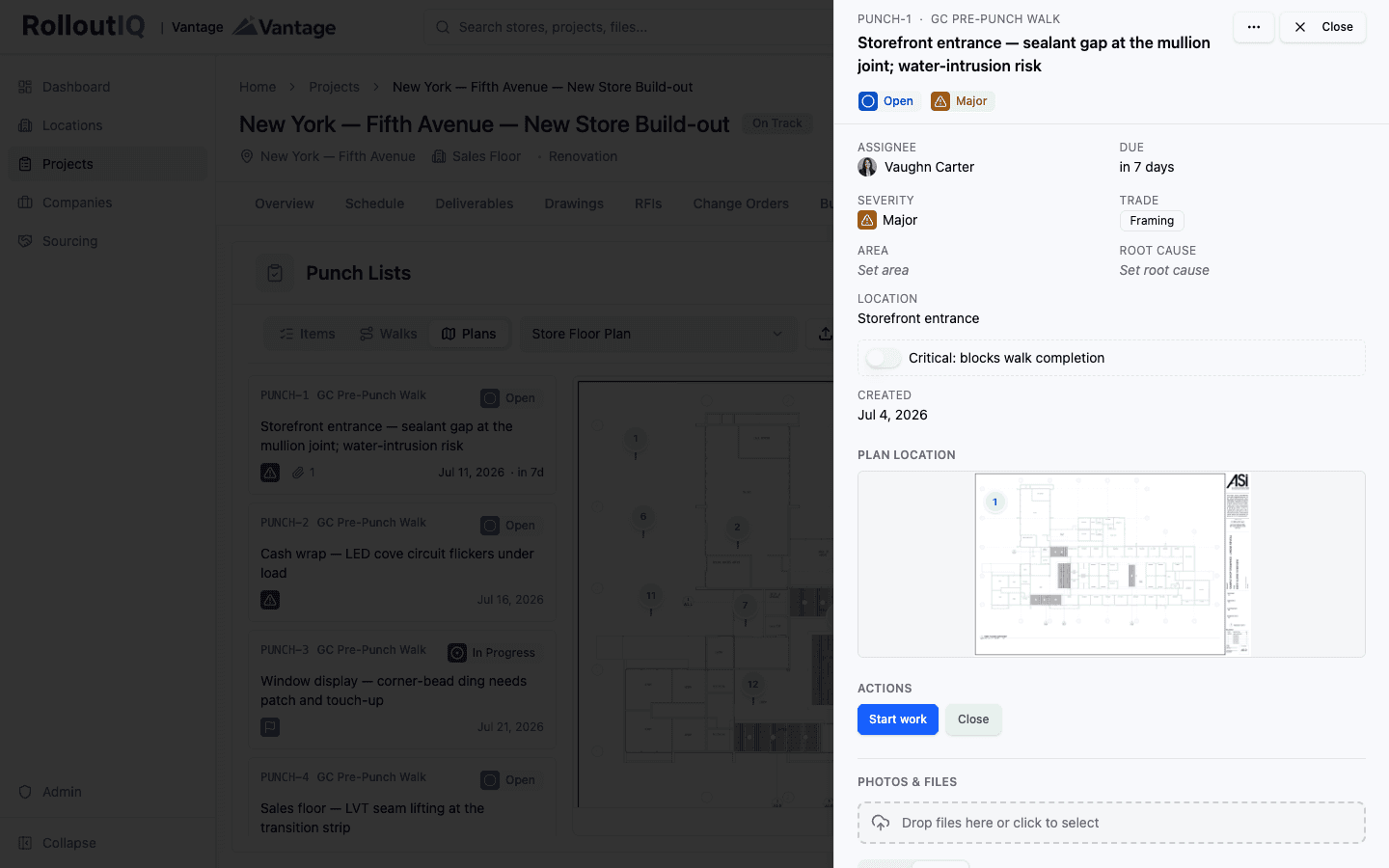
The distinction that protects an opening is between an item that was found and an item that was verified closed. An item should not reach closed until someone with verify authority signs it off after reviewing the evidence, and a walk should be able to trust vendors to self-close only when the situation genuinely calls for it. The default has to stay safe, because a defect closed by the person who created it is not really closed.
That is why criticals gate the walk. An item flagged critical blocks the walk from completing while it is open, so no store clears its pre-opening walk with an operational item unresolved. Each item carries what a verifier and a vendor both need, the photo, the severity, the trade, the plan location, and the assignee, on one record, so the person fixing it and the person verifying it are looking at the same thing.
One List Across Thirty Stores
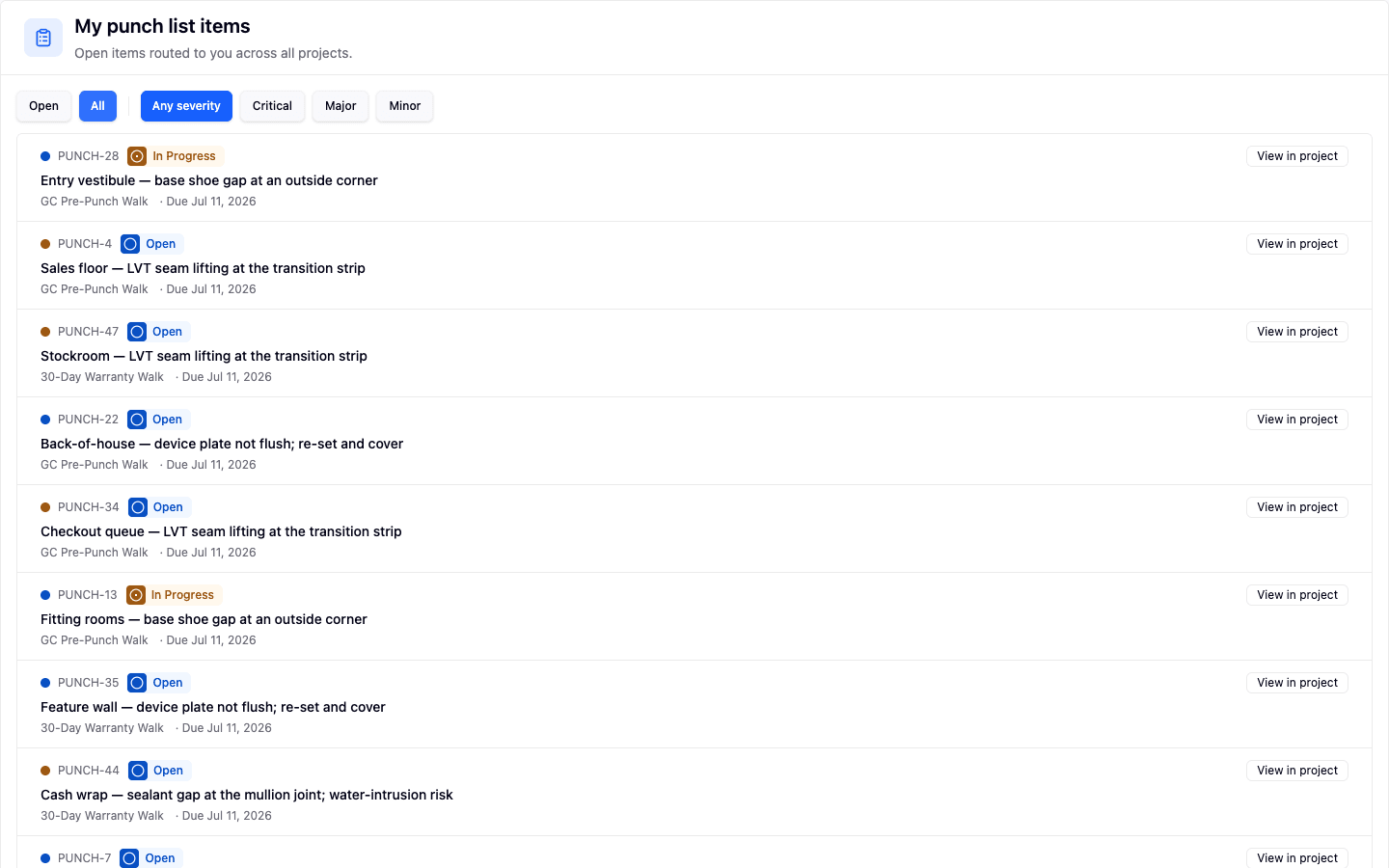
At portfolio scale two things change. First, every vendor works only their own items. A signage vendor and a millwork sub can be invited to the same store and each sees only the items routed to them or their company, never the other's, so cross-vendor work happens without cross-leakage. Second, the person tracking closeout does not open thirty tabs. Every open item routed to them lands in one cross-project inbox, filtered to just what needs action, across every project and every walk type.
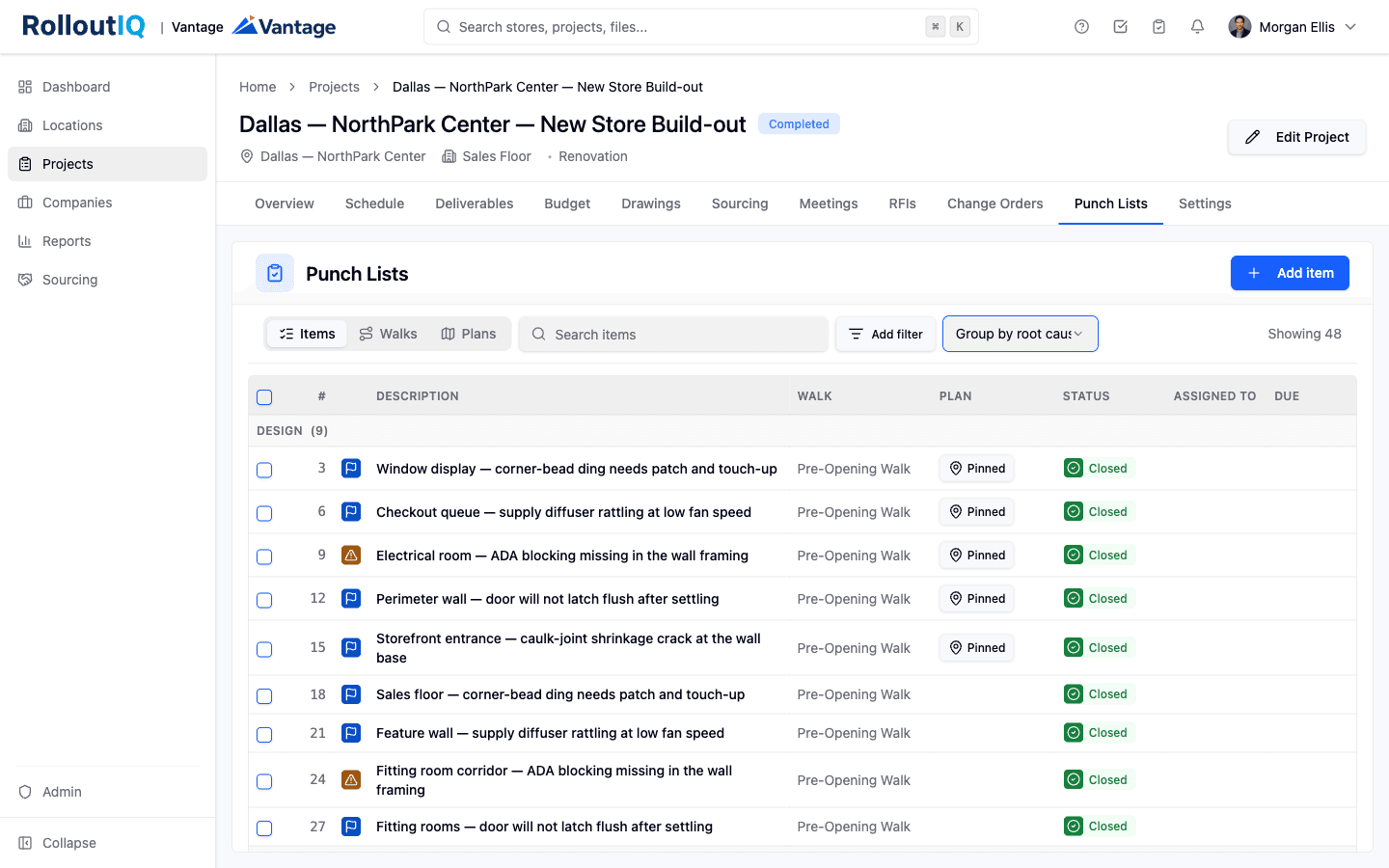
The backlog is also where a rollout finally learns from itself. Because every item carries a trade, an area, a severity, and an optional root cause, a defect that recurs at store five, store fifty, and store five hundred stops being a memory and becomes an observable pattern. When the same door closer fails at a third of new openings, that is a checklist item and a specification fix, caught before the next store is built, not the same punch written out by hand every opening.
What to Look For in Punch List Software
Whatever a multisite team uses to run punch, the same questions separate a system that gets stores open clean from one that just records defects after the fact. Before the next rollout, it is worth pressure-testing the workflow against a short list.
- Does every walk on the project land in one backlog, checklist items and ad-hoc defects together?
- Does it separate what was found from what was independently verified?
- Can a critical item block the walk from clearing until it is fixed?
- Can each vendor see and close only their own items, without seeing the others?
- Can a walker pin an item to the floor plan and capture it from a phone?
- Does every item carry a trade, area, and severity, so recurring defects surface across the portfolio?
The Rollout
The Rollout, in your inbox
A founder's read on retail and multi-site store development. What the latest news means for your pipeline, and what we are building, every couple of weeks.

Written by
Nariman Shariat
Founder, RolloutIQ
Nariman has spent about 20 years opening stores, in the seat between the landlord, the architect, and the general contractor, across some of the largest retail and workplace fleets in the country. Along the way he built the internal platform that ran store development across a fleet, then rebuilt the same idea company after company. He founded RolloutIQ to give multi-site development teams the single source of truth he kept having to build by hand, and writes here about the work of opening and remodeling stores at scale.
More about NarimanKeep Reading
Related Articles
Continue exploring best practices for store development and construction management.
Taking the Rollout Record Onto the Site Walk
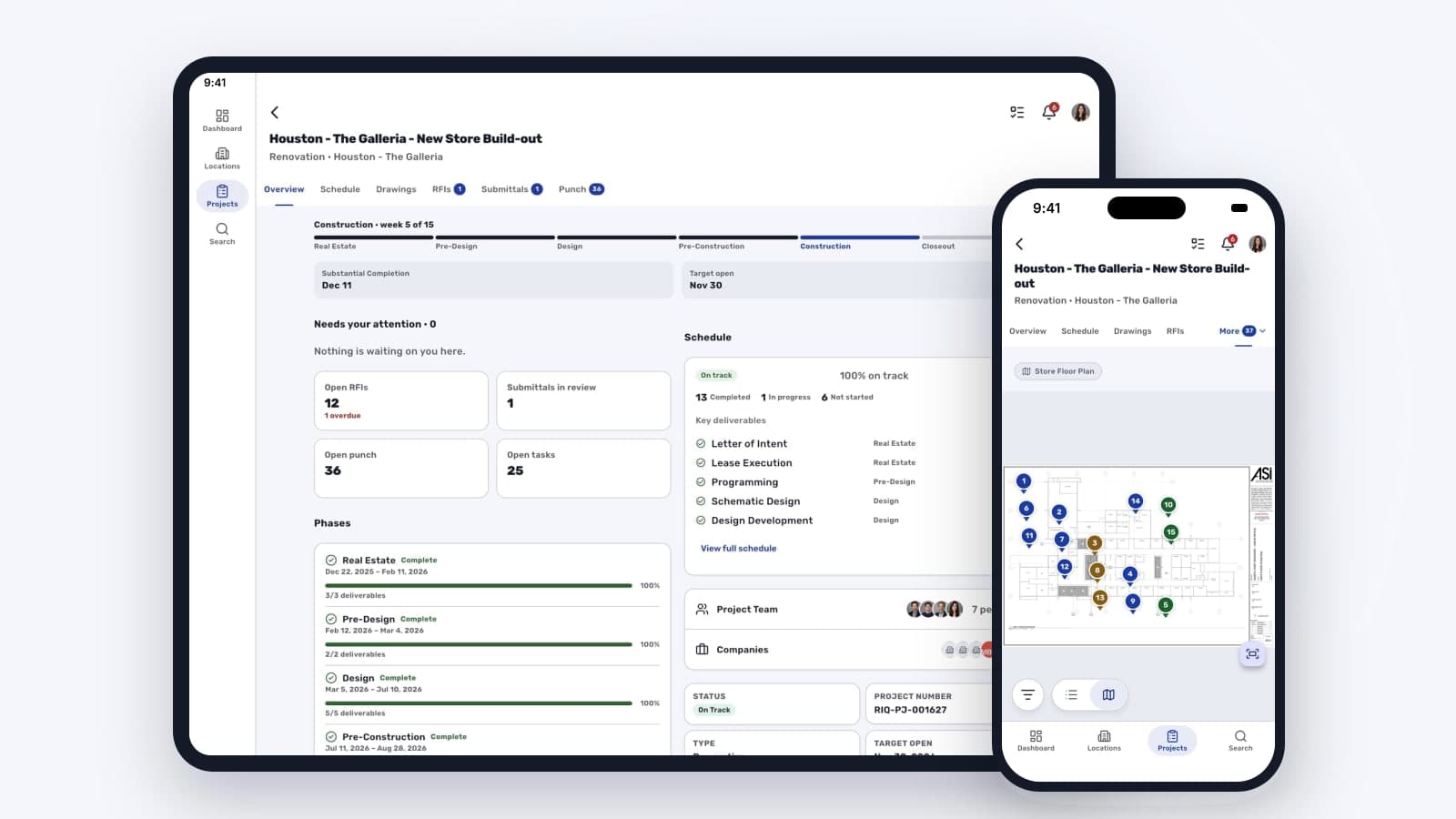
Store visits run on memory when the rollout record lives on a laptop. What changes when the build status and a punch walk pinned to the floor plan travel on the phone you carry into the store, along with the day's progress photos.
Punch List Management at Store Closeout
The punch list is where projects either finish cleanly or drag on for weeks. Here is how multisite operators manage punch lists so closeout actually closes.

Reducing Delays in New Store Openings: A Practical Guide
Every delayed store opening costs money in lost revenue, extended rent obligations, and team morale. Here are the practical strategies that top operators use to hit their dates.
The RFIs You're Answering Twice Are Telling You What to Fix
A top-10 retailer processes 30,000 to 200,000 RFIs a year at over $1,000 each. The hidden cost isn't the processing fee. It's that the same question gets asked 50 times across stores and nobody connects the dots.
Root Cause Coding Is How a Rollout Program Learns
The same question gets asked at store 5, store 50, and store 500. The record that would have prevented it usually exists already, closed and uncoded, in last year's log.
Ready to Build Smarter?
See how RolloutIQ™ can streamline your retail and multi-site rollout program. Book a personalized demo with our team.