

Construction Management
Reading RFIs as a Portfolio Signal
Build the same store 50 times and the questions that keep recurring turn into data worth reading across the fleet. A single RFI only ever speaks for its own store.
The question that stops the work
A request for information is a formal question that holds up a piece of the job until someone answers it. Two drawings disagree on a casework height, or a spec is missing a detail the installer needs. The field cannot guess, so it files an RFI and waits. That waiting is expensive. The Navigant Construction Forum's 2013 study of 1,362 projects and more than a million RFIs put the average cost to review and respond to a single one at about $1,080, and found that roughly 22% never got a written answer at all. The same study counted an average of 796 RFIs per project.
Each of those is a line of paperwork to clear on a single build, but the same paperwork repeated across a program starts to add up to a pattern.
When the same question comes back 50 times
Retail changes the picture, because the prototype is built 50 to 500 times. When two drawings disagree on that casework height, they disagree the same way at every store built from the same set. The RFI that cleared it in Phoenix gets filed again in Tampa by a project manager who never saw the Phoenix answer. Now the same question has cost you $1,080 twice, and it keeps costing until someone notices it is the same question.
That recurrence is the signal. A conflict that appears once is a project problem you solve and forget, but at a dozen stores the problem is the prototype itself, and the RFIs are the trail back to it. Read across the fleet, a rising count on one scope points straight at the sheet or the spec that needs fixing before the next 20 stores repeat it.
The signal only exists if you capture it
None of this works if the answers live in email. An RFI resolved in a Slack thread or a hallway conversation is invisible to the next store, so the pattern never forms. To read across the fleet, every RFI has to be captured the same way, on the record, with enough structure that the data means something later.
Most tools skip exactly that structure. RolloutIQ classifies every RFI as it is filed on three axes, its category, its reason, and its root cause, and keeps the question, the official answer, and the supporting files together on the project it belongs to. That classification is what lets you compare one store's questions against the next, instead of holding piles of answered RFIs with no way to tell which ones repeated.
From record to readout
Once the data is clean, reading it is a matter of pulling it. A program director preparing a quarterly review can filter every RFI on the prototype's electrical scope across the whole program and see the reasons stack up, without filing a ticket with IT or stitching together 50 exports. The recurring root causes rise to the top on their own. That readout is where a prototype revision gets justified, because the cost of the fix now has a store count and a dollar figure behind it.
The honest limit is that reading the pattern is still your team's judgment, and the software surfaces the structured data rather than drawing the conclusion for you. A person still has to look at the stack of electrical RFIs and decide the detail is wrong. The record at least removes the excuse that the data was never there to look at.
The record that holds up in a claim
The second reason to keep RFIs this disciplined shows up long after the store opens. An RFI is often the first written record that a problem existed and who was asked to fix it. A year later, when a dispute surfaces, that log is what a lawyer reads. So it has to hold up. RolloutIQ locks a closed RFI against edits after the fact and keeps a full audit trail of who asked and who answered, while an outside vendor sees only the RFIs they need for their own work, with the internal root-cause classification hidden from them. It is the same record either way, captured once and read later for whichever purpose the moment calls for.
Sources
The RFI cost and volume figures cited in this article come from the following industry research.
- Navigant Construction Forum, Impact & Control of RFIs on Construction Projects (2013), hosted by CMAA - https://www.cmaanet.org/sites/default/files/resource/Impact%20&%20Control%20of%20RFIs%20on%20Construction%20Projects.pdf
The Rollout
The Rollout, in your inbox
A founder's read on retail and multi-site store development. What the latest news means for your pipeline, and what we are building, every couple of weeks.

Written by
Nariman Shariat
Founder, RolloutIQ
Nariman has spent about 20 years opening stores, in the seat between the landlord, the architect, and the general contractor, across some of the largest retail and workplace fleets in the country. Along the way he built the internal platform that ran store development across a fleet, then rebuilt the same idea company after company. He founded RolloutIQ to give multi-site development teams the single source of truth he kept having to build by hand, and writes here about the work of opening and remodeling stores at scale.
More about NarimanKeep Reading
Related Articles
Continue exploring best practices for store development and construction management.
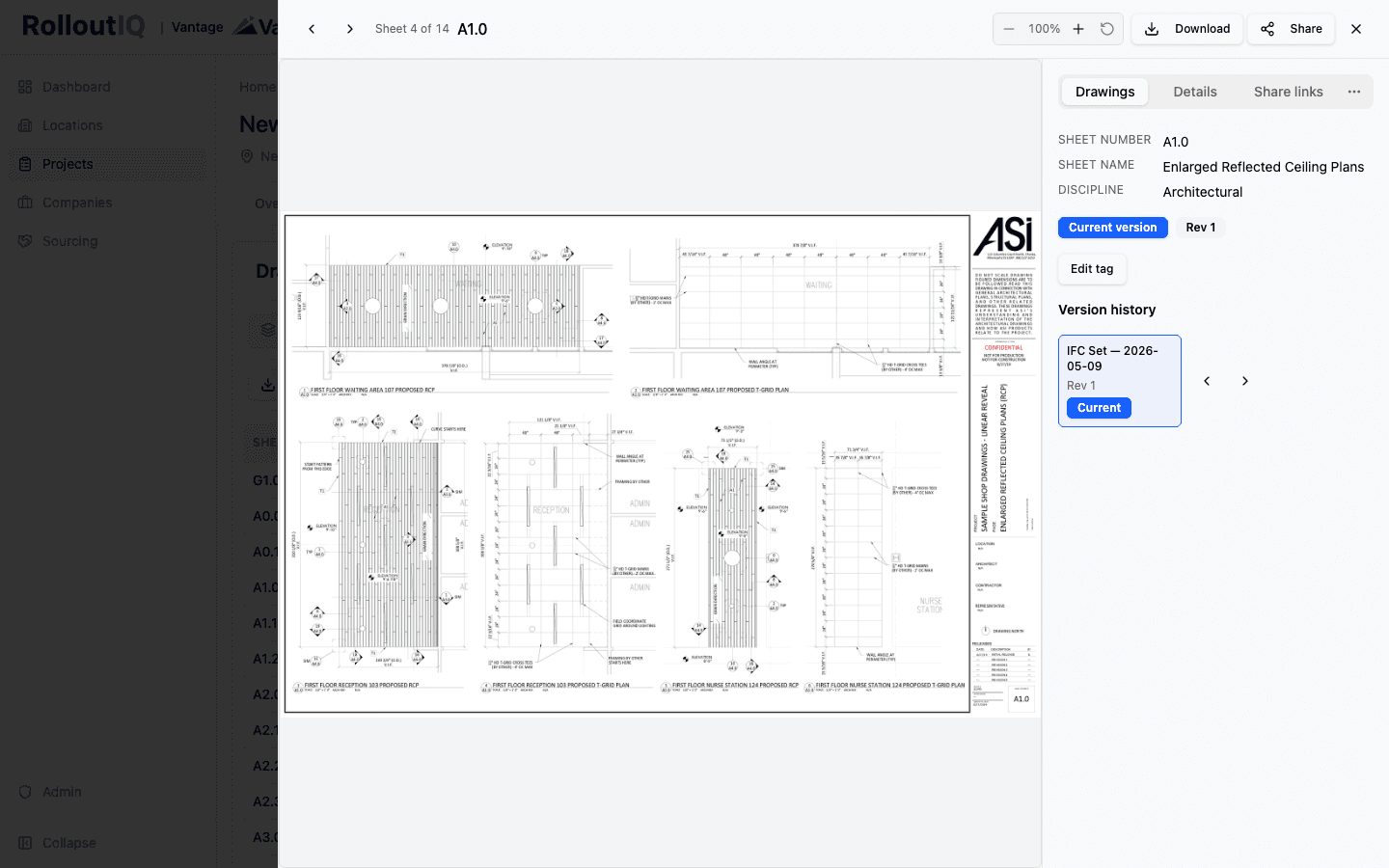
Current Drawing Set Version Control: Keeping the Field Off Stale Sheets
A drawing set is a versioned graph of sheets, not a single PDF. Filename-based storage is why stale sheets reach the field. Per-sheet version identity and automatic supersession on re-issuance keep everyone on the current set.

Why Store Rollouts Fail, and Why the Failure Is Systemic
A store opens late and the general contractor takes the blame. The same slip shows up at the next store, and the next. The causes of rollout failure are a stable, well-documented handful, which is what keeps them recurring at store 5, 50, and 500.
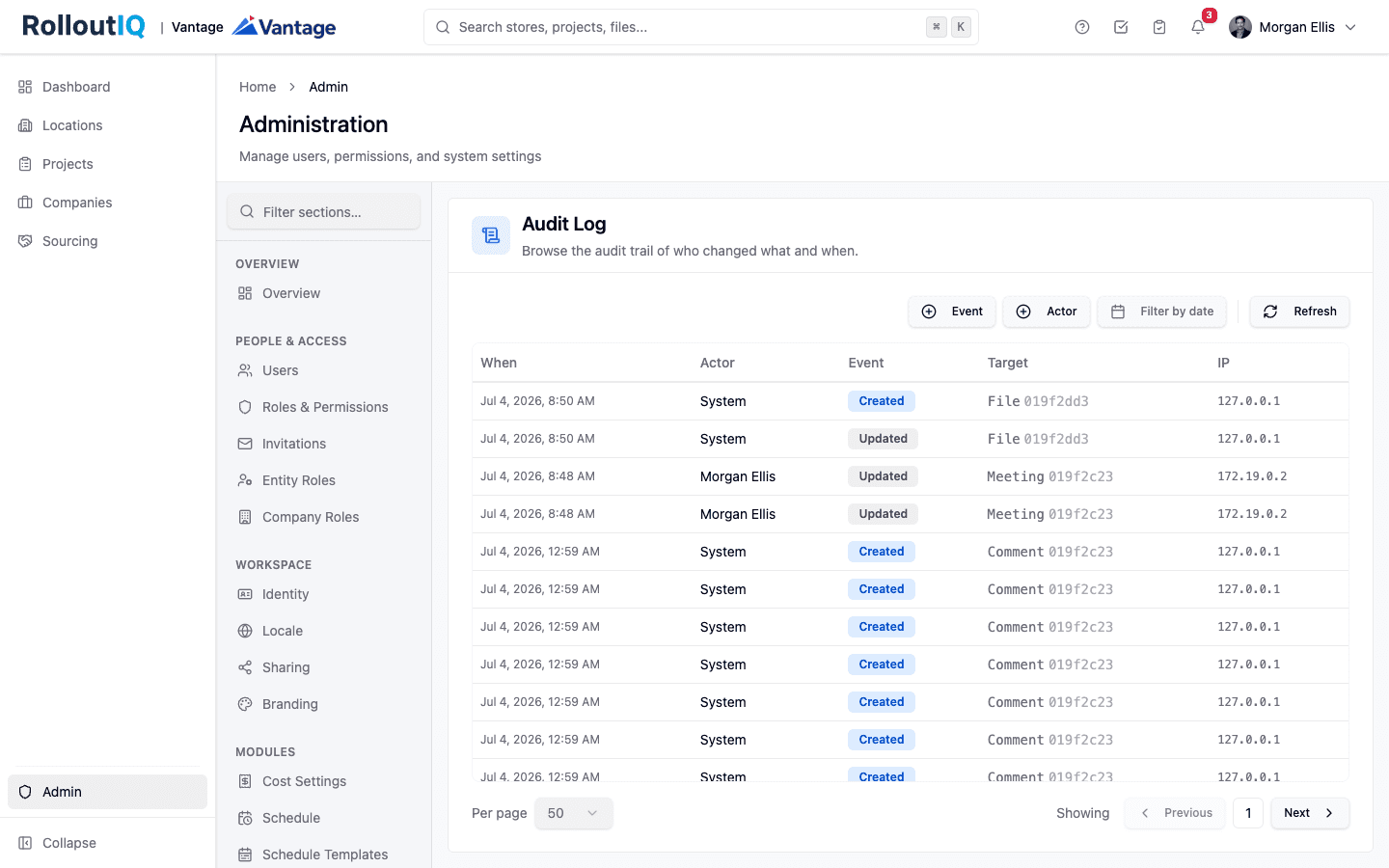
The Audit Trail Is What Settles the Dispute in Retail Construction
In retail construction, the record that would settle a dispute usually never existed. Email and spreadsheets keep no immutable history of who approved what and when. An append-only audit trail does, and it is what wins warranty claims, change-order fights, and compliance reviews.
Ready to Build Smarter?
See how RolloutIQ™ can streamline your retail and multi-site rollout program. Book a personalized demo with our team.