
Construction Management
The audit trail is what settles the dispute
When the record of who approved what lives in email and spreadsheets, you cannot prove it. An append-only audit trail turns commitments into evidence that holds up in a warranty claim, a change-order fight, or a compliance review.
The record that would settle it usually never existed
Every dispute in retail construction comes down to the same question. Who agreed to what, and when. A landlord chargeback, a warranty claim on a refrigeration install, a change order the general contractor swears was approved verbally, a milestone that slipped the night before a store was supposed to open. In each case the resolution hinges on a contemporaneous record of the decision, not on anyone's memory of it.
The problem is that the record usually lives in email threads, text messages, and shared spreadsheets. A spreadsheet can be edited by anyone with the link, and it keeps no history of who changed which cell. An email chain proves a message was sent, but not that a scope was approved, not who saw the final version, and not whether a figure was quietly revised after the fact. When the record that would settle a dispute is spread across half a dozen tools and none of them is immutable, every disagreement becomes a forensic exercise. The party with the better filing habits wins, and the truth is often unrecoverable.
Industry research puts a number on the cost of that fragmentation. Research by PlanGrid and the consultancy FMI, surveying nearly 600 construction leaders, found that rework and other non-optimal activity costs roughly $177 billion a year in US construction labor, and that miscommunication and poor project data together drive about 48 percent of all rework on US jobsites. Break that figure apart and inaccurate or inaccessible information alone accounts for roughly 22 percent of rework, a category of waste that traces directly to records no one can trust or find.

What an append-only record actually captures
An audit trail solves the trust problem by writing the history automatically as work happens, rather than asking people to remember it later. Every meaningful change to a project, a store location, a request for information, a task, a file, or a role assignment writes a row the moment it occurs.
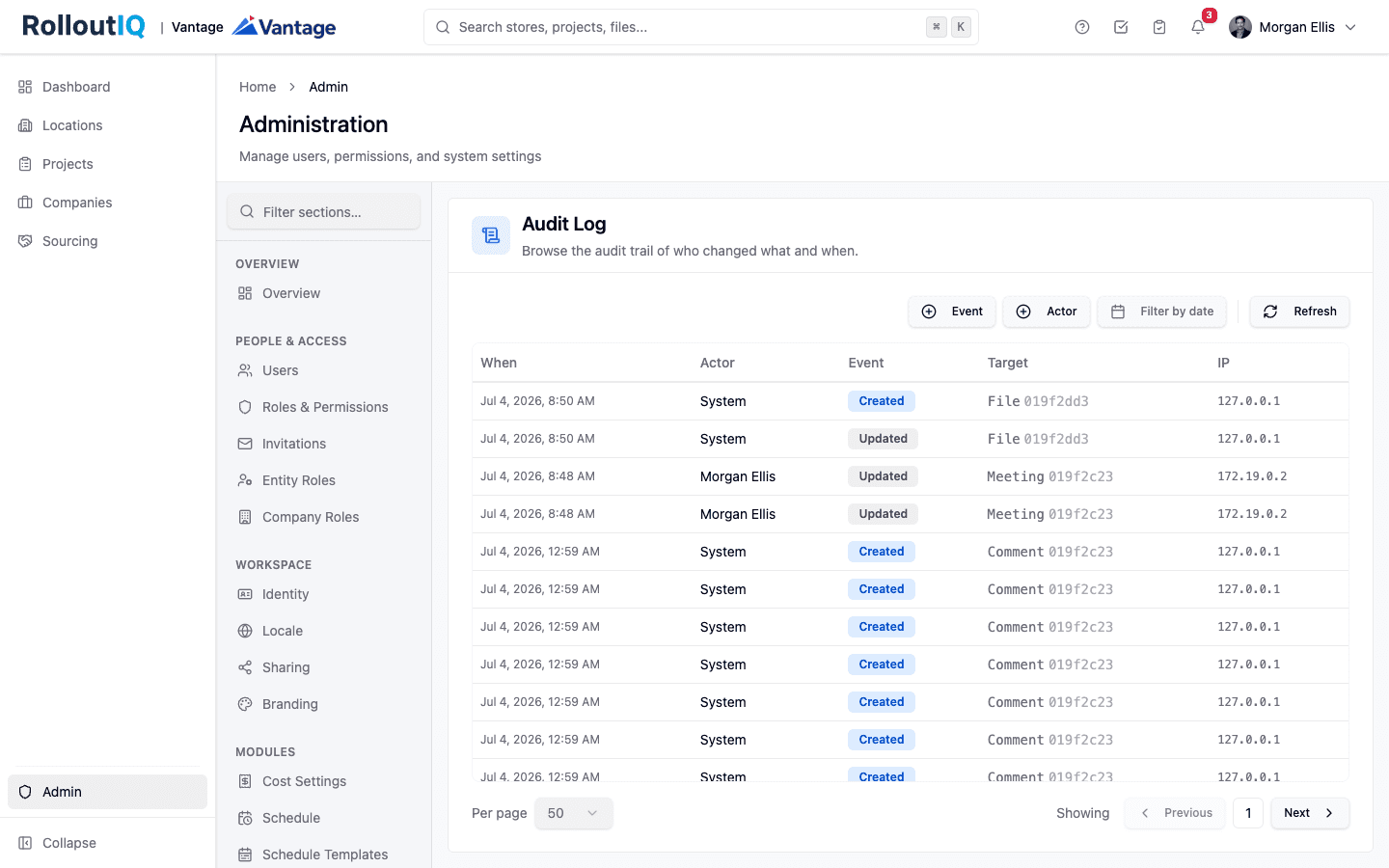
Each row answers the three questions a dispute turns on. Who performed the action, resolved to a named user with an email. What changed, captured as the specific fields that moved, with the previous value and the new value stored side by side so a status change or a revised due date is visible at a glance. And when it happened, stamped to the second. The trail distinguishes records that were created, updated, deleted, and restored, and it carries the request context as well, including the IP address and the browser that performed the action.
That last detail matters more than it looks. A defensible record does not just say a figure changed. It shows the figure was 12 fixtures on Tuesday and 14 fixtures on Wednesday, names the person who made the edit, and omits every field that did not move so the one that did stands out. This is the difference between an assertion and evidence.
Immutability is the whole point
A record only settles disputes if it cannot be quietly rewritten by the party a dispute would embarrass. This is why the trail is append-only and read-only by design. There is no function inside the product to edit, redact, hide, or delete an audit row. Corrections happen by adding a new event, never by altering an old one, so the history only ever grows.
The legal weight of this is well established. RFI logs and their contemporaneous records are routinely admitted as evidence in construction litigation, arbitration, and board claims. Altering that record after the fact is spoliation, and courts respond to it with adverse-inference sanctions, meaning they instruct the fact-finder to assume the missing or altered evidence would have hurt the party that tampered with it. A spreadsheet offers no protection here because nothing stops the edit and nothing records it. An immutable trail removes the temptation and the argument at once.
Immutability does not mean the record leaks sensitive data. Passwords, multi-factor secrets, and session tokens are excluded from the captured values, so a security change shows that a password was changed without ever exposing it.
The people outside your walls are on the record too
Retail rollouts are not built by employees alone. Direct-contract vendors, general contractors, architects of record, and landlords all take actions that a dispute may later turn on. A well-built trail captures those external participants with their own identity, exactly the way it captures internal staff. When a signage vendor updates a submittal or a contractor closes an RFI, the row names them, not a generic shared account.
Two design choices make the record durable over the years that a warranty or a claim window can run. First, visibility is scoped. The full audit log is restricted to the owners and administrators responsible for governance, so the record exists for everyone but is inspected only by the people entitled to review it, and external parties see the slice of the work they participate in rather than the whole trail. Second, the record survives staff turnover. Construction management carries real annual turnover, and project managers move between projects and employers often enough that the person who made a decision is frequently gone by the time it is questioned. When a user is deactivated, their older audit rows still resolve to the real name and email of the person who acted. The chronology stays readable long after the person has left, which is precisely when a dispute tends to surface.
What a defensible record needs
Whether you build the record in a purpose-built platform or try to assemble one from the tools you already have, the same properties separate a record that holds up under questioning from one that collapses.
- An actor on every entry, resolved to a named person with an email, never a shared login or an anonymous 'system' edit.
- A precise timestamp on every change, granular enough to reconstruct the order events actually happened in.
- Before-and-after values for edits, so a revised figure or a changed status shows what it was and what it became.
- Append-only immutability, with no way to edit or delete a past entry from inside the tool.
- Scoped visibility, so external contractors and vendors are captured but each party reviews only what it should.
- Persistence through personnel changes, so deactivated users still resolve to a real identity years later.
- Per-record chronology, so the full history of a single RFI, task, or location can be read in order without rebuilding it by hand.
From a filing habit to a claim file
The value of an immutable trail is clearest at the moment a dispute becomes formal. Construction claim windows are short. Under standard AIA general conditions a claim must be initiated within 21 days of the event that gave rise to it, and differing site conditions carry their own 14-day notice requirement. Reconstructing what happened from memory and scattered email inside those windows is how valid claims get abandoned and weak ones get paid.
A single searchable trail changes the economics of that moment. Instead of paying people to hunt through inboxes, the team filters the record by actor, by event type, and by date range, and reads the chronology of the exact decision in question. The same record that resolves a change-order dispute also answers a warranty claim about who approved an equipment substitution and satisfies a compliance reviewer who needs proof that approvals were recorded with a real actor and timestamp. RolloutIQ writes this trail automatically as the work is done, so the claim file is already assembled before anyone knows they need it.
The record that settles a dispute cannot be created after the dispute starts. It has to have been accumulating, untouched, the entire time. That is the one property email and spreadsheets can never offer, and it is the reason the audit trail, not the argument, is what wins.
Sources
The benchmarks cited in this article come from the following industry research.
- PlanGrid and FMI, research on the cost of construction rework and non-optimal activity, reported by Construction Dive - https://www.constructiondive.com/news/industry-could-be-overspending-177b-per-year-study-finds/529450/

Written by
Nariman Shariat
Founder, RolloutIQ
Nariman has spent about 20 years opening stores, in the seat between the landlord, the architect, and the general contractor, across some of the largest retail and workplace fleets in the country. Along the way he built the internal platform that ran store development across a fleet, then rebuilt the same idea company after company. He founded RolloutIQ to give multi-site development teams the single source of truth he kept having to build by hand, and writes here about the work of opening and remodeling stores at scale.
More about NarimanKeep Reading
Related Articles
Continue exploring best practices for store development and construction management.
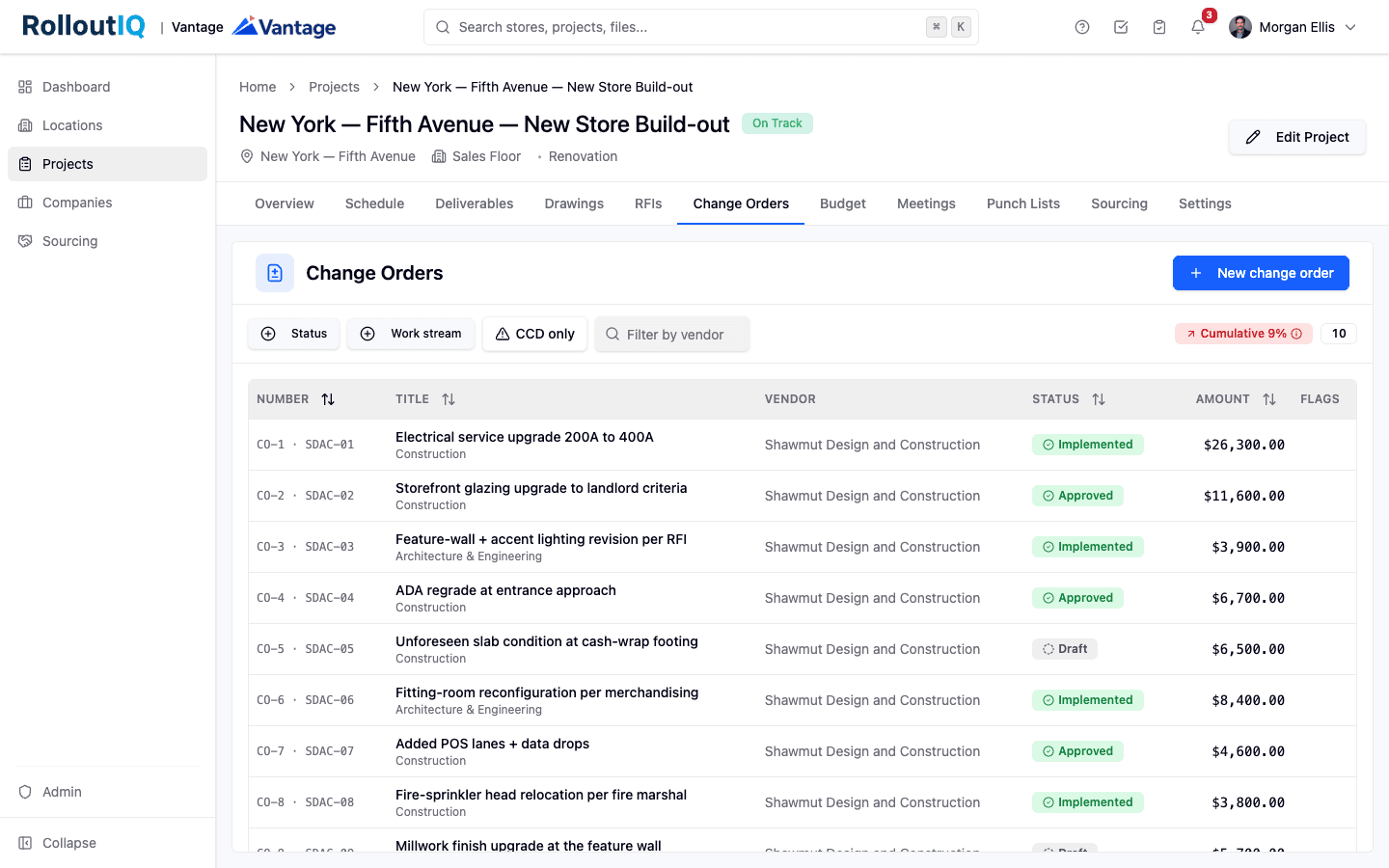
Change Order Management for Retail Rollouts: The Change Outside the GC
On a retail rollout, a large share of cost flows around the general contractor into fixtures, technology, signage, and equipment. Here is how to keep change orders from those streams from surfacing as a closeout surprise.

RFI Management Best Practices for Retail Construction
RFIs are inevitable. Slow RFI responses are not. Here's how high-performing retail construction teams turn RFIs from a delay risk into a managed workflow.
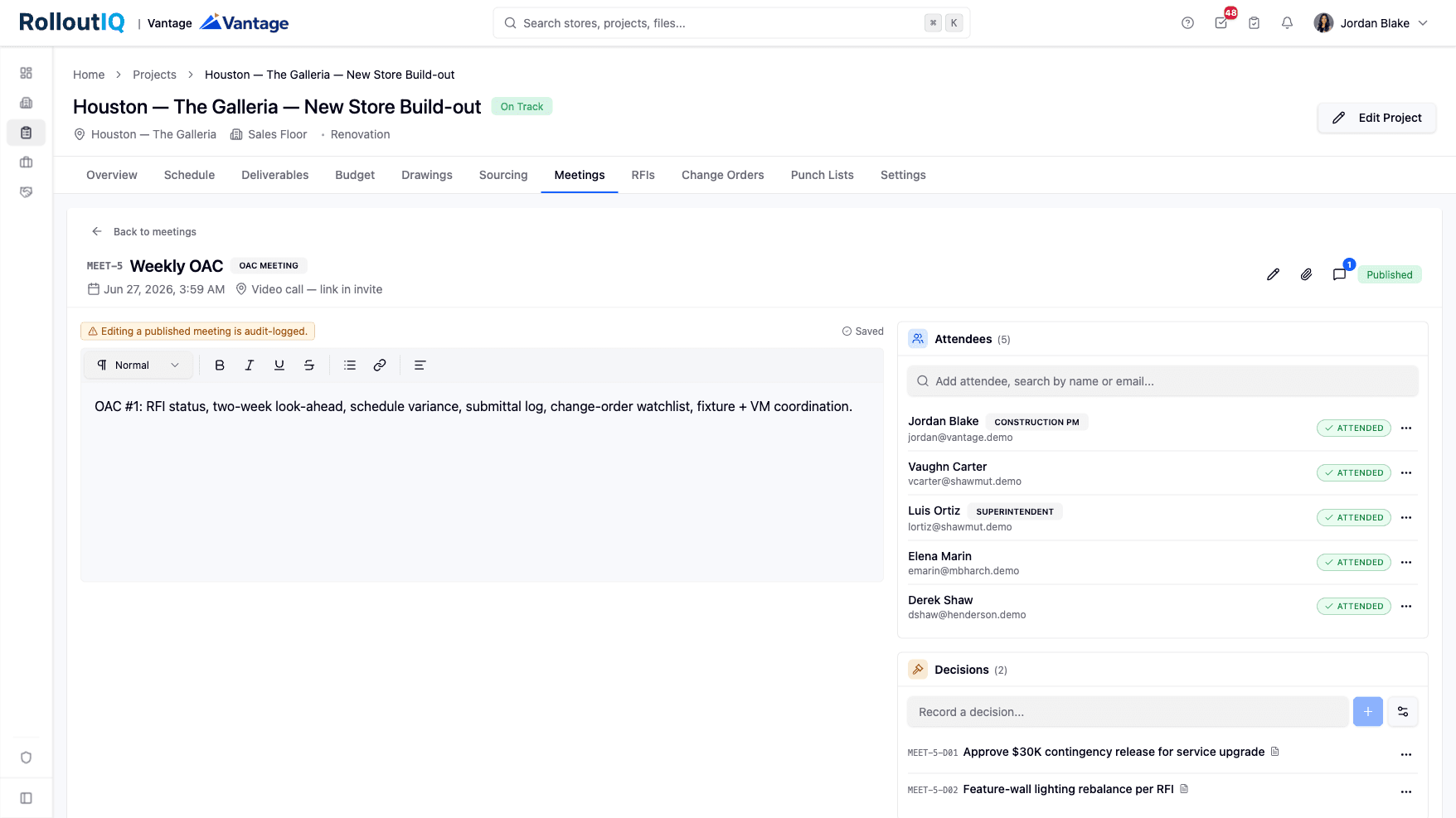
When Twelve OAC Meetings Decide an Opening, Minutes Need to Be Records
A retail rollout decides itself in 12 to 20 OAC meetings, plus 4 to 6 parallel coordination streams running underneath. When minutes live in Word docs and emailed PDFs, the decisions get re-litigated and the action items get lost. Here is what meeting minutes need to do at multisite scale.
Ready to Build Smarter?
See how RolloutIQ™ can streamline your retail and multi-site rollout program. Book a personalized demo with our team.