

Construction Management
RFI Management for Retail Construction
Requests for information are inevitable on every project. How you handle them determines whether they become days of lost progress or minor administrative friction.
Why RFIs Stall Retail Projects
An RFI raised in the field stops some portion of work until it is answered. On retail construction projects with compressed timelines and multiple trades working in close sequence, even short RFI delays cascade quickly.
The cost is not trivial. The Navigant Construction Forum, in the most-cited benchmark study of RFIs, put the average cost to review and respond to a single RFI at about $1,080 in 2013 dollars, and more recent estimates reported by Construction Dive put it closer to $2,000 to $3,000 today. The same Navigant research, which spanned 1,362 projects and roughly 1.1 million RFIs, found that about 22 percent of RFIs never receive a written response at all. Roughly one in five questions your field team raises simply goes unanswered.
The operators who have RFI problems are not the ones who get more RFIs. They are the ones whose RFIs sit in inboxes for days because there is no clear ownership, no SLA, and no visibility into the queue. The fix is process, not fewer RFIs.
Establish an RFI SLA
Every RFI should have a target response time tied to its urgency. The simplest model has three tiers: critical (response in 24 hours, work is stopped), standard (48 to 72 hours), and reference (one week, work continues).
The number to beat is not zero, it is the industry average. Procore's benchmark data puts the typical time from an RFI being opened to its first response at 7.3 calendar days. A tiered SLA is how high-performing teams stay well under that average instead of drifting toward it.
The field team is responsible for tagging the urgency when they submit the RFI. The office team is responsible for responding within the SLA. When the office team disagrees with the urgency rating, that conversation happens fast, not as a reason to delay the response.
Centralize the RFI Log
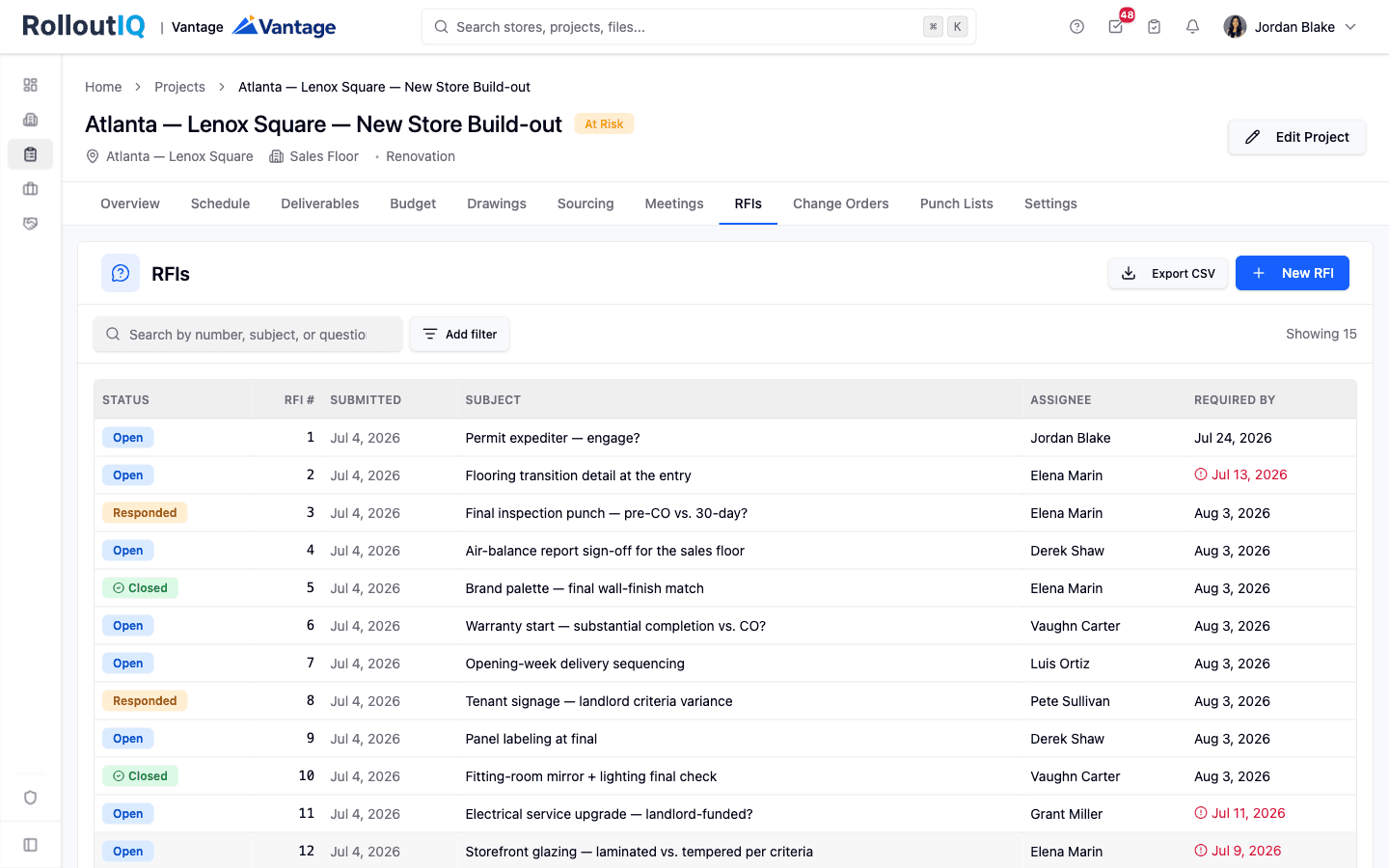
RFIs scattered across email threads, text messages, and field notes are RFIs that get lost. A centralized log per project, accessible to the GC, the architect, the engineer, and the owner team, makes ownership and status visible.
The log should track who raised the RFI, who owns the response, the date submitted, the SLA target, the date answered, and the answer itself. Open RFIs should be visible to leadership in a portfolio view, with old or overdue ones flagged for escalation.
Patterns to Watch
RFI volume and content reveal patterns about your projects and your design process. Track them.
- RFI volume by project compared to similar projects (high volume signals design or scope problems)
- RFI volume by trade (clusters indicate coordination gaps)
- Recurring topics across projects (signals a gap in your standard design)
- Average response time by responder (identifies bottlenecks)
- RFIs leading to change orders (reveals scope or design issues that should have been caught earlier)
Closing the Loop with Pre-Construction
The best RFI management is preventing RFIs from being needed. The Construction Industry Institute has found that roughly 80 percent of RFIs trace back to drawing conflicts, unclear specifications, or missing details. That is a documentation problem, which means most RFIs are preventable upstream rather than inevitable.
When the same questions keep getting asked across projects, that is feedback for your pre-construction and design process. Update your standard drawings, your specifications, or your design review checklist so the issue is closed at the source.
This is where multisite operators have a structural advantage over one-off builders. Every RFI is a learning opportunity that can improve every future project. Capture them, analyze them, and feed them back into the system that produced them.
Sources
The benchmarks cited in this article come from the following industry research.
- Navigant Construction Forum, Impact and Control of RFIs on Construction Projects (April 2013), hosted by CMAA - https://www.cmaanet.org/sites/default/files/resource/Impact%20%26%20Control%20of%20RFIs%20on%20Construction%20Projects.pdf
- Construction Dive, reporting on current per-RFI cost estimates - https://www.constructiondive.com
- Procore, RFI opened-to-first-response benchmark data - https://www.procore.com
- Construction Industry Institute, research on RFI root causes - https://www.construction-institute.org
The Rollout
The Rollout, in your inbox
A founder's read on retail and multi-site store development. What the latest news means for your pipeline, and what we are building, every couple of weeks.

Written by
Nariman Shariat
Founder, RolloutIQ
Nariman has spent about 20 years opening stores, in the seat between the landlord, the architect, and the general contractor, across some of the largest retail and workplace fleets in the country. Along the way he built the internal platform that ran store development across a fleet, then rebuilt the same idea company after company. He founded RolloutIQ to give multi-site development teams the single source of truth he kept having to build by hand, and writes here about the work of opening and remodeling stores at scale.
More about NarimanKeep Reading
Related Articles
Continue exploring best practices for store development and construction management.
Submittal Review Workflows That Do Not Slow the Job Down
A submittal is the gate on procurement, so a slow review reaches past the paperwork and delays the factory itself. This is where submittal workflows break on a rollout, and what to change first.
The Audit Trail Is What Settles the Dispute in Retail Construction
In retail construction, the record that would settle a dispute usually never existed. Email and spreadsheets keep no immutable history of who approved what and when. An append-only audit trail does, and it is what wins warranty claims, change-order fights, and compliance reviews.
Document Management Best Practices for Construction Projects
Poor document management costs construction teams hours every week and creates real project risk. Here are the best practices for getting it right across your portfolio.
The Complete Guide to Multi-Site Construction Management
Managing construction across multiple sites simultaneously requires a fundamentally different approach than single-project management. Here is your complete guide.
The RFIs You're Answering Twice Are Telling You What to Fix
A top-10 retailer processes 30,000 to 200,000 RFIs a year at over $1,000 each. The hidden cost isn't the processing fee. It's that the same question gets asked 50 times across stores and nobody connects the dots.

Right Person, Right Channel: Notifications That Do Not Flood the Inbox
When every module pings everyone, people learn to ignore the alerts that matter. Getting notifications to the right person on the right channel is what keeps the signal above the noise across a rollout.
Ready to Build Smarter?
See how RolloutIQ™ can streamline your retail and multi-site rollout program. Book a personalized demo with our team.