
Construction Management
Root Cause Coding Is How a Rollout Program Learns
Every exception on a project is a piece of evidence about why the program is harder than it should be. Most of it gets closed and thrown away.
Your Program Already Generates the Data It Needs
A rollout produces three continuous streams of evidence about what is not working. RFIs are where the documents were unclear or wrong. Change orders capture scope or price moving after it was supposed to be settled, and punch items are what turns up when the work came out different from the spec.
Each of those is treated as a transaction. Something opened, someone handled it, it closed, and success was measured in cycle time. That is a reasonable way to run one project, and it is exactly why the pattern never gets caught: on a single build, the exception is a one-off.
Rollout is a different situation. You are building the same prototype 50 or 500 times, from the same drawings, with the same fixture package, and often the same vendors. An exception at store 5 is a preview. The same door that failed to latch, the same missing detail, the same question already asked once, all of it recurs, and every repetition costs full price.
The uncomfortable part is that the evidence is almost always already there. The RFI that would have predicted the problem was filed, answered, and closed. What it was missing was a coded cause, which is the one thing that would have let anyone find it again.

The Cost of Answering the Same Question 50 Times
The Navigant Construction Forum studied 1,362 projects carrying roughly 1.1 million RFIs and put the average cost to review and respond to a single RFI at about 1,080 dollars, with roughly 22% receiving no written response at all. It also found that RFI density runs higher on smaller projects, around 17 per million dollars of construction cost on work under 50 million, which is the range nearly all retail construction sits in.
Run that against a real program. A hundred stores at two million dollars each generates a large number of RFIs, and the processing cost alone is a line item nobody has a budget code for. The Construction Industry Institute has attributed roughly 80% of RFIs to drawing conflicts, unclear specifications, or missing details, which is another way of saying most of them trace back to a document you own and could change.
Change orders carry the same signature. AIA Contracts, analyzing 892,457 change orders across 18,229 projects, found an average cost impact of about 5.04% in the one to five million dollar band where most retail tenant improvement work sits. On a hundred store program that is a material number, and the portion of it that repeats a known issue is entirely recoverable.
Across a rollout, that same root cause analysis predicts what the next stores will hit instead of only explaining the last one.
Cause Has to Be Coded When the Record Is Created
The single decision that determines whether any of this works is when the cause gets recorded.
Code it at creation and it costs a few seconds, because the person filing knows exactly why they are filing and picking from a short list is close to free. Wait, and the cost becomes a reconstruction: someone reads a closed thread months afterward, infers intent from a two-sentence answer, and guesses. In practice that never happens, because nobody is funded to do archaeology on last quarter's logs.
Two rules make the discipline survive contact with a busy team. Keep the list short, and make the field required. A cause list with 40 values gets used inconsistently, because the choice between three plausible options becomes a judgment call and different people make it differently, which destroys the comparability the whole exercise depends on. Eight to 12 values is enough to act on. If you need more nuance, add a second axis rather than lengthening the first.
And free text is not a cause code. A description field is valuable and should exist, but it cannot be grouped, counted, or trended. A sentence is documentation. To count, group, or trend a cause you need it recorded as data.
A Cause Taxonomy That Works Across All Three
The categories below hold up across RFIs, change orders, and punch items, which matters more than it sounds. When all three streams share a vocabulary, you can see that a single prototype detail is generating questions in preconstruction, priced changes during the build, and defects at closeout. That is a far stronger case for fixing it than any one stream makes alone.
Adapt the wording to your program, but keep the count low and the boundaries clear.
- Design conflict or omission. The documents disagree with each other, or the detail needed to build it is missing. The prototype team can act on this category most directly.
- Code or jurisdiction. A local amendment, an inspector interpretation, or a plan-review comment forced a deviation. Track the jurisdiction alongside it, because the value here is knowing which cities to pre-adapt for.
- Existing or field condition. What was found on site did not match what was drawn. Common on remodels and landlord deliveries, and a signal about diligence quality more than design quality.
- Brand or prototype change. The standard moved mid-program. Often legitimate and correct, but it should be visible as a program cost rather than absorbed silently into project variance.
- Vendor or fabrication error. Shop drawings, materials, or installation did not match what was approved. This is the category that feeds a vendor scorecard.
- Coordination gap between scopes. Nobody's drawing was wrong, but the boundary between two contracts was never defined. The classic case is general contractor rough-in against a directly purchased fixture or piece of equipment.
- Landlord or base building. Delivered condition, work letter interpretation, or a shell defect. Worth separating because the recovery path is commercial rather than technical.
- Supply or lead time. A substitution or resequence driven by availability rather than by anyone's error.
- Answerable from the documents. The question was already answered in the set. Keep this one visible: the research behind the RFI justification work found roughly 13% of RFIs were not justifiable, and a stubborn share of that is a distribution problem rather than a design problem.
Somebody Has to Own the Loop
Coding causes produces a report. A report does not change anything on its own, and this is where most attempts quietly end.
Most often what is missing is an owner. Prototype teams own revisions and construction teams own delivery, but almost nobody carries a stated objective of reducing next year's exceptions, so nothing converts a pattern into a change. Name the person. It is usually design or standards, with a construction counterpart who supplies the evidence.
There also has to be a cadence and a threshold. Reviewing causes annually is the same as not reviewing them, because a rollout can build 40 stores in the gap. A monthly or quarterly review of the top recurring causes, with an explicit trigger for action (the same cause on five or more stores, or 10 instances in six months) turns a dashboard into a decision.
Psychological safety is easy to overlook, and it is the one that silently ruins the data. If a cause code reads as an accusation, people pick the vague option. Code the artifact rather than the person. The question is what in the documents, the process, or the handoff produced this, and never who was careless. A team that reads the taxonomy as a blame instrument will hand you clean-looking data that means nothing.
The measurement that closes the loop is simple and rarely done. After a prototype revision ships, compare the exception rate on stores built to the new version against stores built to the old one. A real change shows up as a lower exception rate on the stores built to the new version.
What This Looks Like in Practice
RolloutIQ™ treats classification as part of the record rather than an optional afterthought, which is the practical prerequisite for everything above.
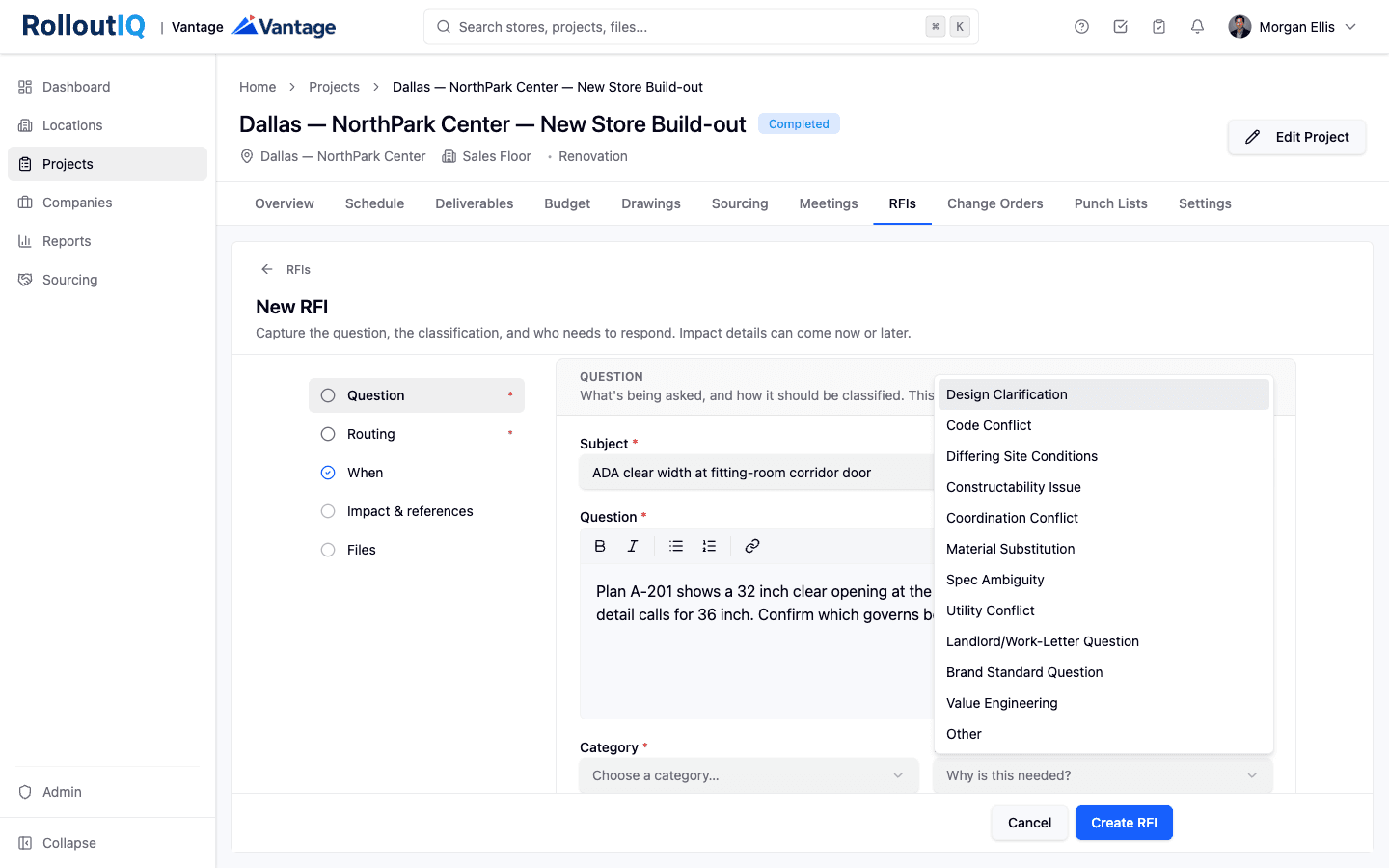
An RFI is classified when it is filed. The person raising it picks a category (the trade or discipline) and a reason (why the question exists), both from lists your administrators maintain in the Library rather than a fixed vendor taxonomy. A root cause is recorded separately on the record for internal analysis. There is a deliberate access rule attached to it. External companies such as general contractors, architects on direct contracts, and direct vendors see the RFIs on the projects they are scoped to, and the root cause field is omitted from their view and their CSV export entirely rather than blanked. That separation is what makes honest internal coding possible on a record a vendor can also see.
One Vocabulary Across Every Walk
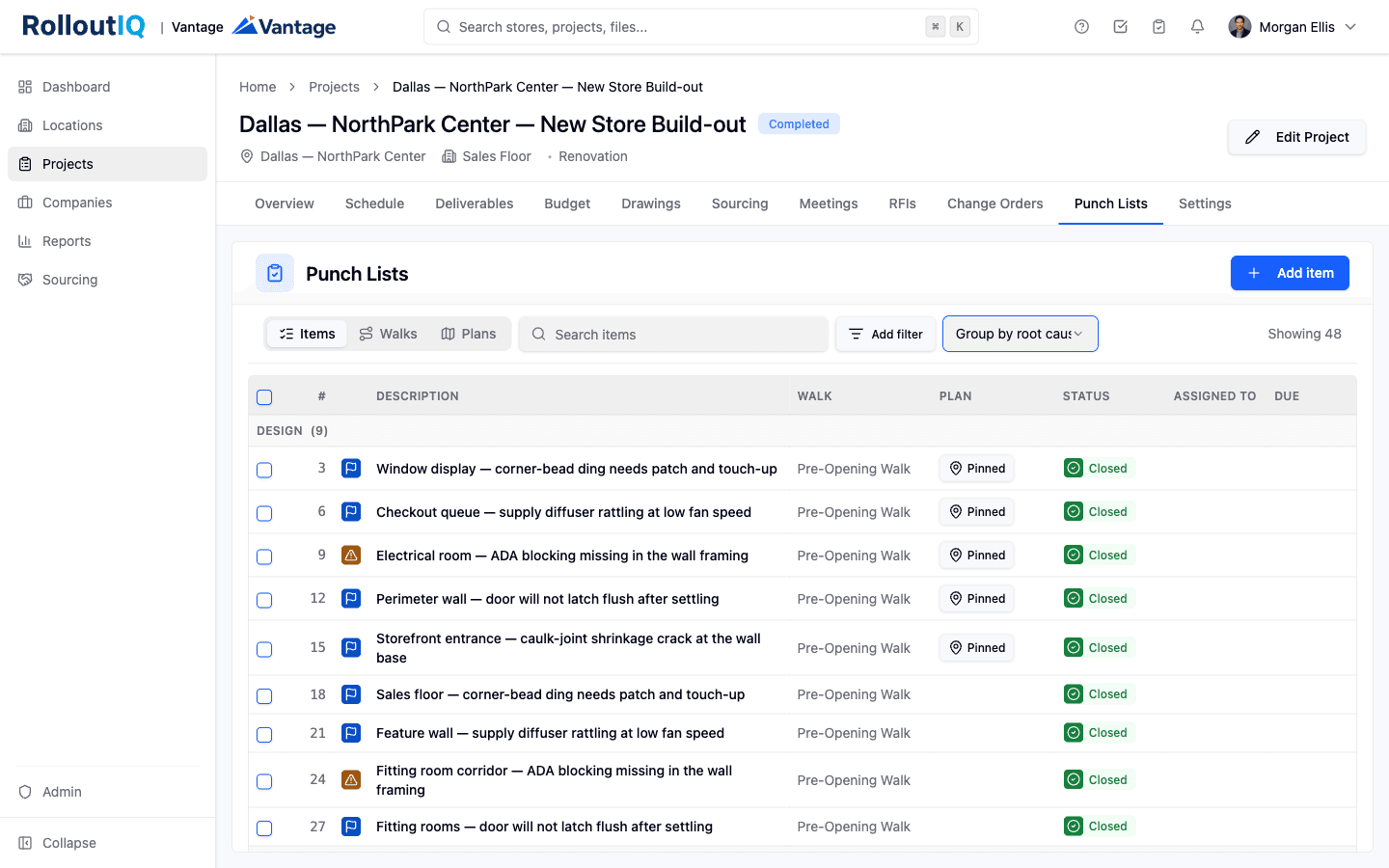
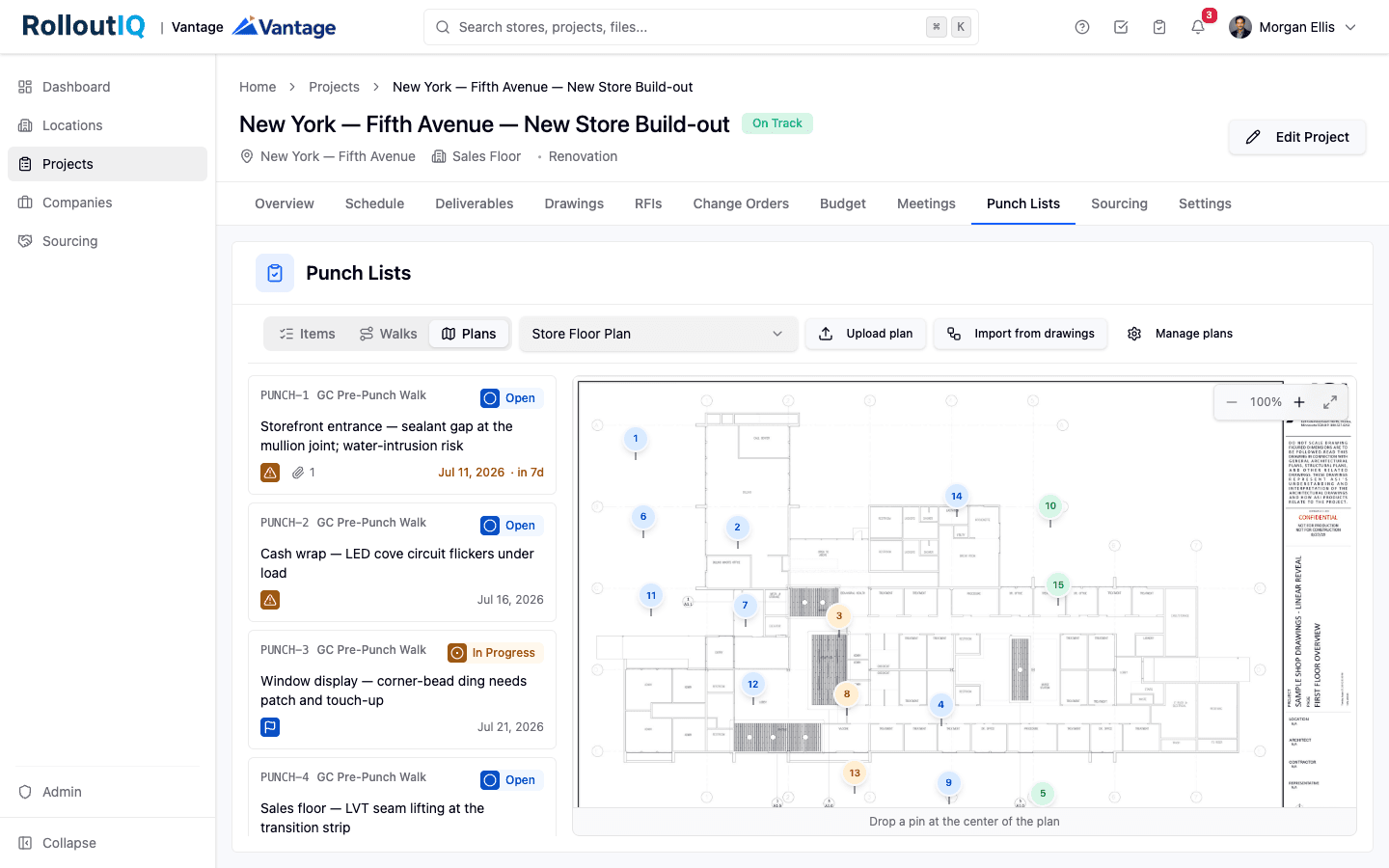
Punch items carry structured trade, area, and severity, plus a root cause, and the backlog can be grouped by any of them. Grouping a walk by root cause is a small change that alters the conversation, because it stops the review being a list of 48 defects and starts it being three numbers.
Change orders record a required internal reason at approval. It is kept for the retailer's records and never shown to the vendor, so the reason a change was accepted survives next to the amount rather than living in the approver's memory.
None of that is analysis on its own, though it is the raw input that makes analysis possible later, and the classification has to exist before you know what you will want to ask of it.
Start With One List
All this needs is one list and one meeting.
Pick the artifact with the highest volume, which for most rollouts is RFIs. Write eight to 10 causes on a single page, in the language your team already uses, and make the field required. Run it for a quarter without promising anyone an outcome, then sit down with the top three causes by count and ask what document or process change would remove them.
You will get one or two real fixes out of that first review, and it will have cost almost nothing, because the data was going to be created anyway. The only thing you changed was whether it was worth keeping.
The economics of a rollout are unusually kind to this kind of work. Preventing one issue on a single project saves that one issue. On a program of a hundred stores, learning something once and encoding it into the standard is the difference between paying for a mistake one time and paying for it 99 more.
Sources
The benchmarks cited in this article come from the following industry research.
- Navigant Construction Forum, Impact and Control of RFIs on Construction Projects (2013), hosted by CMAA - https://www.cmaanet.org/sites/default/files/resource/Impact%20%26%20Control%20of%20RFIs%20on%20Construction%20Projects.pdf
- AIA Contracts, The Truth About Change Orders (2023) - https://learn.aiacontracts.com/articles/the-truth-about-change-orders/
- Construction Industry Institute - https://www.construction-institute.org
The Rollout
The Rollout, in your inbox
A founder's read on retail and multi-site store development. What the latest news means for your pipeline, and what we are building, every couple of weeks.

Written by
Nariman Shariat
Founder, RolloutIQ
Nariman has spent about 20 years opening stores, in the seat between the landlord, the architect, and the general contractor, across some of the largest retail and workplace fleets in the country. Along the way he built the internal platform that ran store development across a fleet, then rebuilt the same idea company after company. He founded RolloutIQ to give multi-site development teams the single source of truth he kept having to build by hand, and writes here about the work of opening and remodeling stores at scale.
More about NarimanKeep Reading
Related Articles
Continue exploring best practices for store development and construction management.
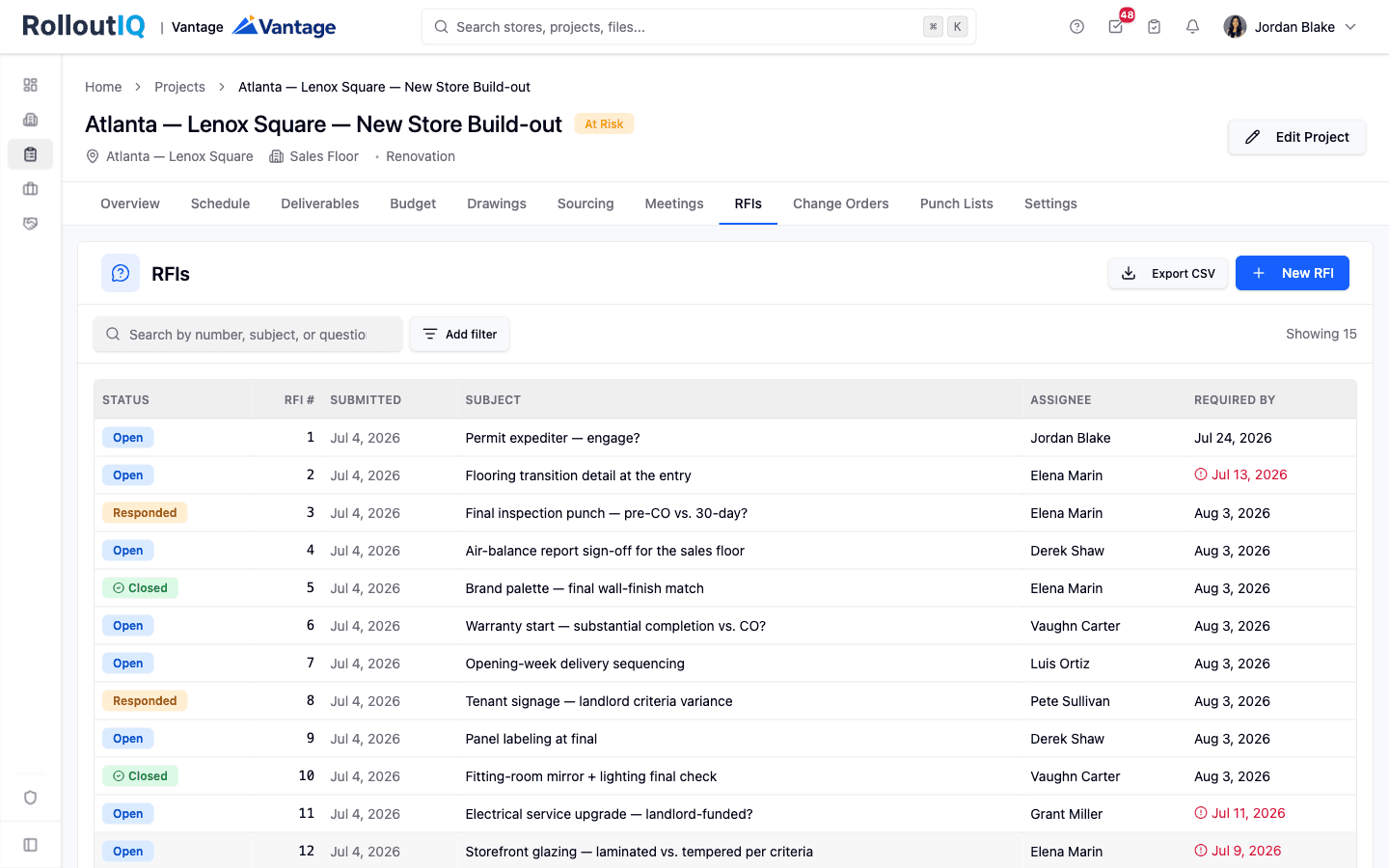
The RFIs You're Answering Twice Are Telling You What to Fix
A top-10 retailer processes 30,000 to 200,000 RFIs a year at over $1,000 each. The hidden cost isn't the processing fee. It's that the same question gets asked 50 times across stores and nobody connects the dots.
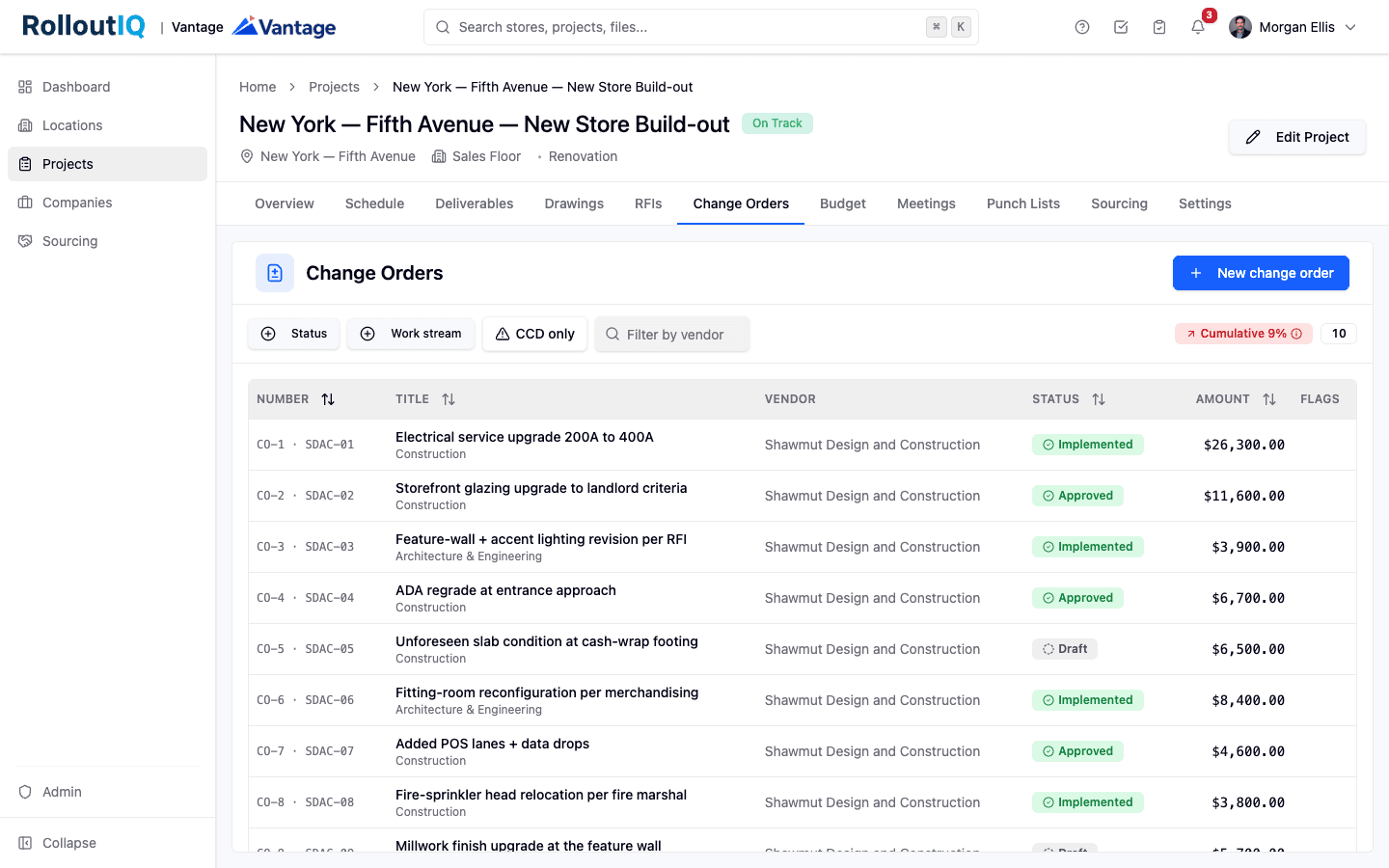
Change Order Management for Retail Rollouts: The Change Outside the GC
On a retail rollout, a large share of cost flows around the general contractor into fixtures, technology, signage, and equipment. Here is how to keep change orders from those streams from surfacing as a closeout surprise.
Punch List Management for Retail Rollouts: One Backlog for Every Walk
Retail store openings run a construction punch list and a separate pre-opening checklist in two different tools, reconciled by email. Here is how to put every walk in one backlog and verify each item before it closes.
Ready to Build Smarter?
See how RolloutIQ™ can streamline your retail and multi-site rollout program. Book a personalized demo with our team.