
Construction Management
A fair bid is only half the job. The award has to be defensible too.
Sealed bidding removes the question of favoritism. A governed, recorded award is what lets you prove, long after the store opens, that the price you paid was arrived at fairly.
When the price is fair but the paper trail is not
Ask any director of construction how the last competitive bid closed and you will hear a familiar story. Five general contractors were invited. Five priced the work in five different layouts. One quoted a lump sum, another broke the same scope into unit prices, a third buried half of it in a line called general conditions. Someone normalized all of it by hand, a decision got made, and the reasoning lived in one estimator's inbox until that estimator left.
The pricing problem is well understood, and side-by-side leveling has become the standard answer to it. The harder problem is process integrity. When a bid closes, can you show that no vendor saw another's number early, that the award went to the right approver rather than the person who wanted the deal, and that the whole sequence would survive an audit or a bid protest two years later. Many retail bid programs cannot, because the bids and the award decision live in email and spreadsheets, which is the single biggest reason institutional bid knowledge evaporates when staff turn over.
This article is about that second problem. Running a sealed bid that is genuinely fair, and turning it into an award that is defensible.

Sealed bidding, and why it removes favoritism
Favoritism in bidding is rarely a bribe. It is far more often a quiet leak. A vendor calls to ask how their number looks and a well-meaning project manager gives a hint. A competitor's total sits open in a shared folder. The moment one bidder can price against another's exposed number, the exercise stops being competitive and becomes theater.
Public procurement solved this a long time ago with the sealed bid, the invitation-for-bid model where every response stays closed until a fixed opening. Private retail borrows the discipline unevenly. Bid openings are internal rather than public, so the seal depends entirely on whoever is collecting responses.
A sealed process closes that gap by hiding every submitted response from your own team until the deadline, then opening all of them at once. No one on the retail side can watch a running total, so no one can leak it, intentionally or not. Vendors never learn who else was invited or what anyone else bid. When the window closes and the responses appear together, the comparison starts from a clean position where every price was set blind. That is the difference between a process you assert was fair and one you can show was fair.
One form, priced the same way by everyone
Sealed bidding only produces a clean comparison if the bids are shaped the same way. If each vendor invents its own structure, opening them simultaneously just reveals five incompatible documents.
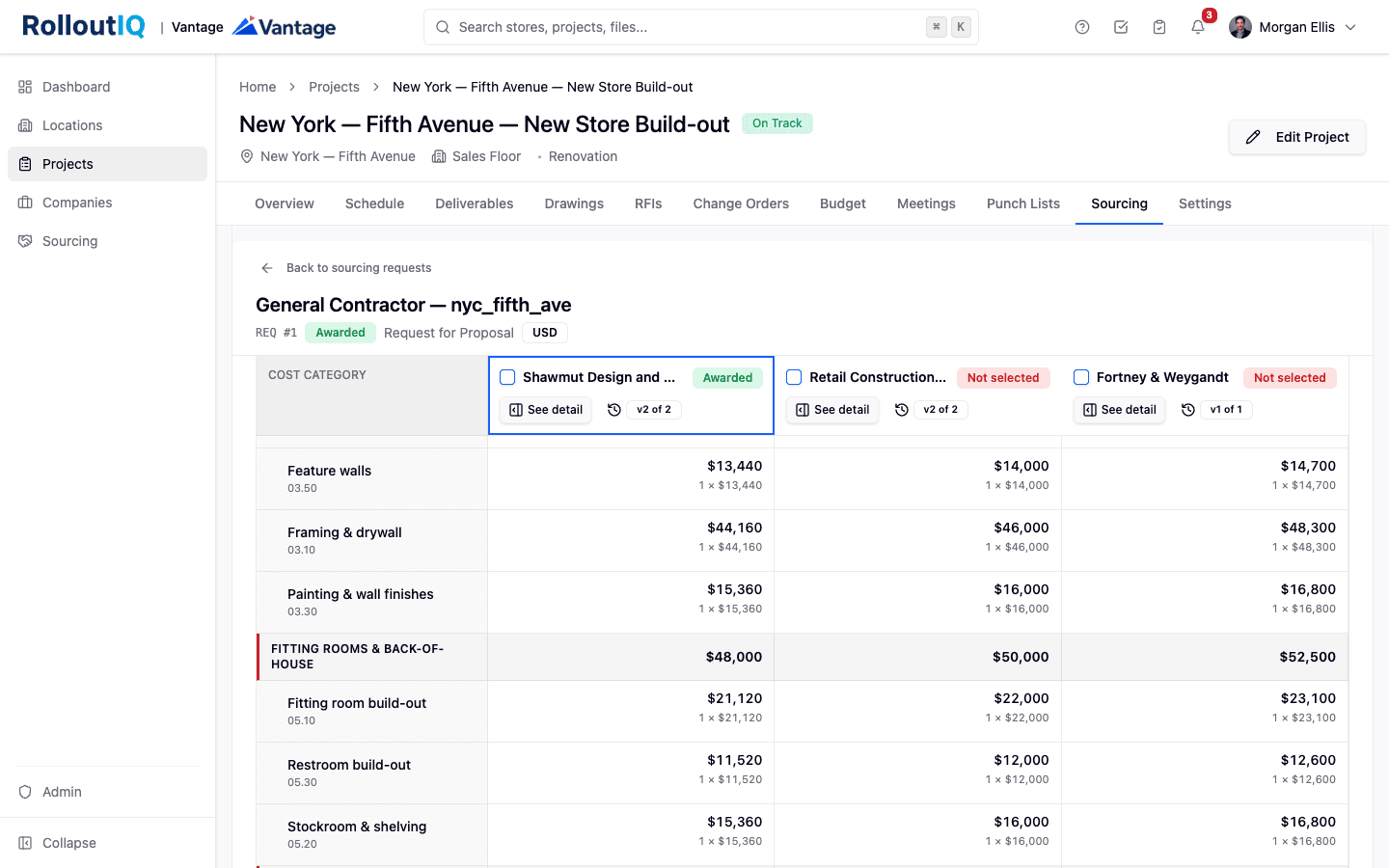
The groundwork is one pricing form that every invited vendor fills out identically. The same cost lines, in the same order, with the pricing method fixed per line so a lump-sum line cannot come back as unit price and a not-to-exceed cannot quietly become cost-plus. Overhead and profit and sales tax are entered as percentages on top of priced work rather than folded invisibly into it. Vendors still add their own exclusions, qualifications, and assumptions as structured call-outs, so scope differences stay visible rather than hidden.
This is what makes the sealed opening meaningful. When responses unseal, they line up as genuinely comparable columns instead of five spreadsheets someone has to reconcile. The leveling work, spotting the outlier line that sits well above or below the pack, is a separate discipline worth its own treatment. What matters here is that comparability is designed in before the first vendor prices anything, not reconstructed afterward.
Awards that route by amount and get a second set of eyes
An open, comparable set of bids still has to become a decision, and the decision is where most of the audit risk lives. Capital governance under Sarbanes-Oxley routinely expects at least three competitive bids on a capital commitment, and it just as routinely expects that the person requesting a purchase is not the person who approves it. Segregation of duties is not bureaucratic caution. It is the control that keeps a single motivated employee from steering a large commitment, and thin bidder pools are separately associated with materially worse pricing.
A governed award enforces this without relying on anyone to remember it. The award routes through an approval chain sized to the amount, so a modest fixture buy and a multimillion-dollar general contractor award do not get the same scrutiny. The requester cannot approve their own award. When an approver is out, the routing delegates rather than stalling. Small teams can opt into self-approval where the control genuinely does not fit, but the default is a second set of eyes on every commitment.
A defensible sealed-bid award tends to share a handful of traits.
- At least three competitive responses, or a written justification on file when there were fewer, since thin bidder pools tend to produce worse pricing.
- Every response sealed until a common deadline, so no vendor priced against another's exposed number.
- One shared pricing form, so the winning number is directly comparable to the ones it beat.
- An approval chain sized to the award amount, not a single signature regardless of size.
- Maker-checker separation, so the person who ran the bid is not the only person who blessed the award.
- A written award rationale attached to the decision, not carried in someone's head.
The record that survives the award
Fairness that cannot be reconstructed later is fairness you will eventually have to argue about. Bid documents in retail are typically kept for seven years, and longer where construction-defect statutes of repose run long, precisely because an award can be questioned well after the store opens.
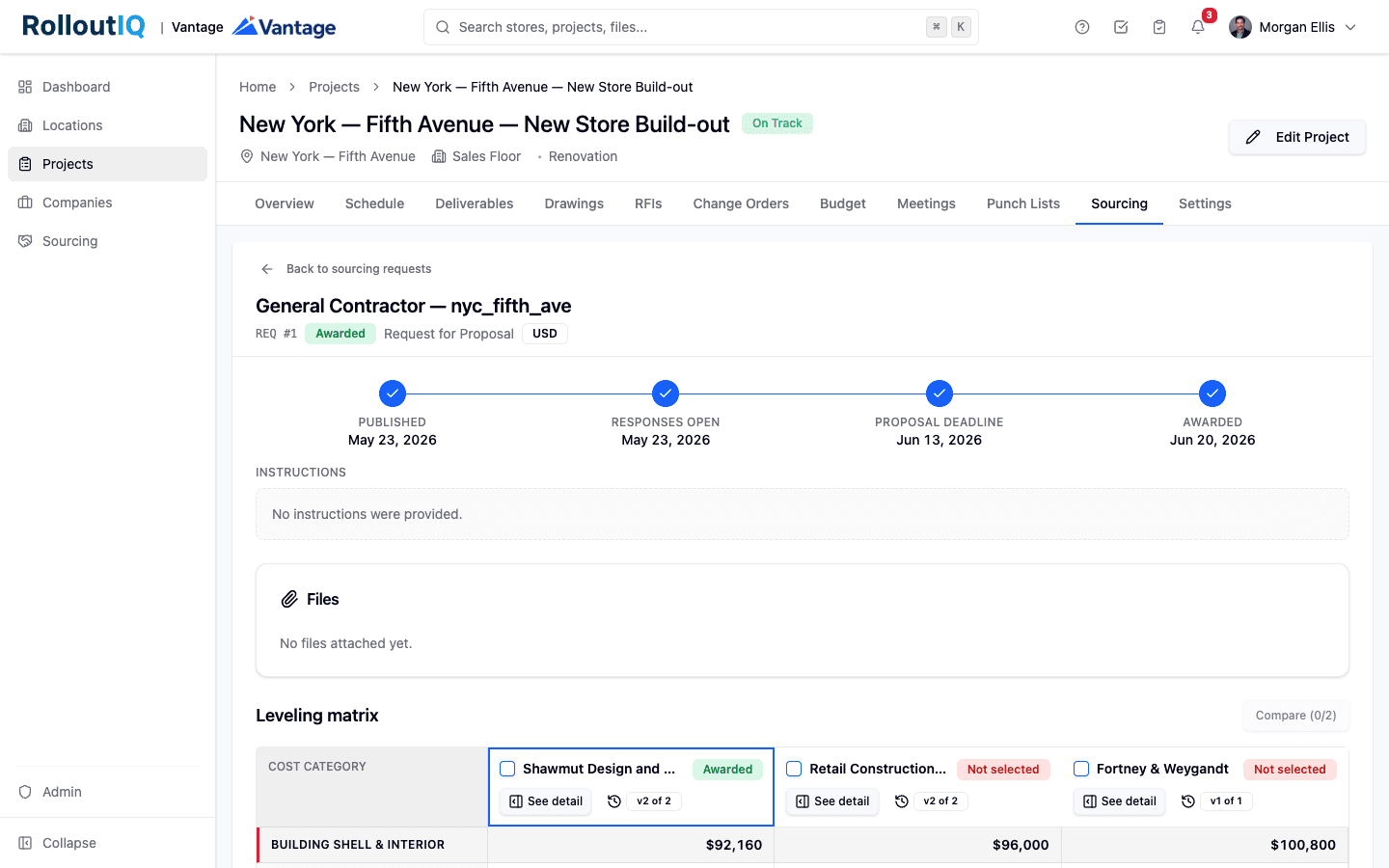
The record has to be immutable to be worth keeping. Every submitted bid is frozen as its own version, so a number cannot be quietly edited after opening. When a vendor revises during an open window, or the team returns a bid for revision, the prior submission survives rather than being overwritten, and any two versions can be read side by side to see exactly what changed in price, narrative, or qualifications. An audit trail records who did what and when, against which version. That is the artifact that answers a protest or an internal audit, and it is the institutional memory that does not walk out the door when a project manager changes jobs.
This is the layer RolloutIQ treats as non-negotiable, because a bid history that can be edited after the fact is not really a history at all.
From approved award to committed cost
The last handoff is where fairness turns into money. An award that was run cleanly and approved properly still has to become a committed number in the budget, and if that happens by someone retyping a figure into a spreadsheet, a new gap opens right at the point where the whole exercise was supposed to pay off.
When the awarded bid carries straight into the project budget, the committed price is the number that was actually approved, not a transcription of it. If the award lands over budget, that overage surfaces as a revision to review rather than a surprise discovered at closeout. The chain stays intact from the sealed opening through the approved award to the committed cost, with no manual reentry breaking it in the middle.
Put together, none of this is exotic. It is the public-sector sealed-bid discipline, the segregation-of-duties control that capital governance already assumes, and the seven-year record that litigation already expects, applied to the way retail actually buys construction. The teams that get burned are rarely the ones who paid too much. They are the ones who could not show, after the fact, that the price they paid was arrived at fairly. A sealed bid that flows into a governed, recorded award means you never have to reconstruct that story, because you were building it the whole time.
The Rollout
The Rollout, in your inbox
A founder's read on retail and multi-site store development. What the latest news means for your pipeline, and what we are building, every couple of weeks.

Written by
Nariman Shariat
Founder, RolloutIQ
Nariman has spent about 20 years opening stores, in the seat between the landlord, the architect, and the general contractor, across some of the largest retail and workplace fleets in the country. Along the way he built the internal platform that ran store development across a fleet, then rebuilt the same idea company after company. He founded RolloutIQ to give multi-site development teams the single source of truth he kept having to build by hand, and writes here about the work of opening and remodeling stores at scale.
More about NarimanKeep Reading
Related Articles
Continue exploring best practices for store development and construction management.
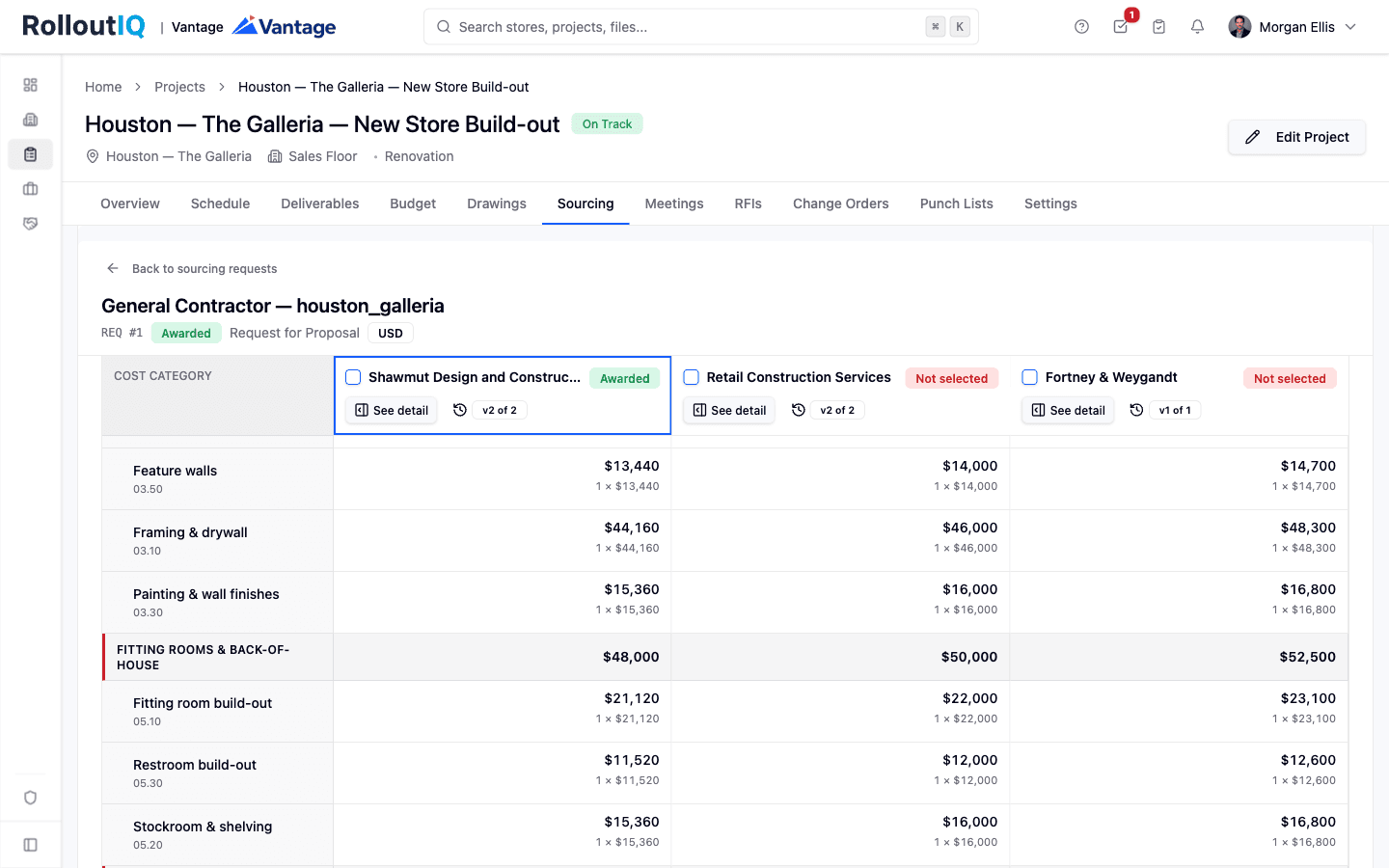
Bid Leveling: Where Your Real Construction Cost Is Decided
The lowest bid is rarely the lowest cost. Bid leveling, the work of making competing bids comparable, can eat 40 to 80 hours a project. Here is how multisite teams make competitive bidding fast, fair, and auditable.

Vendor Management Best Practices for Retail Buildouts
Your vendors make or break your rollout timeline. Learn how top retail operators manage vendor relationships, track performance, and build reliable trade networks.

Managing Budgets Across Multiple Construction Sites
Budget management across multiple construction sites requires portfolio-level financial visibility and proactive cost controls. Here is how leading operators do it.
Ready to Build Smarter?
See how RolloutIQ™ can streamline your retail and multi-site rollout program. Book a personalized demo with our team.