
Construction Management
Bid Leveling Is Where Your Real Construction Cost Is Decided
Comparing competing bids is slow, manual, and easy to get wrong, and it is where the actual contract price gets set. Here is what competitive bidding should look like across a store rollout.
The Real Cost Hides in the Comparison, Not the Bid
Getting from a need for pricing to a committed contract price is one of the slower, messier exercises in store development. A team sends a scope out to several contractors, the bids come back, and someone has to decide which number is real.
The trouble is that the lowest bid is rarely the lowest cost. One contractor excluded the rooftop units. Another carried an allowance where a competitor carried a firm number. A third qualified half the electrical scope. Until those differences are normalized, the totals on the page are not comparable, and the comparison is where the real decision gets made.
That normalization, called bid leveling, is quietly enormous. Estimators spend something like 60 to 80 percent of their bid-evaluation time on it, and a mid-size project with fifteen to twenty trade packages can absorb 40 to 80 hours of leveling work. Done in spreadsheets, it is slow, error-prone, and almost impossible to audit later.

Why Bid Comparison Breaks Down at Multisite Scale
On a single project, leveling is painful but survivable. Across a rollout it compounds. A chain opening 150 stores a year is running on the order of 150 competitive bids a year, each arriving in its own format.
The root problem is that bids are collected, not structured. When every contractor prices in their own spreadsheet, no two layouts match. There is no shared line structure, no fixed pricing method per line, and no consistent place for exclusions and qualifications. Generic project tools and email do not impose any of that, so the comparison work falls entirely on the estimator, every time, on every project.
There is a fairness dimension too. When responses trickle in and your own team can see them as they arrive, a late bidder can be coached, intentionally or not. And when the award lives in an email thread, there is no record of who approved a six-figure commitment, which is exactly the gap that capex governance and auditors care about. Worth noting is that bids with fewer than three competitors tend to produce materially worse pricing, so the answer is not fewer bids. It is making more bids genuinely comparable.
What Structured Sourcing Looks Like
A better approach treats sourcing as structured data from the start rather than a pile of attachments to reconcile at the end. A few things change.
Every vendor prices the same form. A reusable template lays down the same cost lines for every bidder, with the pricing method fixed per line, so the bids are directly comparable the moment they arrive. Exclusions and qualifications are captured as structured call-outs rather than buried in a cover letter. When the buy is sensitive, sealed bidding keeps every response hidden from your own team until the deadline, then opens them all at once.
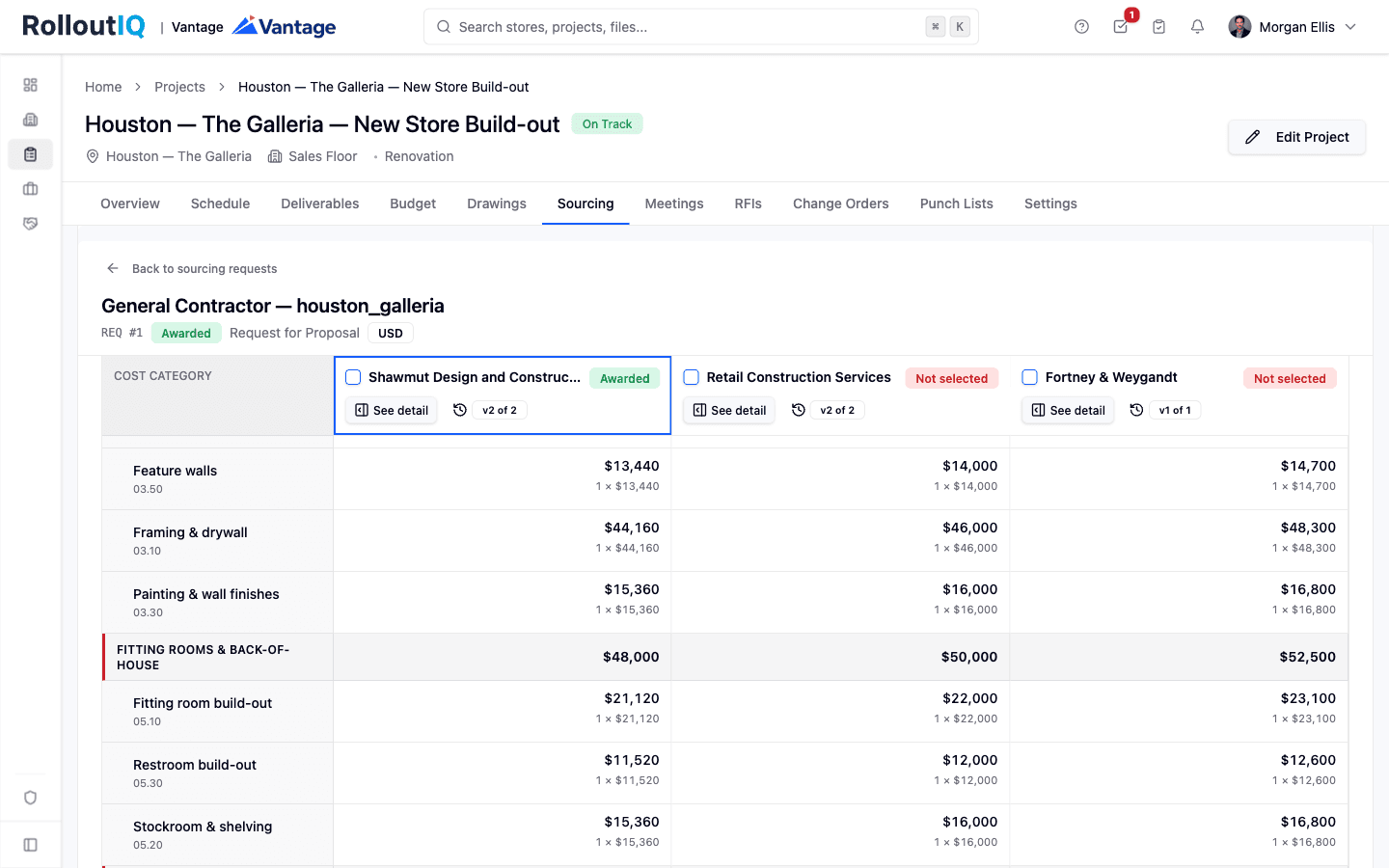
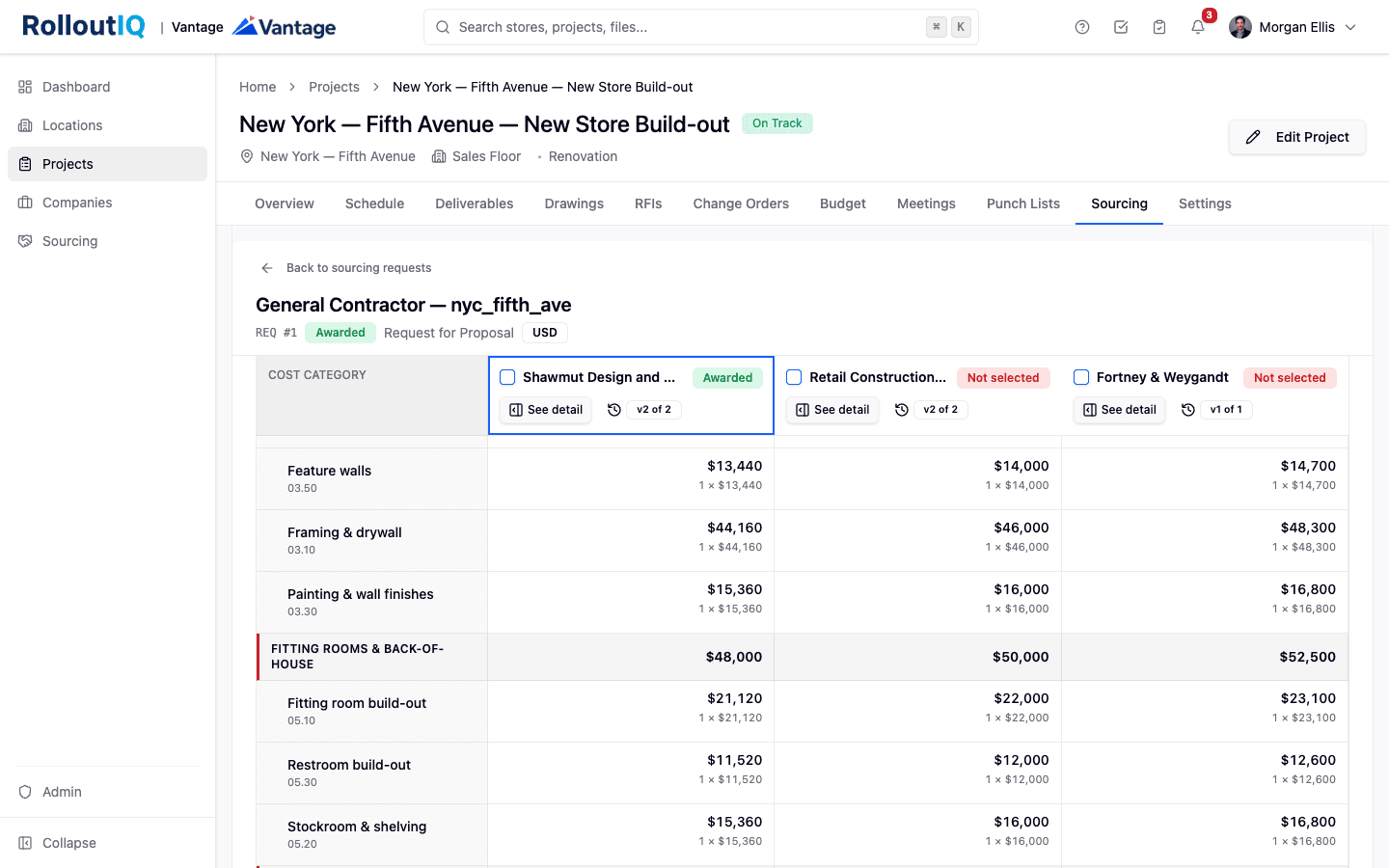
The comparison itself becomes a leveling matrix. Every vendor lines up as a column and every cost line as a row, with section subtotals, a grand total, and automatic flags on the line items that sit well above or below the pack. The 40-to-80-hour spreadsheet exercise turns into reading a screen. And because every submission is frozen as an immutable version, you can put two versions of a bid side by side and see exactly what changed.
This is the model RolloutIQ™ built its Sourcing workflow on, and it carries through to the award. The award routes through an approval chain sized to the amount, the requester cannot sign off their own award, and the winning number flows into the project budget without rekeying.
What It Looks Like in Practice
Picture a project manager who needs a general contractor for the next build. They apply their standard pricing form, attach the drawings and site photos, and invite five contractors. Each one prices the same lines, adds overhead and profit and sales tax as percentages, lists what it is excluding, and submits.
Because the request is sealed, no one on the retail side sees a number until the window closes. When it does, all five bids open at once on the leveling matrix. The manager scans the flagged outliers, opens the two closest bids to read their qualifications, and awards the winner. The award exceeds the manager's approval limit, so it routes to finance automatically, and once approved the committed number lands in the budget. The losing bidders are notified without a separate email.
What to Require From a Bidding Process
Whatever tool a team uses, the bar for a defensible competitive bid is the same. Use this as a checklist for your own process, then close the gaps.
Get this right and the payoff is not just a lower price. It is a faster cycle, a fairer process, and a record you can stand behind when the commitment is questioned. That is the outcome RolloutIQ™ is built to make routine across a portfolio of stores.
- One shared pricing form every vendor fills out the same way, with the pricing method fixed per line so totals are comparable.
- Structured exclusions and qualifications, so scope gaps are visible rather than buried in a narrative.
- At least three competitive bids, since thinner competition reliably costs more.
- Sealed responses on sensitive buys, opened together at the deadline.
- A leveling view that flags outliers automatically instead of leaving it to a manual spreadsheet pass.
- A governed award, where the size of the commitment sets who signs off and the requester cannot approve their own.
- An award that carries into the budget with its full history intact, so the next audit has the record.
The Rollout
The Rollout, in your inbox
A founder's read on retail and multi-site store development. What the latest news means for your pipeline, and what we are building, every couple of weeks.

Written by
Nariman Shariat
Founder, RolloutIQ
Nariman has spent about 20 years opening stores, in the seat between the landlord, the architect, and the general contractor, across some of the largest retail and workplace fleets in the country. Along the way he built the internal platform that ran store development across a fleet, then rebuilt the same idea company after company. He founded RolloutIQ to give multi-site development teams the single source of truth he kept having to build by hand, and writes here about the work of opening and remodeling stores at scale.
More about NarimanKeep Reading
Related Articles
Continue exploring best practices for store development and construction management.
Sealed Bidding and Governed Awards in Retail Construction
A sealed bid keeps every vendor honest, but the exercise only holds up if the award that follows is governed and recorded. Here is how process integrity works from sealed opening to committed budget.
Coordinating a Multi-Site Retail Rollout
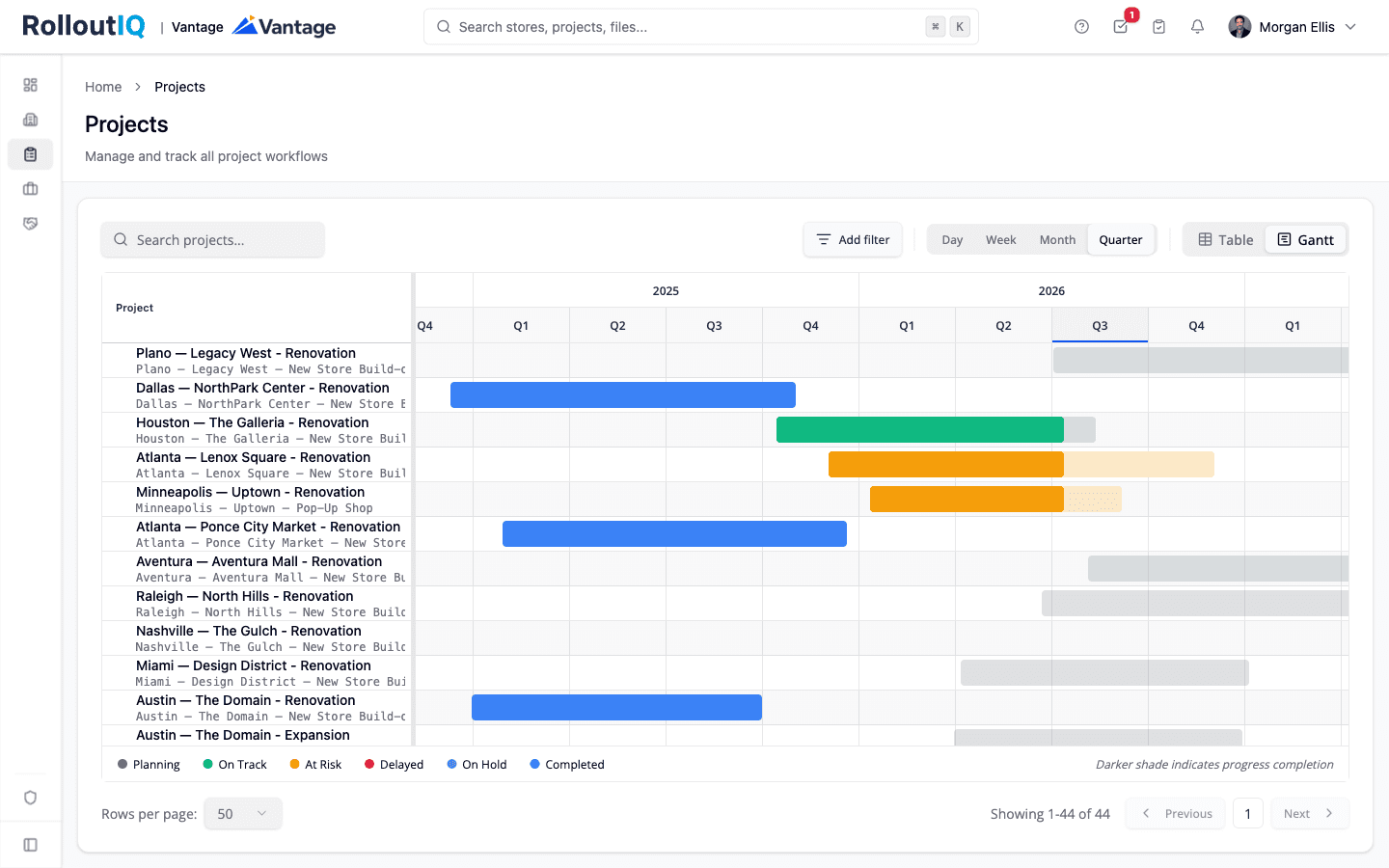
Running fifty store projects at once is not fifty times running one. Here is how to coordinate a multi-site retail rollout across vendors, permits, long-lead procurement, and opening dates.

Vendor Management Best Practices for Retail Buildouts
Your vendors make or break your rollout timeline. Learn how top retail operators manage vendor relationships, track performance, and build reliable trade networks.

A Store Rollout Budget Should Be a Governed Baseline
The budget for a store project covers six cost families, not just construction, and the hard part of all of it is governance rather than arithmetic. Here is what it means to run the whole project budget as a baseline.
Change Order Management for Retail Rollouts: The Change Outside the GC
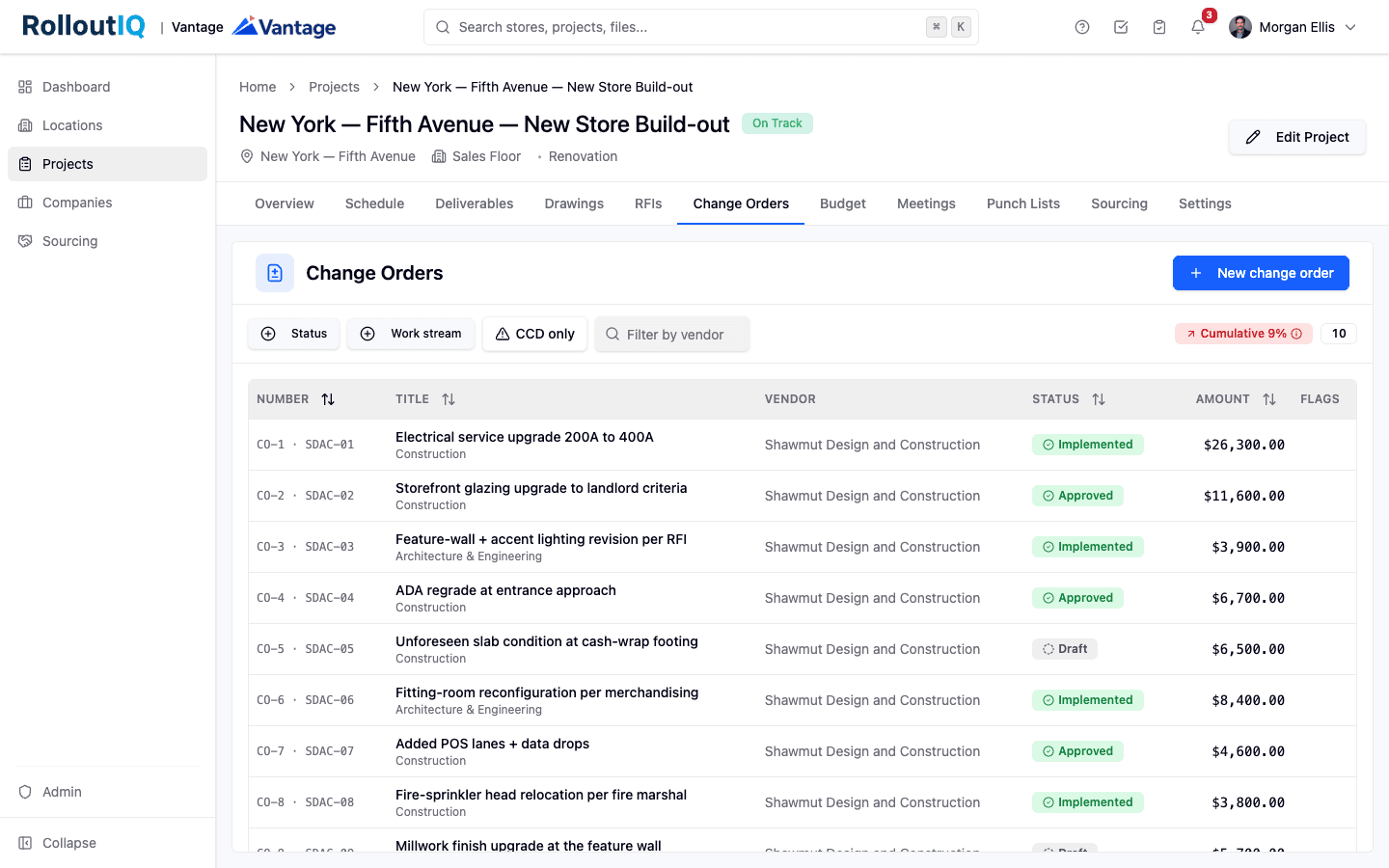
On a retail rollout, a large share of cost flows around the general contractor into fixtures, technology, signage, and equipment. Here is how to keep change orders from those streams from surfacing as a closeout surprise.
Ready to Build Smarter?
See how RolloutIQ™ can streamline your retail and multi-site rollout program. Book a personalized demo with our team.