

Budget Management
Managing Budgets Across Multiple Construction Sites
Strategies for maintaining financial control across a portfolio of concurrent construction projects.
The Challenge of Multisite Budget Management
Managing the budget for a single construction project is straightforward. Managing budgets across 10, 20, or 50 concurrent projects is an entirely different discipline. Every project has its own cost variables, change orders, and vendor pricing. Without a centralized view, it is impossible to understand your true financial exposure.
The industry-wide track record is sobering. The McKinsey Global Institute found that large construction projects typically run up to 80 percent over budget and take 20 percent longer than scheduled, and KPMG's Global Construction Survey found that only about a third of projects come within 10 percent of their budget. A multisite operator inherits that risk on every project in the pipeline at once, which is exactly why budget control cannot be left to each site to manage on its own.
The operators who maintain financial control at scale are the ones who treat budgeting as a portfolio-level function, not just a project-level one. They track costs consistently, forecast accurately, and catch variances early enough to course correct.
Establishing a Standard Budget Template
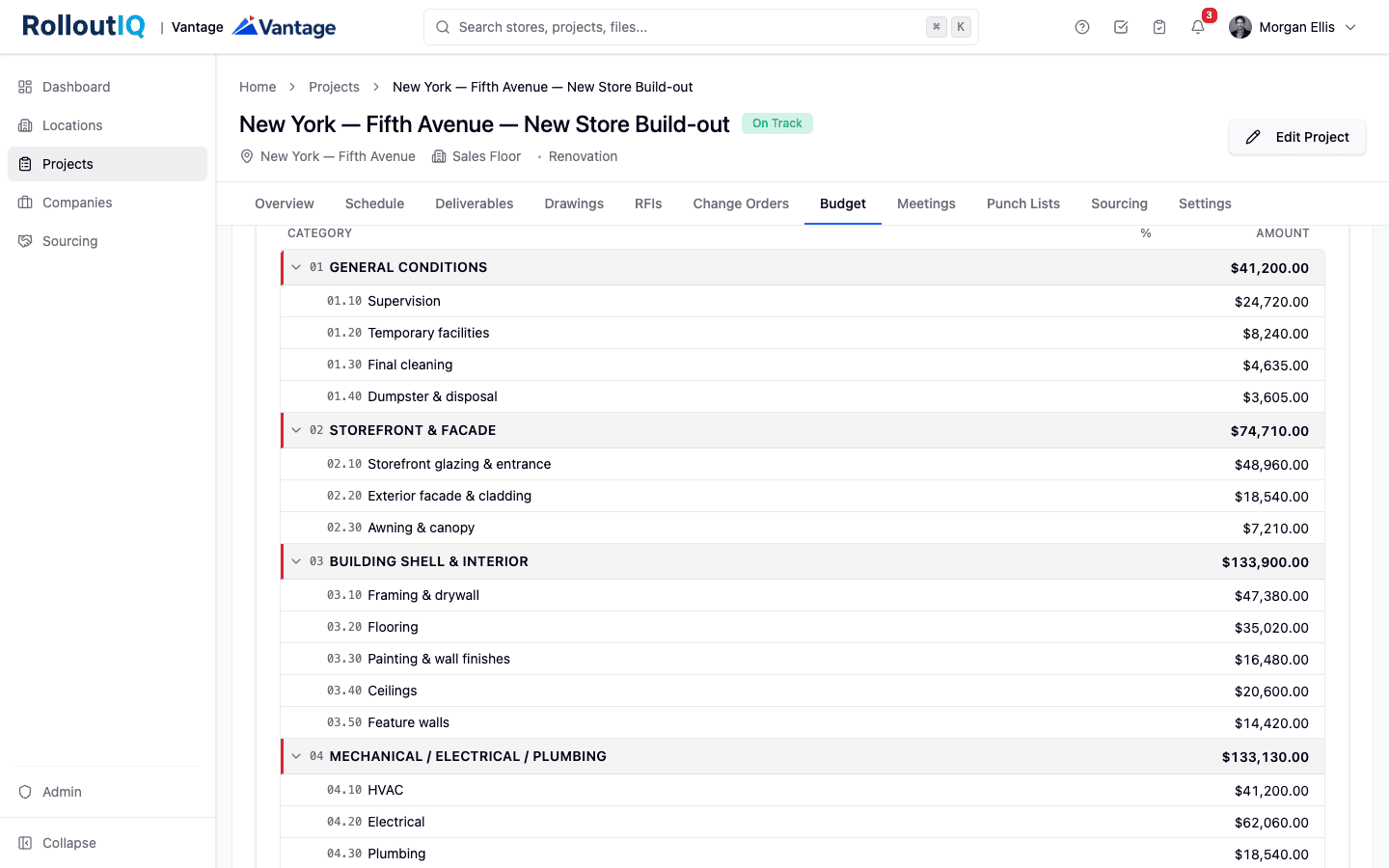
Consistency starts with a standard budget template that every project uses. This template should include all major cost categories, a contingency line, and a structure for tracking committed versus actual costs.
- Hard costs - General contractor, subcontractors, materials, equipment, and fixtures.
- Soft costs - Architectural and engineering fees, permits, inspections, and consulting.
- FF&E - Furniture, fixtures, and equipment specific to your brand standards.
- Technology - POS systems, network infrastructure, security, and AV.
- Contingency - Typically 5 to 10 percent of total project cost, drawn down as risks materialize.
Change Order Management
Change orders are where budgets go to die. Without a disciplined change order process, scope creep accumulates quietly until the project is significantly over budget. Every change order should require documented justification, cost impact analysis, and approval from the appropriate authority level.
Tracking change orders across your portfolio reveals patterns. If you are consistently seeing change orders for the same types of issues, such as unforeseen site conditions or design conflicts, you have an opportunity to address the root cause in your pre-construction process rather than absorbing the cost on every project.
Forecasting and Earned Value Tracking
The budget number that matters most is not what you have spent. It is what you are going to spend. Accurate forecasting requires tracking committed costs, not just invoiced amounts, and regularly updating your estimate at completion based on current project conditions.
Earned value tracking takes this a step further by comparing the value of work completed against the amount spent. This analysis reveals whether you are getting what you are paying for and whether the project is trending toward a budget overrun before the invoices arrive.
Portfolio-Level Financial Reporting
Executives need a portfolio-level financial view that shows total committed capital, projected versus actual spend by quarter, and variance trends across the project pipeline. This reporting should be automated, not manually compiled, so that leadership is working with current data rather than last month's numbers.
Effective financial reporting also benchmarks cost per square foot and cost per location across your portfolio. These benchmarks become increasingly valuable over time as they give you a data-driven basis for evaluating bids, negotiating contracts, and setting realistic budgets for future projects.
Sources
The benchmarks cited in this article come from the following industry research.
- McKinsey Global Institute, Reinventing Construction: A Route to Higher Productivity (2017) - https://www.mckinsey.com/capabilities/operations/our-insights/reinventing-construction-through-a-productivity-revolution
- KPMG, Global Construction Survey 2015 (Climbing the Curve) - https://assets.kpmg.com/content/dam/kpmg/pdf/2015/05/construction-survey-201502.pdf
The Rollout
The Rollout, in your inbox
A founder's read on retail and multi-site store development. What the latest news means for your pipeline, and what we are building, every couple of weeks.

Written by
Nariman Shariat
Founder, RolloutIQ
Nariman has spent about 20 years opening stores, in the seat between the landlord, the architect, and the general contractor, across some of the largest retail and workplace fleets in the country. Along the way he built the internal platform that ran store development across a fleet, then rebuilt the same idea company after company. He founded RolloutIQ to give multi-site development teams the single source of truth he kept having to build by hand, and writes here about the work of opening and remodeling stores at scale.
More about NarimanKeep Reading
Related Articles
Continue exploring best practices for store development and construction management.
Earned Value Management for Retail Rollouts
Money spent and work completed are two different numbers, and the gap between them is where budgets quietly fail. Here is how earned value works on a rollout, scaled down from the megaproject version.
The Cost Code Structure That Makes a Retail Portfolio Comparable
When every project's budget is a different spreadsheet, nothing rolls up and no two stores compare. A shared chart of cost categories and families is what makes a multisite portfolio answerable to one question. What does a store cost.

A Store Rollout Budget Should Be a Governed Baseline
The budget for a store project covers six cost families, not just construction, and the hard part of all of it is governance rather than arithmetic. Here is what it means to run the whole project budget as a baseline.
The Complete Guide to Multi-Site Construction Management
Managing construction across multiple sites simultaneously requires a fundamentally different approach than single-project management. Here is your complete guide.
Ready to Build Smarter?
See how RolloutIQ™ can streamline your retail and multi-site rollout program. Book a personalized demo with our team.