
Store Development
A Store Is Not a Project
Why modeling a Location, a Space, and a Project as three separate objects is what lets a retailer manage the same store across many projects over years.
A store is not a project
Most retail development teams run on tools that were built for a general contractor putting up a single building. Those tools have exactly one organizing object, the project, and everything hangs off it. That works fine when the job is a one-time build with a start, an end, and a handoff. It breaks the moment you manage a portfolio of stores that each go through many builds over their lives.
Here is where it breaks. You open a store as a project. Five years later that same store gets a refresh, so you open a second project. Nothing connects the two, so the history splinters. The address, the square footage, the lease facts, the record of who built it the first time, all of it lives inside the first project and does not carry forward. Ask a simple portfolio question, such as how many projects this store has been through or what this location has cost across its whole life, and a flat model cannot answer it. The store was never a durable thing in the system. It was a folder that closed when the ribbon was cut.
The fix is not a better project tracker. It is a data model that treats a store, its real estate, and the work done to it as three separate things.

The Location is the store that outlives its projects
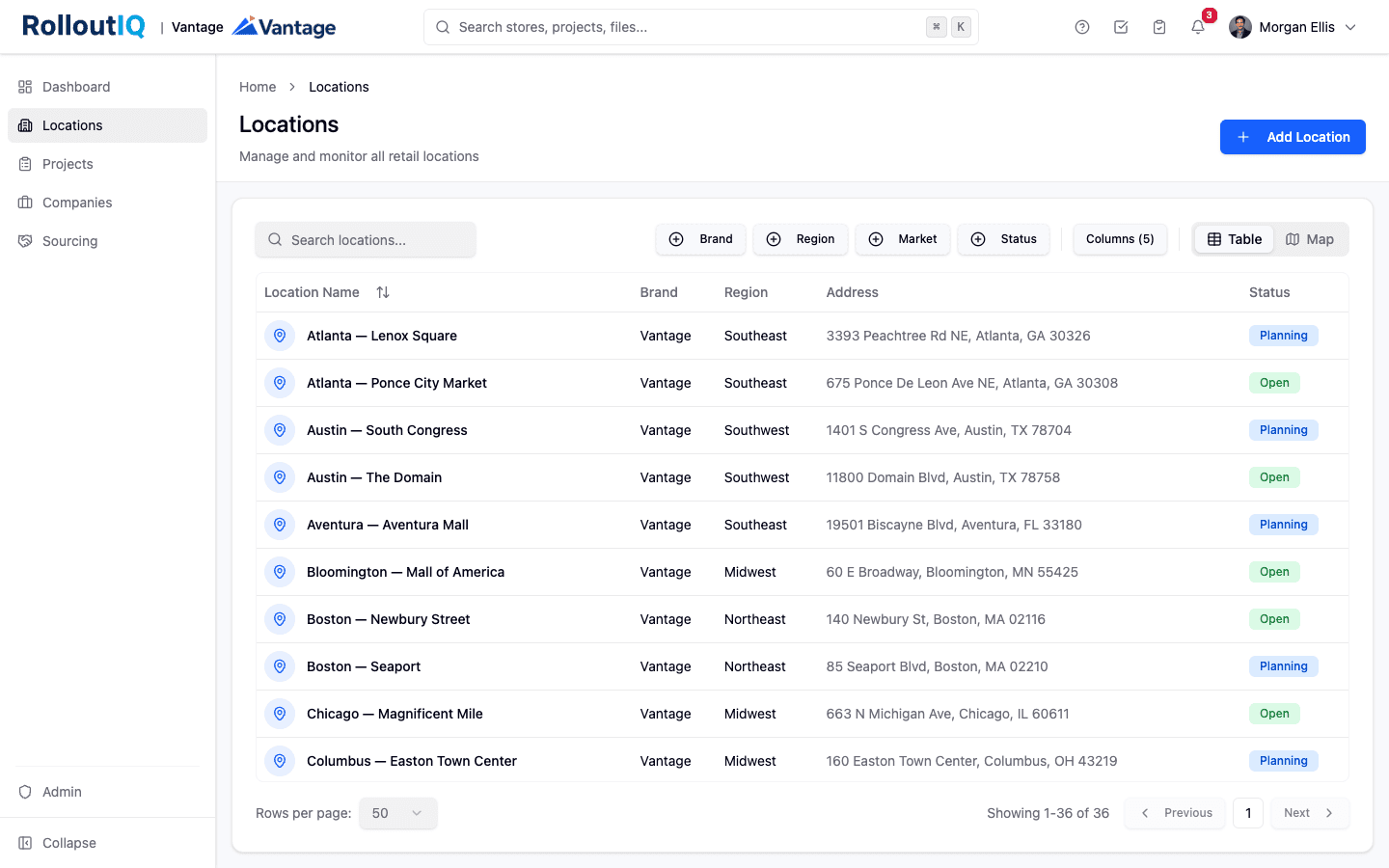
A Location is the durable business unit, the store as an ongoing place in your portfolio. It has a store number, a brand, a region, a market, an open date, and a lifecycle stage. It persists. A new build opens it, refreshes update it every several years, a relocation moves it, and a closure eventually retires it, but through all of that the Location stays the same record. Every project the store has ever been through rolls up to it.
That durability is what makes portfolio questions answerable. Because the Location is the join point, its real estate, the premises it has occupied over time, and every project across its lifetime all sit under one canonical record. Its lifecycle stage, planning, upcoming, open, or closed, can be computed from the dates you already keep rather than maintained by hand, so the portfolio view stays honest without anyone updating a status field. The store register stops being three spreadsheets that never reconcile and becomes one place that answers how many of your six hundred stores are mid-remodel right now.
The Space is the real estate, not the store
Underneath the Location sits the Space, the physical premises. The leased suite in the mall, the freestanding pad, the in-line shop in the strip center, the ground-leased corner lot. The Space is the real estate, with its own address, square footage, and type, distinct from the operating store that lives in it and the construction work that happens to it.
Keeping the Space separate from the Location matters because retail portfolios move. Stores relocate to a bigger box across the same center, expand into the suite next door, or convert from in-line to pad. When a flat model folds the real estate into the project, a relocation erases the through-line. The prior premises and its project history evaporate, and you cannot tell the new lease apart from the old one. Modeled as its own object, a Space is durable across renovations and addressable in its own right. A Location can occupy different Spaces over its life as it relocates, and a Space can host different Locations over time as one store closes and another backfills the box. The lease facts, the address, and the historical projects attached to that piece of real estate stay together while the store moves around them.
The Project is what happens at a Location, and then ends
A Project is the time-bounded workflow. A new build, a remodel, a refresh, a relocation, a conversion, or a closure. It is anchored to a target open date and it aggregates the schedule, drawings, tasks, files, and team that the work needs to ship. Unlike the Location and the Space, a Project is supposed to end. It has a start, an open date, and a fixed budget of weeks to get there, and when the doors open its job is essentially done.
The discipline that matters is that a Project belongs to a Space, and through it to a Location, rather than existing on its own. You do not create a floating project. You create it against the real estate it will run against, so it travels with that Space in the historical record. That single relationship is what lets one Location run many Projects over years without the history fragmenting. The second refresh is the store's fourth project, not an unrelated folder. The retailer manages the same store across many projects precisely because the store and the work were never the same object.
Schedule, budget, vendors, and documents all play at two levels
Get the three objects right and a second property falls out of the model, the portfolio and project duality. Every concept in retail development exists at two levels at once. A project has a schedule, and the portfolio has a heat map of every opening against plan. A project has a budget, and the portfolio has a capital plan. A project has a general contractor, and the portfolio has a bench of contractors with performance history across many jobs. It is the same underlying data, shaped one way for the person running one store and another way for the director running dozens.
A flat model can only ever show you the project-level view, because it has no durable Location or Space to aggregate against. When the objects are separated correctly, a specific set of questions becomes answerable that were previously trapped in project-silo spreadsheets.
- How many projects a given store has been through, and what each one was
- What a single location has cost across its entire life, not just its most recent build
- Which locations are due for a refresh based on when they last had one
- Which stores are mid-remodel, in permitting, or in planning right now across the whole portfolio
- How a relocation reads as one continuous store history rather than two disconnected jobs
- Which real estate the brand has ever occupied, including premises it has since left behind
- Whether a store's cost or timeline is an outlier against the rest of the portfolio
Model the portfolio you actually run
The distinction sounds academic until you live inside a portfolio for a few years. A general contractor building one job is right to organize everything around the project, because for them the project is the whole world and it ends when the building is done. A retailer is in a different business. The store is the enduring asset, the real estate is a moving part underneath it, and the projects are episodes in a life that spans decades.
Modeling a Location, a Space, and a Project as three distinct objects is not a feature. It is the decision that determines whether a system can answer portfolio questions at all. Flatten them and you get a competent tracker for the job in front of you and amnesia about everything that came before. Separate them and the same store stays legible across every project, every relocation, and every refresh it goes through. RolloutIQ is built on that separation, because a store is not a project, and the tools that pretend otherwise were built for a single job, not a portfolio.
The Rollout
The Rollout, in your inbox
A founder's read on retail and multi-site store development. What the latest news means for your pipeline, and what we are building, every couple of weeks.

Written by
Nariman Shariat
Founder, RolloutIQ
Nariman has spent about 20 years opening stores, in the seat between the landlord, the architect, and the general contractor, across some of the largest retail and workplace fleets in the country. Along the way he built the internal platform that ran store development across a fleet, then rebuilt the same idea company after company. He founded RolloutIQ to give multi-site development teams the single source of truth he kept having to build by hand, and writes here about the work of opening and remodeling stores at scale.
More about NarimanKeep Reading
Related Articles
Continue exploring best practices for store development and construction management.
Optimizing Your Store Development Process from Site Selection to Grand Opening
Store development is one of the most complex workflows in retail operations. Learn how leading operators streamline every phase from site selection through grand opening.

Bring Your Own AI: Connect Your Assistant to Your Rollout Data
Every software tool now ships its own AI copilot and charges for it. You can instead bring your own AI, connecting the assistant you already use to your live rollout data through an open standard.

The Retail Rollout Timeline: From Lease to Grand Opening
From lease execution to grand opening, a store project moves through a predictable set of milestones. Here is the retail rollout timeline by phase and format, and where the time actually goes.

The Single Source of Truth Is What Lets a Program Scale
Most teams read single source of truth as one system, then run a consolidation project that does not fix anything. The useful definition is narrower, and it decides whether a program survives its own growth.
Ready to Build Smarter?
See how RolloutIQ™ can streamline your retail and multi-site rollout program. Book a personalized demo with our team.