
Construction Management
A shared cost code structure is what makes a portfolio comparable
Fragmented per-project cost spreadsheets never reconcile. A shared taxonomy of cost categories and families, priced against by every budget, sourcing form, and change order, is what lets you compare stores across a rollout.
You cannot answer what a store costs
Ask a director of store development what a store costs and watch the answer fracture. One project team built its budget in a spreadsheet organized by trade. Another organized by construction phase. A third inherited a workbook from a general contractor and never rebuilt it. Every workbook is internally reasonable, and none of them agree with the others. When finance tries to compare a flagship in one market against three inline builds in another, the lines do not sit next to each other. Flooring is buried inside a single finishes total on one sheet and broken into four rows on the next. Signage is a hard cost here and a separate bucket there. The comparison leadership wants, what a store costs and why one costs more than another, cannot be assembled without a week of manual reconciliation.
The problem is structural. When each project starts from its own blank spreadsheet, nothing forces two budgets to share a spine. The numbers roll up into a portfolio total, but they do not roll up into a portfolio comparison. A mid-size new store can carry one to two hundred active cost lines and a large-format build two to three hundred, so the drift compounds fast. The fix is a shared cost structure that every project prices against before anyone opens a budget.

Two axes, one catalog
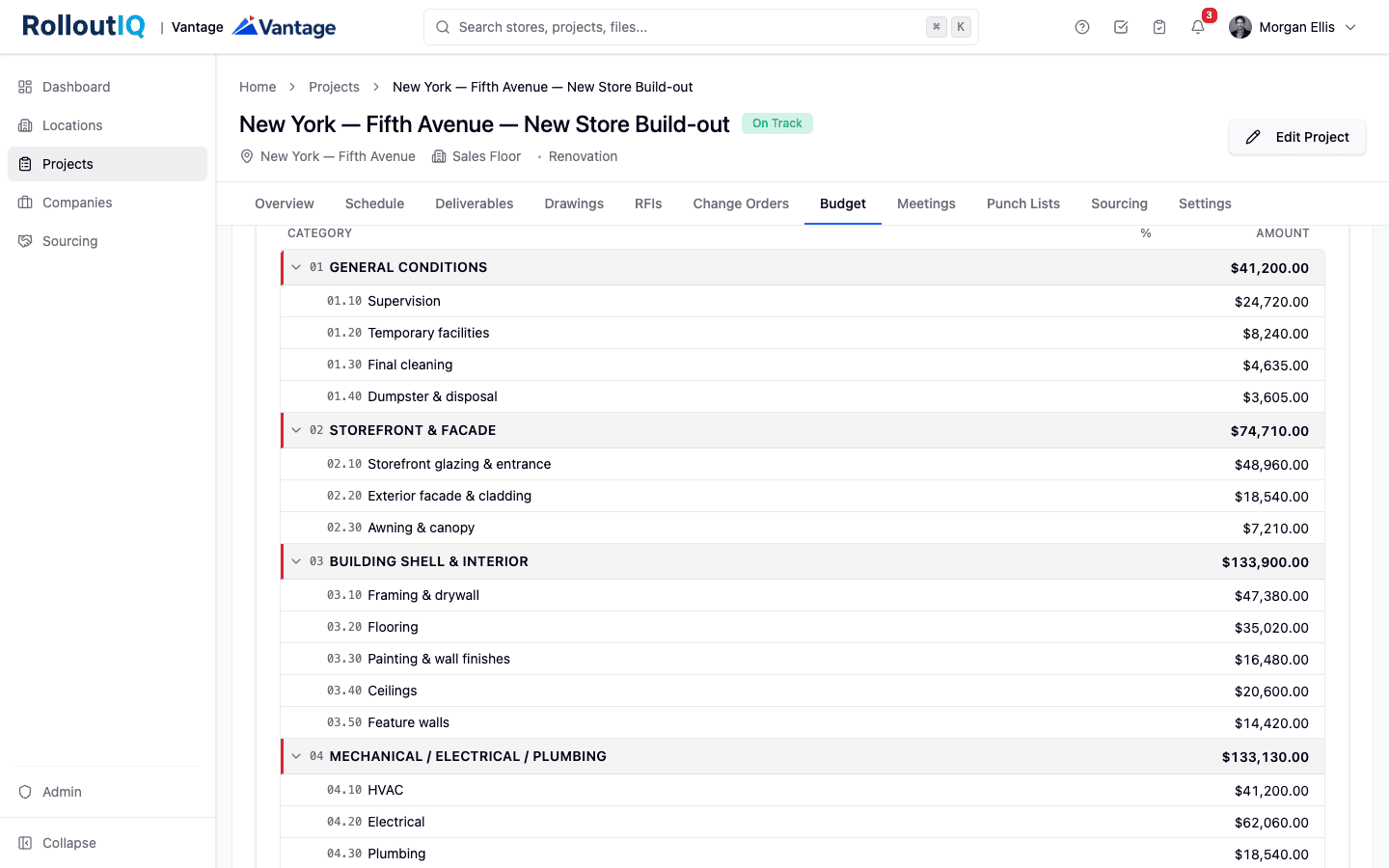
A durable cost structure has two independent dimensions, and conflating them is where most homegrown systems go wrong. The first is a hierarchy of cost categories, the tree of buckets and line items that mirrors how the team thinks about work. Retailers almost never adopt raw CSI MasterFormat, the fifty-division specification standard architects use for bidding. A prototype rollout does not need forty-eight separate concrete sections. It needs concrete as one rollup, and it needs business-language buckets like Signage, Technology, and Kitchen that a store development team owns, not an architect. Most retailers flatten the standard into a three-level chart. Division or bucket, then category or phase, then line item.
The second dimension is an accounting classification stamped on every category, independent of where it sits in the tree. This is the cost family, and the industry converges on a small, stable set. Hard costs, the physical work put in place, typically run sixty-five to eighty percent of a project. Soft costs, the professional and owner fees, run fifteen to thirty percent and are usually expressed as a percentage of hard costs rather than of the total. FF&E lands anywhere from five to twenty-five percent depending on format, with kitchen-heavy QSR and refrigeration-heavy grocery at the top. IT runs two to eight percent, pre-opening three to ten, and contingency five to fifteen. Keeping these two axes separate is what lets one line, say back-of-house flooring, sit under Finishes in the tree while carrying the Hard Costs family for reporting. Collapse them into a single list and you lose the ability to reslice.
Why the accounting axis earns its keep
The cost family carries treatment that downstream numbers have to honor, and three families make the point.
FF&E deserves its own axis because it behaves nothing like construction. Fixtures and equipment are usually purchased directly by the retailer rather than through the general contractor, they depreciate on a five-to-seven-year schedule instead of the building's much longer life, and they hit a separate ledger account. Burying FF&E inside a construction division, the way the specification standard does, throws away exactly the distinctions finance needs.
Pre-opening is the cleaner example. Training, hiring, and grand-opening marketing are expensed as incurred under the relevant accounting standard, not capitalized like the build. A cost structure that does not carry a capitalizable flag forces someone to re-sort every line by hand at close.
Contingency behaves differently again. It is a reserve drawn down against identified risks, not a normal cost, and it is sized by project type. Roughly five to ten percent for a new ground-up store and ten to fifteen for a remodel, where concealed conditions dominate. Cost escalation through 2026 pushed many programs toward an eight to twelve percent baseline. A structure that treats contingency as a pool, with a default percentage per category, keeps that reserve visible instead of scattered across a dozen lines. RolloutIQ models these as seeded families with sensible defaults, so pre-opening arrives expensed and contingency behaves as a reserve without anyone reconstructing the accounting from scratch.
One structure, priced against everywhere
A shared catalog is only worth building if everything prices against it. The reason fragmented spreadsheets never reconcile is that the budget, the vendor pricing form, and the change order each carry their own private list of lines. When a sourcing form uses categories the budget has never heard of, the numbers cannot meet. When a change order codes an addition against a line that exists on one project and not another, the portfolio loses the thread.
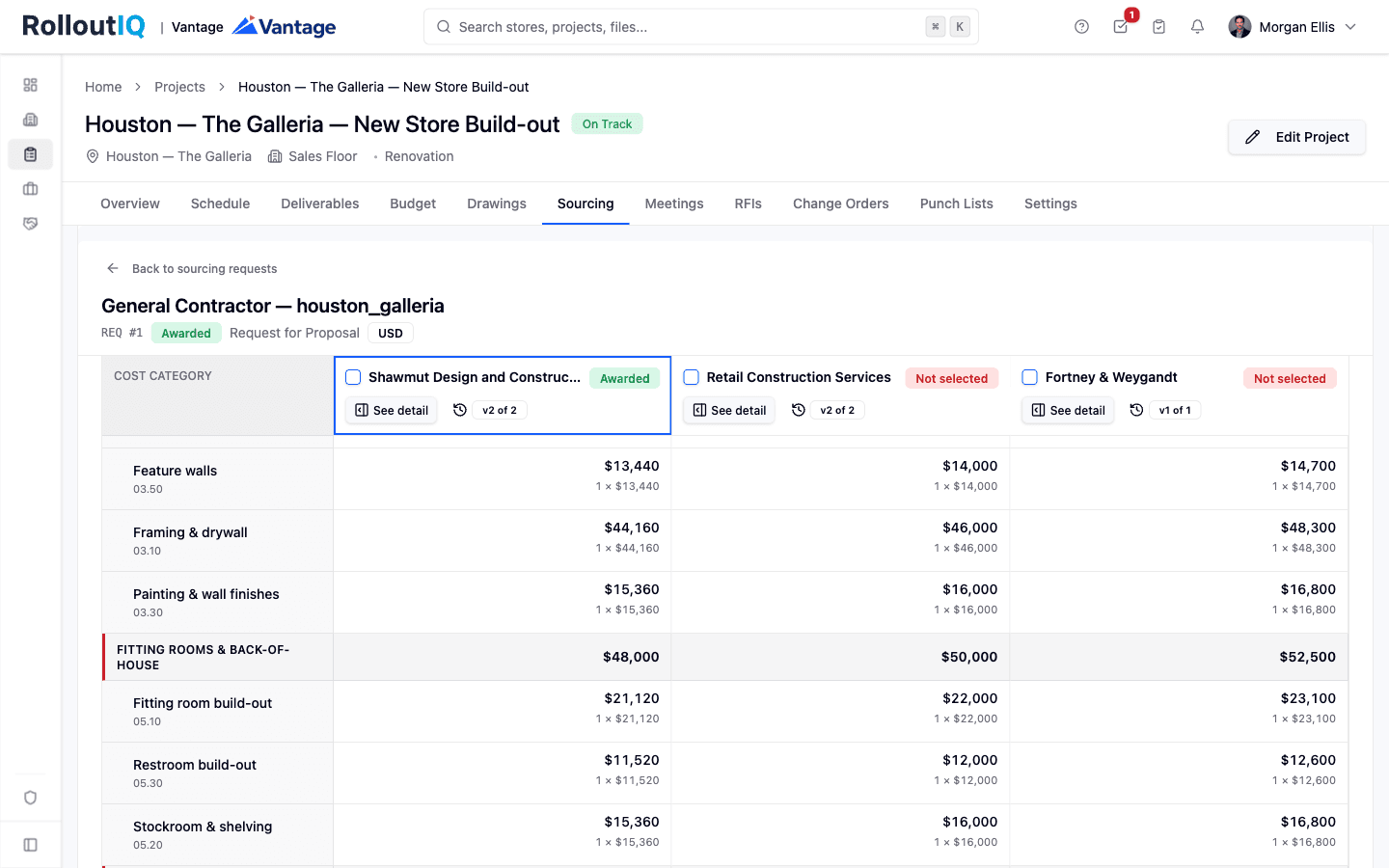
The alternative is a single owner-defined catalog that every cost tool reads from. The budget lines resolve to it, the vendor pricing forms resolve to it, and the change orders resolve to it. Because the same categories and families sit underneath all three, a dollar of flooring means the same thing wherever it lands, and it can roll up many ways at once. By trade for the project manager, by hard-or-soft for the executive summary, by region for the portfolio view, by capitalizable-or-expensed for finance. This multi-dimensional tagging, one line rolling up several directions simultaneously, is the single most important structural requirement for comparing stores across a portfolio. It is also what lets last year's actuals flow cleanly back into next year's prototype estimate, because the buckets have not moved.
Building a cost code structure for a retail portfolio
A shared structure is worth doing once, carefully, before the next wave of projects starts inventing its own. A practical build order looks like this.
- Start from how your team talks, not from a specification standard. Flatten trades into business-language buckets like Site, Shell, Interior, MEP, Finishes, FF&E, Signage, Technology, and Pre-Opening rather than importing fifty divisions nobody uses.
- Keep the tree to about three levels. Bucket, then category, then line item. Deeper than that and no one maintains it; shallower and you cannot reslice.
- Stamp every category with a cost family. Hard, soft, FF&E, IT, pre-opening, and contingency, plus overhead and profit and sales tax where you price them as markups on top of the work.
- Set the accounting treatment on the family, not the line. Capitalizable versus expensed, so pre-opening and contingency behave correctly without anyone hand-sorting at close.
- Give each category a stable code that is unique within its parent, and carry an external account code so the structure maps to your ERP rather than fighting it.
- Size contingency into the structure with a default percentage per category, tuned to project type, so the reserve is visible from day one instead of discovered late.
- Make it the only catalog. Point budgets, vendor pricing, and change orders at the same tree so nothing anywhere prices against a private list.
Comparability is a structural choice
The question that starts every portfolio review, what does a store cost, is answerable only when the cost structure is decided before the budgets are. Fragmented per-project spreadsheets are the predictable result of letting each project invent its own spine. A shared chart of cost categories, crossed with a stable set of families that carry their own accounting treatment, turns a stack of incomparable workbooks into a portfolio that rolls up cleanly and slices many ways.
The categories mirror how the team works, the families keep the accounting honest underneath, and every downstream tool prices against the same catalog. Set that foundation once and the hard question, why does this store cost more than that one, stops requiring a week of reconciliation and starts being a report. The work is unglamorous, and it is the difference between a portfolio you can compare and a pile of spreadsheets you cannot.
The Rollout
The Rollout, in your inbox
A founder's read on retail and multi-site store development. What the latest news means for your pipeline, and what we are building, every couple of weeks.

Written by
Nariman Shariat
Founder, RolloutIQ
Nariman has spent about 20 years opening stores, in the seat between the landlord, the architect, and the general contractor, across some of the largest retail and workplace fleets in the country. Along the way he built the internal platform that ran store development across a fleet, then rebuilt the same idea company after company. He founded RolloutIQ to give multi-site development teams the single source of truth he kept having to build by hand, and writes here about the work of opening and remodeling stores at scale.
More about NarimanKeep Reading
Related Articles
Continue exploring best practices for store development and construction management.

Managing Budgets Across Multiple Construction Sites
Budget management across multiple construction sites requires portfolio-level financial visibility and proactive cost controls. Here is how leading operators do it.

A Store Rollout Budget Should Be a Governed Baseline
The budget for a store project covers six cost families, not just construction, and the hard part of all of it is governance rather than arithmetic. Here is what it means to run the whole project budget as a baseline.
Bid Leveling: Where Your Real Construction Cost Is Decided
The lowest bid is rarely the lowest cost. Bid leveling, the work of making competing bids comparable, can eat 40 to 80 hours a project. Here is how multisite teams make competitive bidding fast, fair, and auditable.
Ready to Build Smarter?
See how RolloutIQ™ can streamline your retail and multi-site rollout program. Book a personalized demo with our team.