
RFI Management
Request for Information Workflow Built for Retail Rollouts
RFIs are the most expensive form of question-asking in construction. Independent benchmarks put per-RFI cost at $1,080 to $3,000, and a top-10 US retailer generates 30,000 to 200,000 RFIs per year across an active pipeline. RolloutIQ™ runs RFIs as a structured, classified, vendor-safe workflow with an audit trail that holds up in a claim file.
The Problem
Why RFI Management Breaks at Scale
With no structure, RFIs turn into email threads. Classification is what makes recurring patterns visible enough to prevent recurrence, and only an audit trail lets a dispute resolve quickly instead of slowly and expensively.
Email Threads Lose the Official Answer
Questions and answers buried in Slack and email lose the original drawing reference, the proposed approach, and the final answer. Roughly 22% of construction RFIs never get a written answer at all, leaving the field operating on a verbal recollection.
Free-Text Records Mean No Cross-Store Learning
When the same prototype gets built 50 to 500 times, the same questions get asked over and over. Free-text RFIs without structured classification leave that pattern invisible across the portfolio.
Vendors See Everything or Nothing
Sharing an RFI log with a direct-contract refrigeration vendor or general contractor usually means handing them visibility the retailer's lawyer would not want shared, or nothing at all. Both options are wrong.
What RolloutIQ™ Does
What RolloutIQ™ Does
RolloutIQ™ runs every RFI as a structured record on its project, with three-axis classification, an explicit official answer, vendor-safe visibility, and a litigation-grade audit trail.
Three-Axis Classification
Every RFI carries a Category, a Reason, and a Root Cause from your tenant's reference catalogs. Administrators customize the vocabulary in the Library so the classification matches how your team actually talks about issues.
Assignees, Cc, and the Official Answer
Assign one or more people who owe an answer, plus Cc recipients who only watch, modelled after the AIA G716 distribution. The requester marks any comment as the official answer, which flips the RFI to Responded and badges that comment as the binding response.
Notifications on the Events That Matter
In-app and email notifications on assignment, reassignment, official-answer-marked, close, and reopen. @-mentions inside the comment thread fire an immediate notification to the mentioned user. Mentions in the question body are intentionally blocked, so submitters cannot bypass proper assignment.
Closed RFIs Lock Down
When an RFI closes, the comment thread locks. A record that may end up in a claim file cannot be quietly edited after the fact. Administrators can reopen with a written reason of at least eight characters, which is recorded in the audit trail alongside every status change.
Vendor Blackout on Root Cause
External company users see only the RFIs on projects they are scoped to. The Root Cause field, the one a lawyer would not want shared with a vendor, is omitted from the vendor's view and from any CSV they export.
Per-Project Auto-Numbering and CSV Export
Each project auto-numbers its RFIs as RIQ-RFI-000001, RIQ-RFI-000002, and so on, matching industry convention. Export any filtered set of RFIs to CSV, honouring both your filters and the requester's visibility scope, so a vendor's export contains only what that vendor is allowed to see.
Highlights
Inside the RFI Workspace
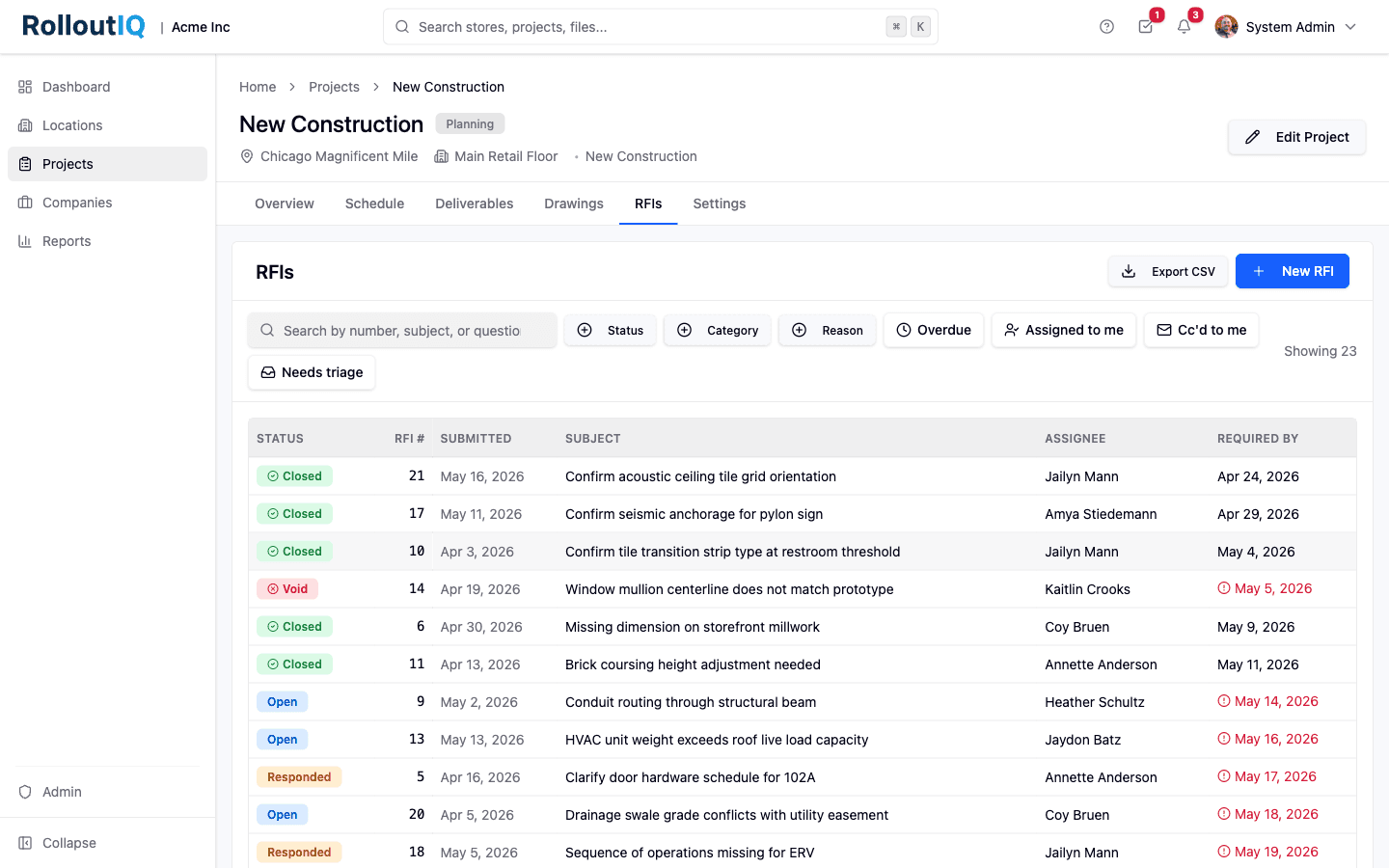
Filters that match how the field thinks, and a single RFI record structured enough to hold up in a claim file.
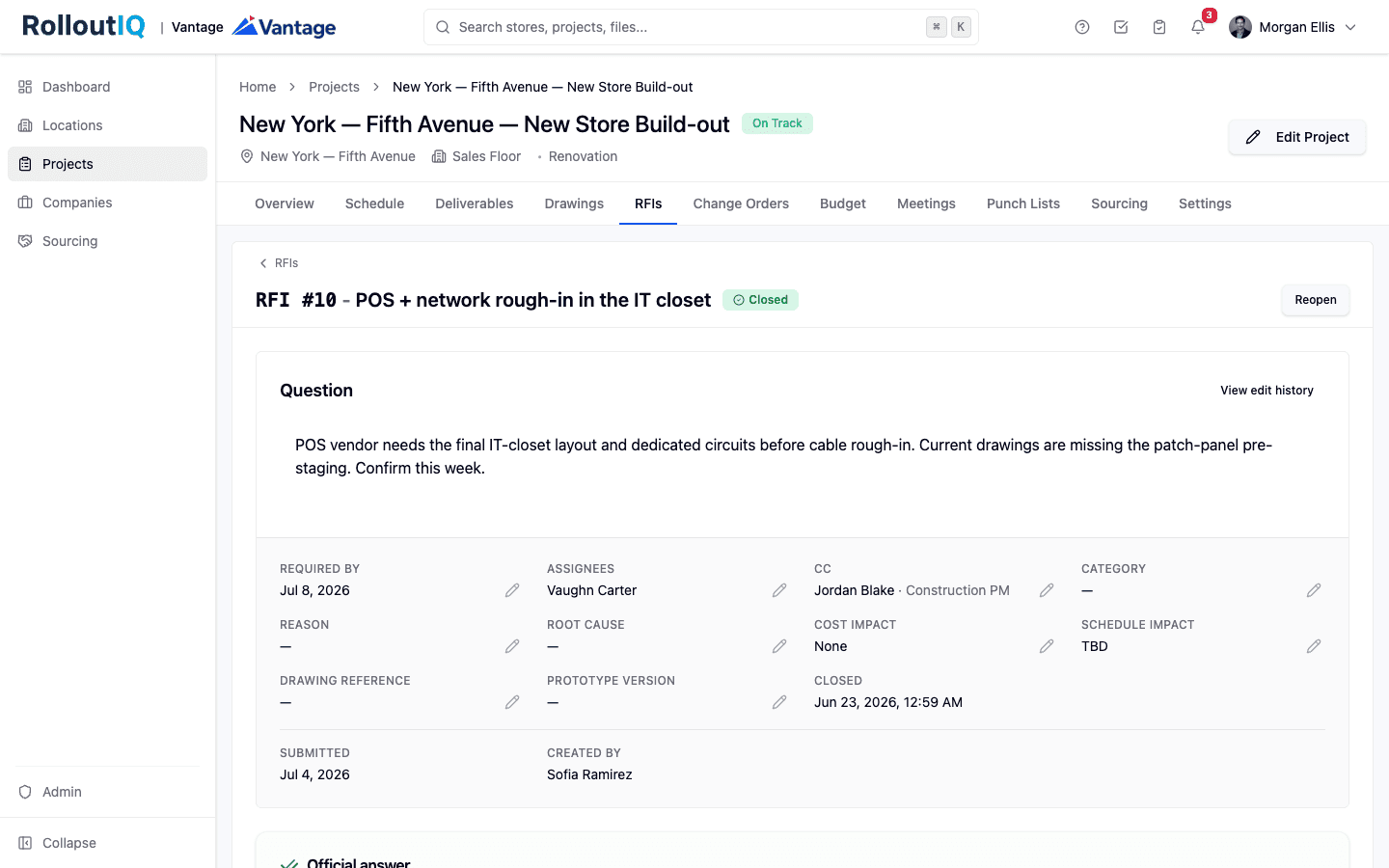
The question, the official answer, and the whole trail
Open an RFI to see the question body with attachments, the threaded discussion, and the one comment badged as the binding official answer. Every assignment, reassignment, status change, and reopen is recorded with actor and timestamp, and closed RFIs lock so the record cannot be quietly edited.
In Practice
How Multisite Teams Use It
Resolve Disputes Against an Immutable Record
When a vendor claims a change order is warranted because of an unanswered question, the closed-RFI record either supports or refutes the claim. The audit trail records every assignment, status change, official-answer mark, and reopen, with actor and timestamp.
Run RFIs With Direct Vendors and GCs Safely
Refrigeration vendors, architects on direct contracts, and general contractors file and answer RFIs on the projects they are scoped to, without ever seeing the retailer's internal Root Cause classification or RFIs from projects they have no business reading.
Lay the Data Foundation for Cross-Store Learning
Every RFI carries the same structured classification across every project, so the data is finally good enough to learn from. Use the CSV export today to feed your reporting stack, and inherit cross-project portfolio analytics as they ship.
FAQ
RFI Management FAQ
RFI management software gives Requests for Information a structured workflow instead of email threads and spreadsheets. RolloutIQ™ captures each RFI with three-axis classification, an explicit official answer, per-project auto-numbering, vendor-safe visibility, and a litigation-grade audit trail.
Every RFI carries the same structured classification on every project, with per-project auto-numbering and the official answer marked on the binding comment. That consistency is what lets you spot recurring questions across stores instead of re-answering them on the next fifty projects.
Yes. Direct vendors, architects, and general contractors file and answer RFIs only on the projects they are scoped to, and vendor blackout hides sensitive fields such as Root Cause. CSV export honors the same visibility scope.
Closed RFIs lock their comment thread, an administrator can reopen with a recorded reason, and the full history is retained. That gives you defensible RFI tracking for disputes and closeout.
Ready to Run RFIs as a Structured Workflow?
See how RolloutIQ™ turns RFI management into pattern-detection fuel for your entire rollout program. Book a demo with our team.