

Construction Management
Schedule Float and How to Use It
Float is the buffer in your construction schedule. How you identify it, protect it, and allocate it determines whether your projects absorb shocks or compound them.
What Float Actually Is
Schedule float is the amount of time an activity can be delayed without delaying the project completion. Activities on the critical path have zero float (any delay pushes the end date). Activities off the critical path have positive float (they can move within a window without affecting the end).
Float exists in every project schedule, even tight ones. The question is whether your team knows where it is, how much there is, and who has the authority to use it.
Why Float Matters More on Multisite Projects
On a single-project build, float is a project management consideration. On a multisite portfolio, it is also a resource allocation tool. When 20 projects are running simultaneously and resources are shared (regional PMs, key trades, equipment vendors), float on one project is what lets you reallocate to a project that needs help.
Multisite operators who do not track float at the portfolio level lose this leverage. They treat each project's schedule as fixed, which means a delay anywhere becomes a delay somewhere else.
Identifying Float in Your Schedules
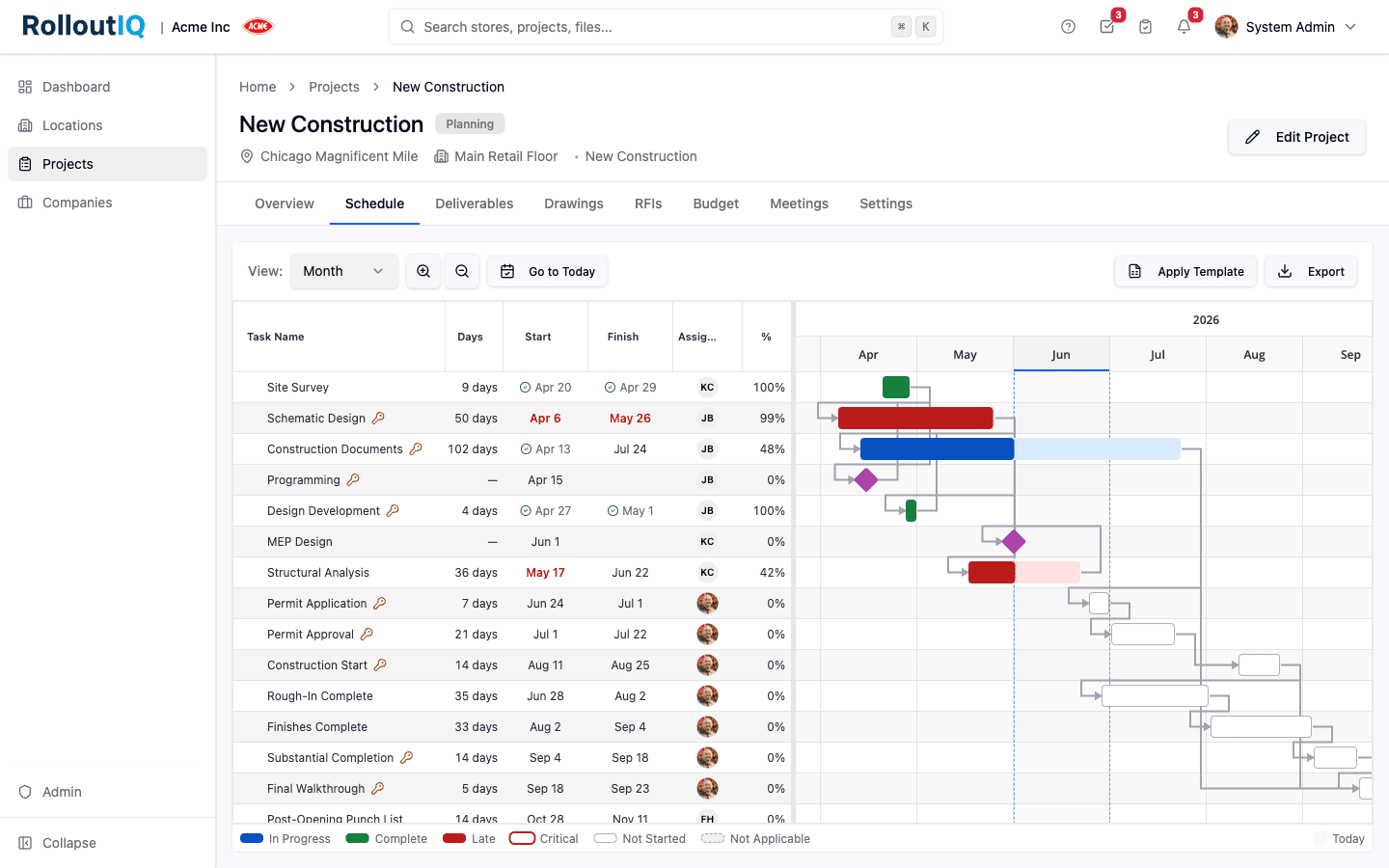
Float identification requires a properly built schedule with defined dependencies. If your schedule is a list of dates without dependency relationships, float is invisible. The schedule has to be a network, not a calendar.
- Build construction schedules with predecessor and successor relationships, not just start and end dates
- Run critical path analysis to identify zero-float activities
- Document total float for non-critical activities
- Distinguish total float from free float (free float is the amount an activity can move without affecting any other activity)
- Update float weekly as the project progresses; float changes constantly
Using Float Strategically
Most teams burn float reactively. A trade is late, the schedule has float in that area, the float gets consumed, no decision is made. Eventually the float is gone and the next delay hits the critical path. This matters because delay is the norm, not the exception. The McKinsey Global Institute found that large construction projects typically take about 20 percent longer to finish than scheduled, so float is the cushion that absorbs that variance, and a team that spends it without deciding to has nothing left when the real problem arrives.
Strategic float use is different. Float is treated as a resource, like budget contingency. It is allocated deliberately to protect against the risks the team has identified. It is reviewed before being spent. The team knows when float is going to be consumed and has visibility into how much remains.
When float does run out, the usual fallback is to buy time with overtime, and that has a steep, predictable cost. The Business Roundtable's classic study of scheduled overtime found that sustained overtime erodes labor productivity by roughly 10 percent in the early weeks and by up to about 30 percent after 12 continuous weeks, so the hours you add stop buying the days you need. Protecting float is almost always cheaper than crashing the schedule to recover it.
On a multisite portfolio, float can also be reallocated across projects when resources shift. If a regional PM moves from a project with three weeks of float to one with zero float, both projects' schedules need to be re-evaluated.
Float as Communication
Float numbers are also a communication tool with executives and stakeholders. Saying a project has 10 days of total float on the critical path versus zero days tells a story about risk and intervention urgency.
Leadership reviewing a portfolio of 20 projects can use float as a triage signal. Projects with zero or negative float are at risk and need attention. Projects with healthy float are absorbing normal variance. The numbers focus management attention where it matters rather than turning every status update into a binary on-track or off-track conversation.
Sources
The benchmarks cited in this article come from the following industry research.
- McKinsey Global Institute, Reinventing Construction: A Route to Higher Productivity (2017) - https://www.mckinsey.com/capabilities/operations/our-insights/reinventing-construction-through-a-productivity-revolution
- The Business Roundtable, Scheduled Overtime Effect on Construction Projects, with corroborating analysis from the Construction Industry Institute - https://www.construction-institute.org/effects-of-scheduled-overtime-on-labor-productivity-a-quantitative-analysis
The Rollout
The Rollout, in your inbox
A founder's read on retail and multi-site store development. What the latest news means for your pipeline, and what we are building, every couple of weeks.

Written by
Nariman Shariat
Founder, RolloutIQ
Nariman has spent about 20 years opening stores, in the seat between the landlord, the architect, and the general contractor, across some of the largest retail and workplace fleets in the country. Along the way he built the internal platform that ran store development across a fleet, then rebuilt the same idea company after company. He founded RolloutIQ to give multi-site development teams the single source of truth he kept having to build by hand, and writes here about the work of opening and remodeling stores at scale.
More about NarimanKeep Reading
Related Articles
Continue exploring best practices for store development and construction management.
Scheduling a Retail Rollout Is a Team Sport
The schedule the whole team depends on usually lives in a file most of the team cannot open. Here is the case for one shared, role-scoped schedule that internal staff and outside partners work together.

Reducing Delays in New Store Openings: A Practical Guide
Every delayed store opening costs money in lost revenue, extended rent obligations, and team morale. Here are the practical strategies that top operators use to hit their dates.

When One Date Slips, Everything Else Should Shift: Schedule Editing at Multisite Scale
Most schedule tools let you change a date but won't shift the dependent items. The result is a schedule that drifts from reality the day after it's published. Here's how schedule editing should work at multisite scale.

The Retail Rollout Timeline: From Lease to Grand Opening
From lease execution to grand opening, a store project moves through a predictable set of milestones. Here is the retail rollout timeline by phase and format, and where the time actually goes.
Ready to Build Smarter?
See how RolloutIQ™ can streamline your retail and multi-site rollout program. Book a personalized demo with our team.