
Industry Outlook
The 2026 Retail Construction Squeeze
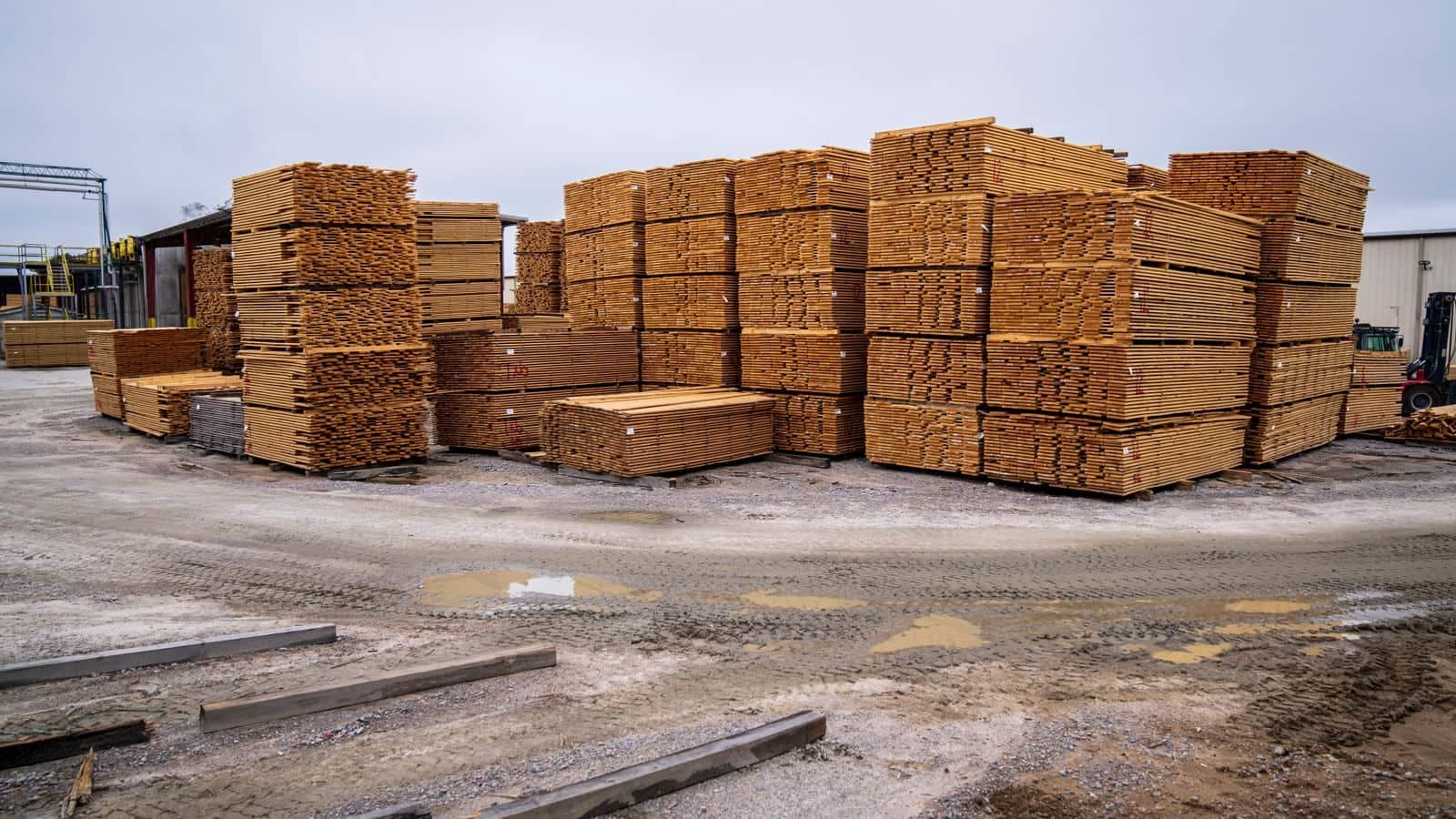
Retail construction is contracting while store openings are growing. Here is what that paradox means for multisite operators and how to plan around it.
The News
Two data points define the 2026 retail construction picture, and they are pulling in opposite directions.
On the supply side, CRE Daily reported that retail construction activity fell to 64.2 million square feet in the first quarter of 2026, an 8 percent decline from 2025 and well below the 10-year average of roughly 90 million square feet. Colliers projects new retail construction will drop 37 percent for the full year. Rising land prices, elevated construction costs, and high interest rates are the primary headwinds, with residential, industrial, and mixed-use projects competing for the same viable sites.
On the demand side, ICSC's 2026 outlook cites a Telsey Advisory Group forecast of 1.4 percent growth in store openings excluding restaurants, climbing to 1.8 percent when restaurants are included. Off-price, beauty, and discount retailers are leading the expansion. Brands actively pushing growth include H-E-B, Aldi, Michaels, and Walmart. In the Dallas-Fort Worth market alone, 52 new grocery stores are projected across 2025 through 2027.
Why It Matters for Multisite Operators
When supply contracts and demand expands, the result is competition for the same finite resources. For retail rollout teams, that competition shows up in three places.
First, general contractor capacity tightens. The qualified retail GCs who can deliver on brand standards are being courted by more clients, and lead times for project starts stretch out. Second, subcontractor and trade availability shrinks in high-growth markets. The Dallas, Houston, and Austin metros that lead the country in pre-leased retail construction are also where trade capacity is most strained. Third, permit timelines extend in jurisdictions where municipal staff is processing more applications across construction categories at once.
The operators who feel this least are the ones with established vendor networks, disciplined pre-construction processes, and pipeline visibility that lets them sequence projects strategically. The operators who feel it most are the ones who treat each new store as a one-off project and rely on spot-market vendor relationships.
What This Reveals About the 2026 Cycle
The construction slowdown does not signal weak retail demand. It signals constrained development economics. Telsey is forecasting more openings, not fewer. The mix is just shifting away from ground-up construction toward redevelopment, infill projects, and heavy remodels of existing locations.
Newmark's view (cited in the same ICSC outlook) reinforces this. Their analysts expect 2026 deliveries to hit historical lows but construction starts to accelerate from the 2024-2025 trough, with most growth coming from redevelopment rather than new builds. That has practical implications. Redevelopment projects involve different stakeholders, different permitting paths, and different vendor relationships than ground-up construction. Operators whose playbooks are optimized for new builds need to update them for repositioning work.
The second-order trend is regional concentration. Dallas, Houston, and Austin are leading retail construction with nearly all projects pre-leased, while Miami and Detroit show the weakest pipelines. Multisite operators with national footprints will see uneven execution conditions across their pipeline, and treating every market the same is a mistake.
What Operators Should Do
The 2026 conditions reward proactive operators and punish reactive ones. Five concrete moves to make this quarter:
- Re-validate your vendor network. Confirm capacity and lead times with every GC and key subcontractor in your top three operating markets. Identify which relationships are at risk and where you need backup options.
- Lengthen your permit assumptions. If you have been planning around 2024 timelines, add 30 to 60 days to your standard permit milestones for any project starting in the second half of 2026.
- Prioritize your pipeline. Rank every active project by strategic importance and by execution risk. The constrained environment means you may not deliver every project on the original schedule, so know which ones cannot slip.
- Build a redevelopment playbook. If your standard process was designed for ground-up new builds, document the differences for repositioning, infill, and remodel projects. Different vendors, different permits, different stakeholder reviews.
- Increase portfolio visibility. When resources are scarce, leadership needs to see the whole pipeline at once to make allocation decisions. Disconnected spreadsheets and per-project tracking will not surface the trade-offs that matter.
The Operators Who Win
The 2026 retail construction cycle is going to separate the operators who treat store development as a process from those who treat it as a series of projects. The supply-demand math means there is no way to scale by adding more people or finding cheaper vendors. The only path is operational discipline: tighter pre-construction, better vendor management, more accurate forecasting, and portfolio-level decision-making.
The brands hitting their 2026 expansion targets will be the ones whose teams treated this environment as predictable rather than surprising. The data has been pointing in this direction for over a year. The question is what your team does with it now.
Sources
Reporting and data referenced in this article:
- CRE Daily, Retail Construction Slows Nationwide in 2026 - https://www.credaily.com/briefs/retail-construction-slows-nationwide-in-2026/
- ICSC, 11 Retail Real Estate Predictions for 2026 - https://www.icsc.com/news-and-views/icsc-exchange/11-retail-real-estate-predictions-for-2026
- ICSC, Retail Outlook for 2026: Store Openings Rise, New Developments and Mixed-Use Projects - https://www.icsc.com/news-and-views/icsc-exchange/retailer-updates-development-investment-financing-news-gbt-concorde-simon-ggp-more
The Rollout
The Rollout, in your inbox
A founder's read on retail and multi-site store development. What the latest news means for your pipeline, and what we are building, every couple of weeks.

Written by
Nariman Shariat
Founder, RolloutIQ
Nariman has spent about 20 years opening stores, in the seat between the landlord, the architect, and the general contractor, across some of the largest retail and workplace fleets in the country. Along the way he built the internal platform that ran store development across a fleet, then rebuilt the same idea company after company. He founded RolloutIQ to give multi-site development teams the single source of truth he kept having to build by hand, and writes here about the work of opening and remodeling stores at scale.
More about NarimanKeep Reading
Related Articles
Continue exploring best practices for store development and construction management.
Bid Leveling: Where Your Real Construction Cost Is Decided
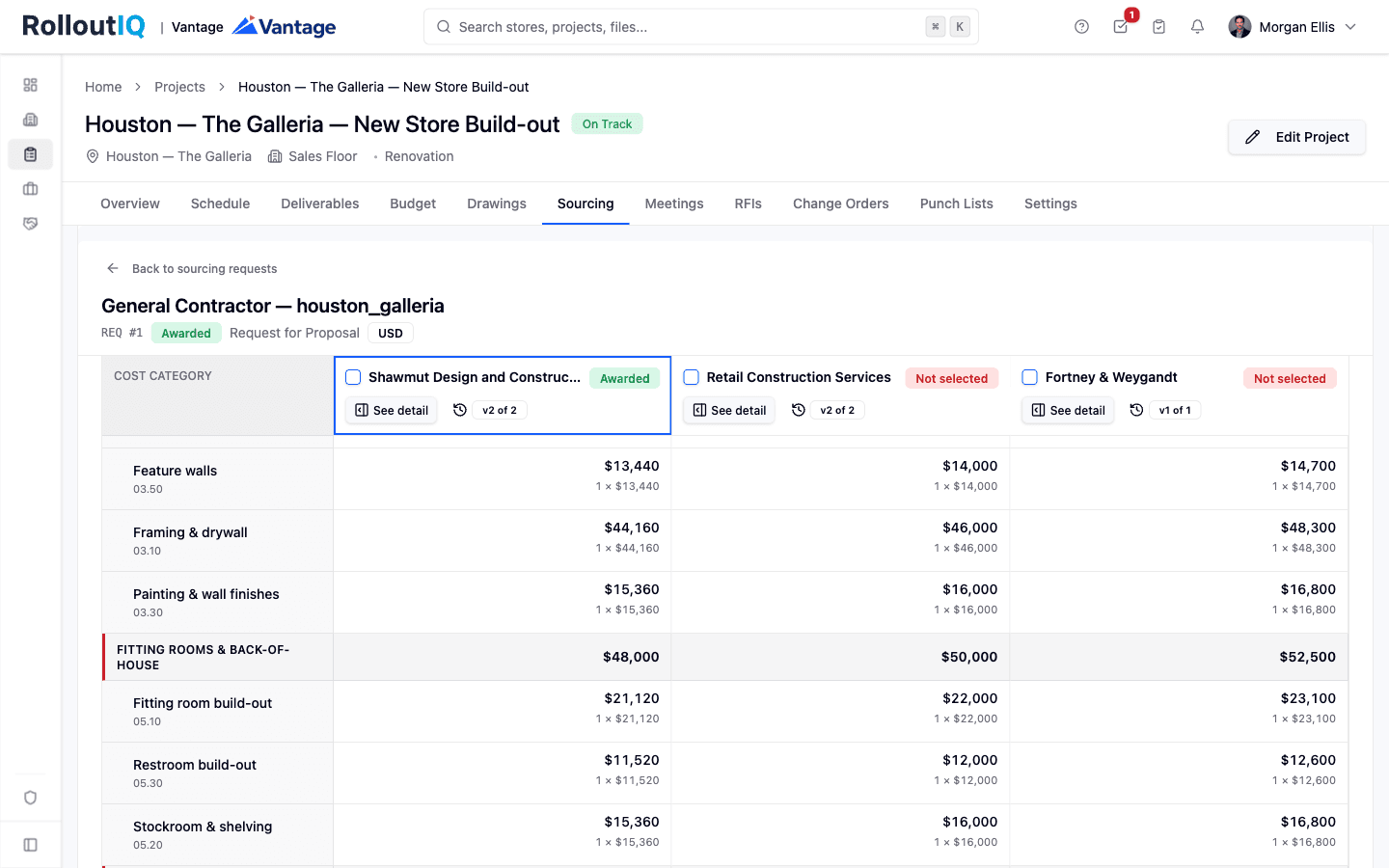
The lowest bid is rarely the lowest cost. Bid leveling, the work of making competing bids comparable, can eat 40 to 80 hours a project. Here is how multisite teams make competitive bidding fast, fair, and auditable.
Change Order Management for Retail Rollouts: The Change Outside the GC
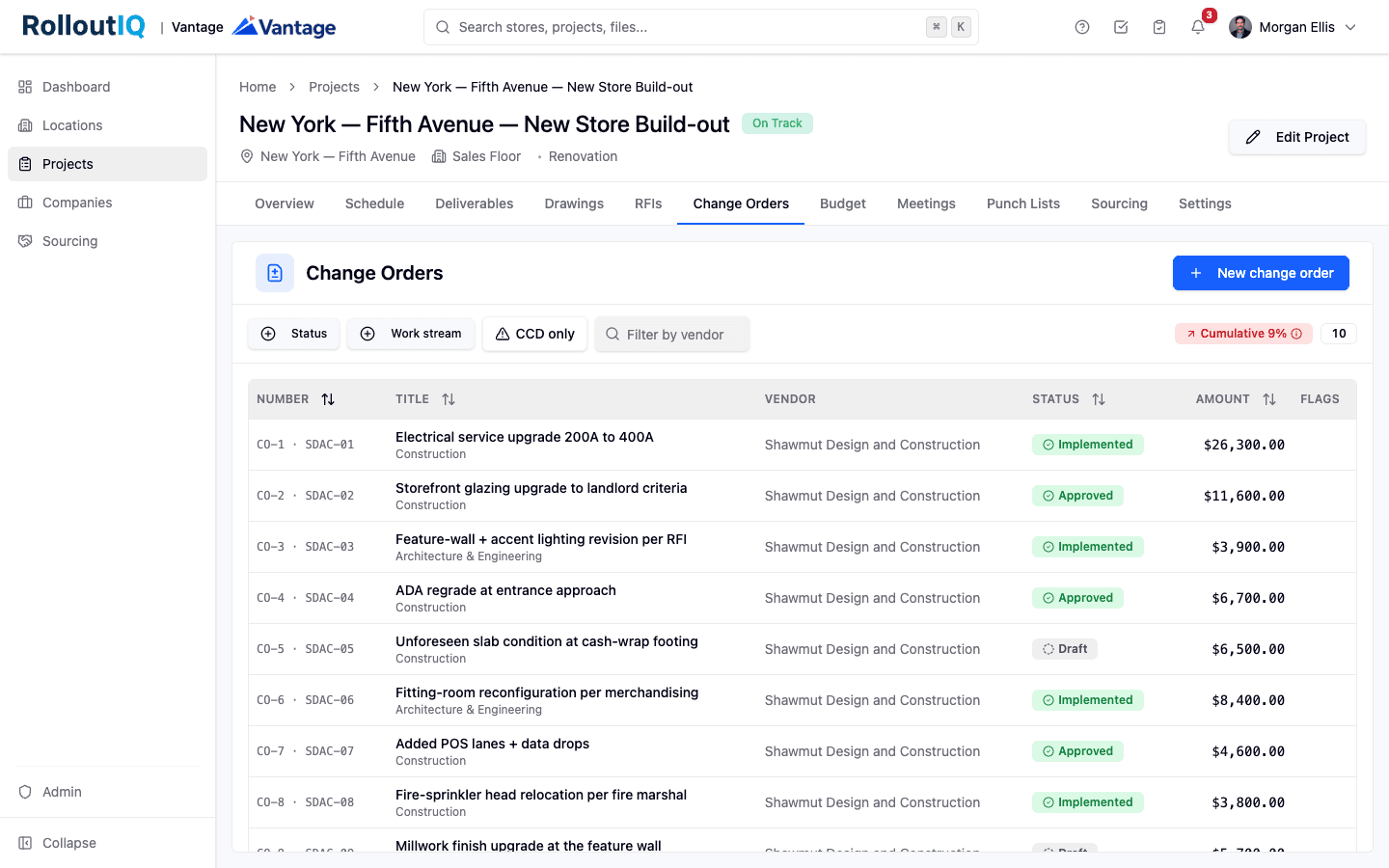
On a retail rollout, a large share of cost flows around the general contractor into fixtures, technology, signage, and equipment. Here is how to keep change orders from those streams from surfacing as a closeout surprise.

Managing Budgets Across Multiple Construction Sites
Budget management across multiple construction sites requires portfolio-level financial visibility and proactive cost controls. Here is how leading operators do it.

Construction Schedule Float and How Multisite Operators Should Use It
Schedule float is one of the most useful and most misused concepts in construction management. Here is how multisite operators should think about it.
The Labor Number Got Better. The Retail Construction Math Got Worse.
ABC says construction needs 349,000 new workers in 2026, down from 500K-plus a year ago. The headline reads like relief. For retail operators running 50 to 500 store programs, the underlying math just got harder.
The Complete Guide to Multi-Site Construction Management
Managing construction across multiple sites simultaneously requires a fundamentally different approach than single-project management. Here is your complete guide.
Ready to Build Smarter?
See how RolloutIQ™ can streamline your retail and multi-site rollout program. Book a personalized demo with our team.